MHA review petition on Governor and President assent to laws
Source:The Hindu ↗
Why It Matters
It involves a fundamental constitutional debate regarding the legislative powers of States versus the discretionary powers of the Governor and the President, with direct implications for Centre-State relations, federalism, and the separation of powers.
Summary
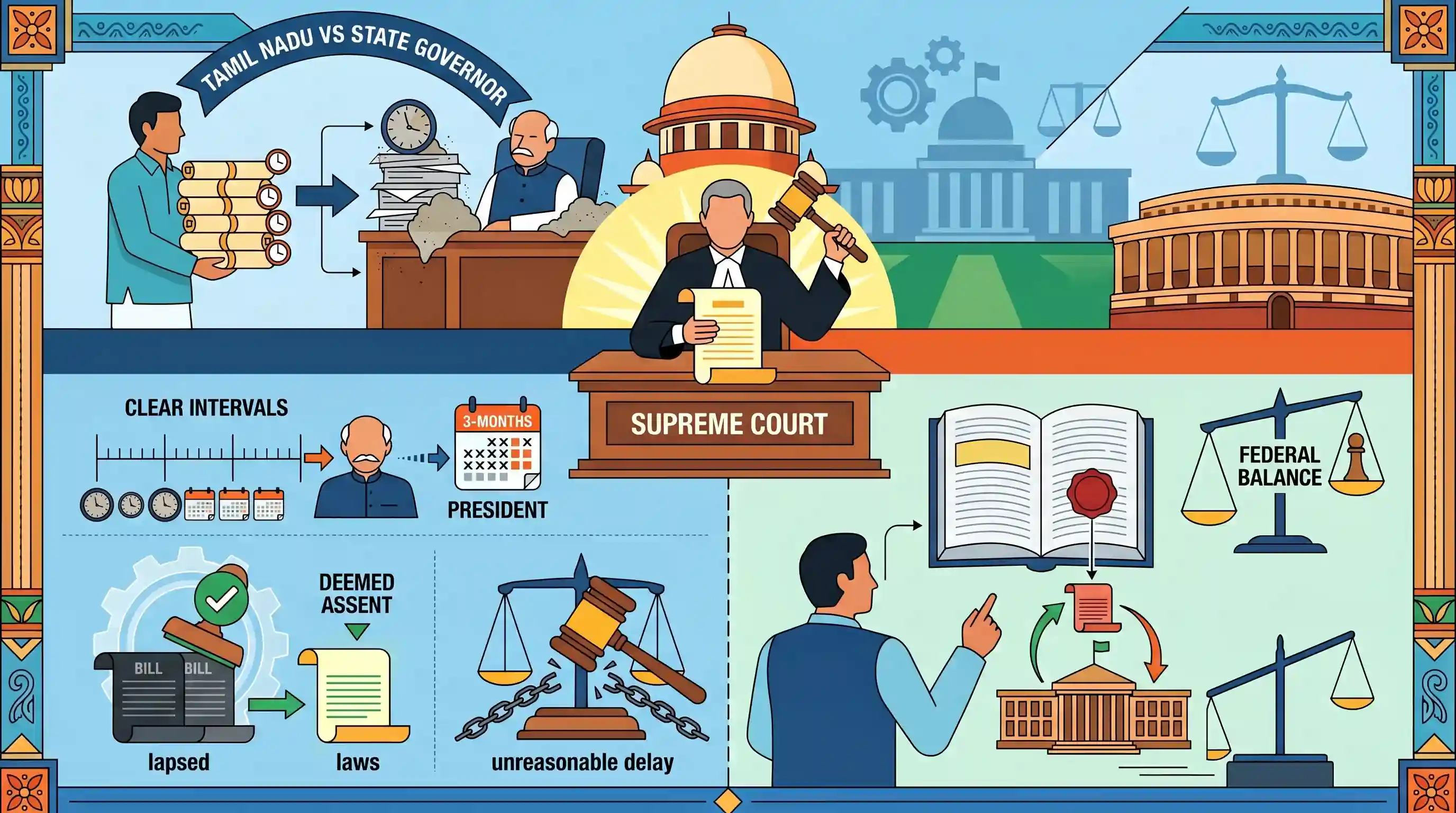
The Union Ministry of Home Affairs (MHA) plans to file a review petition against the Supreme Court's April 8 judgment concerning the roles of the Governor and the President in assenting to State laws. The ruling, which stemmed from a petition by the Tamil Nadu government regarding delayed assent to 10 Bills, allowed judicial intervention in cases where Governors unreasonably delay assents. It mandated a three-month timeline for the President to decide on reserved State Bills and paved the way for "deemed" assent to Bills that were previously considered "lapsed" due to withheld assent. The Centre contests this, asserting that under Article 201, a withheld Bill must be reintroduced in the State Assembly to be revived. This highlights the friction in Centre-State relations, the scope of the Governor's discretionary powers under Article 200, and judicial boundaries over legislative processes.
Key Points
- The MHA intends to challenge the Supreme Court ruling that limits the Governor's ability to indefinitely withhold assent to State Bills and sets a 3-month timeline for the President's review.
- The apex court judgment allowed judicial review when Governors unreasonably delay decisions on Bills, a departure from traditional constitutional practices where timelines were not strictly enforced.
- The ruling allowed the Tamil Nadu government to notify 10 Acts as 'deemed' to have received assent, bypassing the MHA's stance that withheld Bills lapse and must be reintroduced.
- The Centre's argument rests on the interpretation of Article 201, maintaining that once assent is withheld, the legislation cannot be restored without re-passage in the State Assembly.
- The development underscores ongoing federal tensions and the debate over the discretionary powers of Governors and the Union Government in State legislative matters.
Important Terms
Article 200 of the Constitution

Outlines the Governor's options when presented with a State Bill: granting assent, withholding it, returning it for reconsideration, or reserving it for the President's consideration. The Supreme Court forbids "pocket vetoes" under this provision.
UPSC context
GS Paper II: Indian Constitution. Tests understanding of the legislative process and the Governor's role as a constitutional head.
Article 201 of the Constitution
Specifies the President's role for State Bills reserved by the Governor. The President can grant assent, withhold it, or direct the Governor to return the Bill to the State Legislature for reconsideration.
UPSC context
GS Paper II: Centre-State Relations. Tests knowledge of the President's veto powers over State legislation.
Discretionary Powers of the Governor
Powers exercised by the Governor independently of the Council of Ministers. The Supreme Court recently clarified that this discretion is limited and subject to constitutional norms to prevent legislative stalling.
UPSC context
GS Paper II: Role of the Governor. Tests the limits of executive power versus legislative autonomy in a parliamentary system.
Judicial Review
The judiciary's power to examine the constitutionality of legislative and executive acts. Recent rulings allow review of the Governor’s and President’s timelines for assenting to Bills to prevent "unconstitutional inaction."
UPSC context
GS Paper II: Separation of Powers. Tests the judiciary's role in enforcing constitutional timelines on other branches.
Review Petition
A constitutional procedure under Article 137 allowing the Supreme Court to reconsider its own judgment to correct apparent errors. The MHA uses this to contest timelines imposed on the President.
UPSC context
GS Paper II: Structure and functioning of the Judiciary. Tests understanding of legal remedies in the appellate system.
Federalism
The division of power between the Union and States. Conflicts over Bill assent highlight tensions between Central oversight (Governor/President) and State legislative sovereignty.
UPSC context
GS Paper II: Issues and challenges pertaining to the federal structure. Core concept for Mains on Centre-State dynamics.
Prelims Trap
The Constitution mandates a three-month timeline for the President to decide on reserved State Bills.
The 3-month timeline is a Supreme Court judicial innovation, not a constitutional provision. Article 201 of the original Constitution specifies no time limit for the President's decision.
Static Concepts Connected
What are the Governor's options under Article 200 when presented with a State Bill?
- Assent or Withhold: The Governor may grant assent or withhold assent to the Bill.
- Return for Reconsideration: Return non-money bills for reconsideration. If repassed by the legislature (with or without amendments), the Governor must give assent.
- Reserve for President: Reserve the Bill for the President. This is mandatory if the Bill endangers the position of the State High Court.
How does Article 201 govern State Bills reserved for the President?
- President's Options: The President can either assent to the Bill or withhold assent.
- Return and Reconsideration: The President may direct the Governor to return a non-money bill to the State Legislature, which has six months to reconsider it.
- No Repassage Obligation: Unlike the Governor, the President is not constitutionally bound to give assent even if the Bill is repassed by the State Legislature.
Cross-Topic Patterns
Article 142 and Separation of Powers
The SC using "deemed assent" via Article 142 crosses into legislative domains, sparking classic Separation of Powers debates routinely tested in GS-II (Judicial Activism vs. Overreach).
Gubernatorial Friction in Federalism
Links with recent Sarkaria and Punchhi commission debates on restricting the Governor's discretionary veto to prevent policy paralysis in opposition-ruled states.

A 2026 Prelims question will likely mix original constitutional text (no time limits) with the SC's new 3-month timeline.
Linked PYQs · 2
Linked PYQs · 2
- 2022MainsGS2
Discuss the essential conditions for exercise of the legislative powers by the Governor. Discuss the legality of re-promulgation of ordinances by the Governor without placing them before the Legislature.
- 2024MainsGS2
What changes has the Union Government recently introduced in the domain of Centre-State relations ? Suggest measures to be adopted to build the trust between the Centre and the States and for strengthening federalism.
