MHA Integrates Artificial Intelligence to Modernize Internal Security
Source:Indian Express ↗
Why It Matters
Highlights the practical applications of AI/ML and blockchain in modernizing India's law enforcement, marking a paradigm shift in internal security from a reactive approach to a predictive, tech-driven framework (e.g., predictive policing, automated moderation, combating financial mules, and tackling dark web threats).
Summary
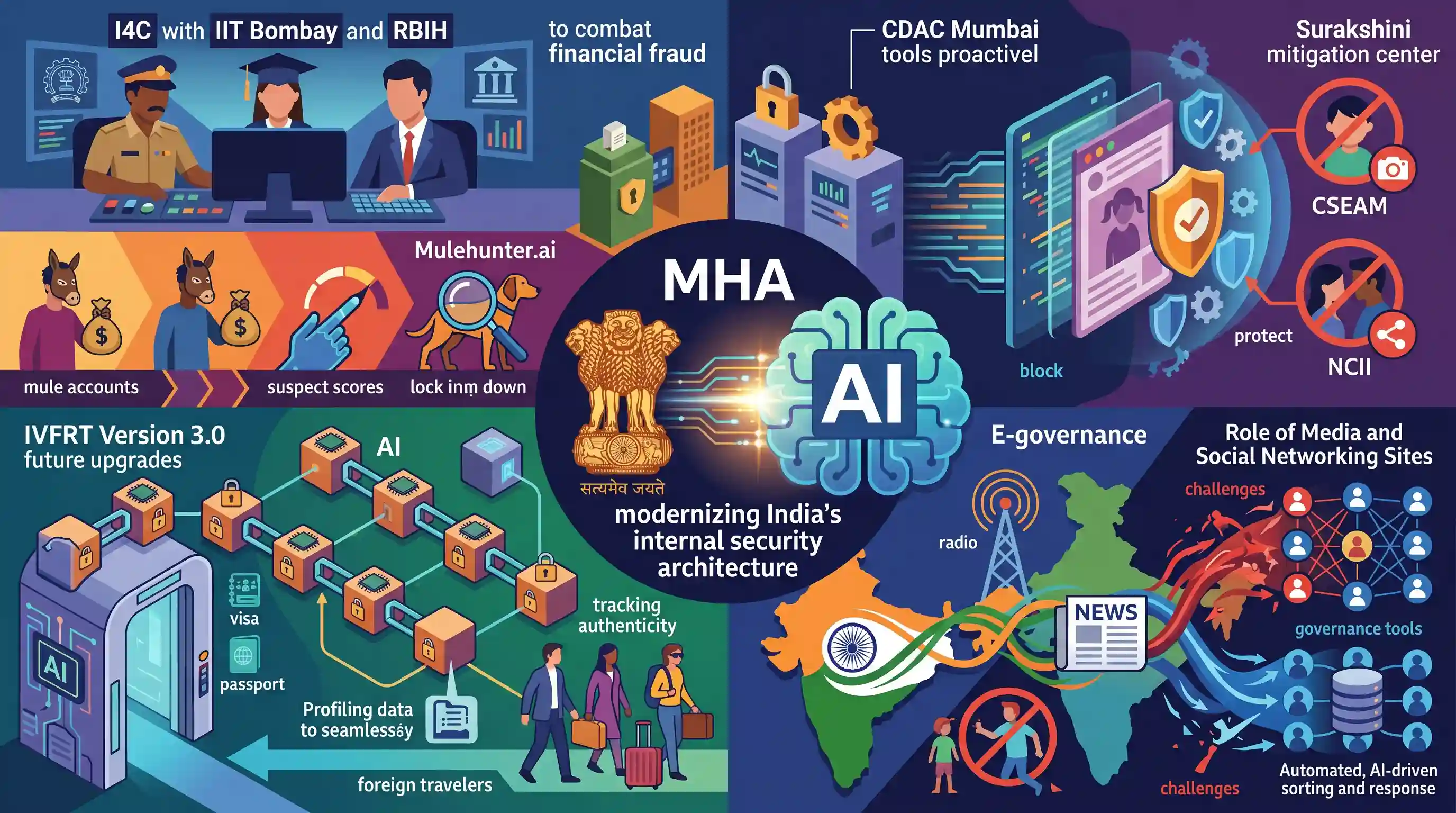
The Ministry of Home Affairs (MHA) is extensively leveraging Artificial Intelligence (AI) to modernize India's internal security architecture. Key initiatives include the I4C's collaboration with IIT Bombay and the Reserve Bank Innovation Hub (RBIH) to combat financial fraud by assigning "suspect scores" to mule accounts and deploying the AI-driven "Mulehunter.ai" tool. Furthermore, specialized tools developed by CDAC Mumbai alongside the "Surakshini" mitigation center are designed to proactively screen and block Child Sexual Exploitation and Abuse Material (CSEAM) as well as Non-Consensual Intimate Imagery (NCII). Future upgrades, such as the IVFRT Version 3.0, will incorporate AI and Blockchain technologies to revamp the immigration, visa, and foreign traveler tracking ecosystem.
Key Points
- I4C is developing an AI-assisted, multi-lingual complaint registration system for the 1930 anti-cybercrime helpline.
- MHA has partnered with IIT Bombay and the Reserve Bank Innovation Hub (RBIH) to analyze behavioral patterns and assign AI-driven 'suspect scores' to banking mule accounts.
- RBIH's Mulehunter.ai model is being integrated with I4C's suspect registry to proactively intercept fraudulent cyber financial transactions.
- A Proactive Monitoring Tool developed by CDAC Mumbai helps trace and verify Child Sexual Exploitation and Abuse Material (CSEAM) globally.
- The 'Surakshini' Mitigation Centre employs automated hash-matching to shift digital content moderation of CSEAM and Non-Consensual Intimate Imagery (NCII) from reactive takedowns to preventive blocking.
- The Bureau of Immigration's IVFRT Version 3.0 upgrade will deploy AI, Machine Learning, and Blockchain for intelligent traveler profiling and enhanced security of digital records.
Important Terms
Indian Cyber Crime Coordination Centre (I4C)

The apex national coordination body under the Ministry of Home Affairs (MHA) designed to provide a comprehensive framework for Law Enforcement Agencies (LEAs) to combat cybercrime.
UPSC context
GS Paper III: Cyber Security. Essential for questions on institutional measures against cyber threats and inter-agency coordination.
MuleHunter.ai
An AI and Machine Learning-based model developed by the Reserve Bank Innovation Hub (RBIH) to detect and flag "mule accounts" exploited for money laundering and financial fraud.
UPSC context
GS Paper III: Internal Security/Money Laundering. Tests knowledge of technological solutions for financial crimes and digital banking security.
Surakshini
A proposed mitigation center under the MHA to proactively identify, block, and remove Child Sexual Exploitation and Abuse Material (CSEAM) and Non-Consensual Intimate Imagery (NCII) from the web.
UPSC context
GS Paper II: Social Justice/Governance. Relevant for discussions on digital safety for women and children and proactive content moderation.
IVFRT Version 3.0
The latest phase (2026–2031) of a mission-mode e-governance project incorporating AI and Blockchain to revamp India's immigration, visa, and foreign traveler tracking ecosystem.
UPSC context
GS Paper II: E-governance. Tests understanding of how emerging technologies (AI/Blockchain) improve public service delivery and border security.
Reserve Bank Innovation Hub (RBIH)
A wholly-owned subsidiary of the Reserve Bank of India (RBI) established to foster financial innovation and create technological solutions for the banking sector, such as fraud detection tools.
UPSC context
GS Paper III: Economy/Internal Security. Important for understanding the role of institutional innovation in preventing financial instability and cyber-frauds.
Centre for Development of Advanced Computing (CDAC)
The premier R&D organization of the Ministry of Electronics and Information Technology (MeitY) that develops advanced IT solutions, including forensic and proactive monitoring tools for the MHA.
UPSC context
GS Paper III: Science & Technology. Crucial for questions on indigenous technology development and the indigenization of software for national security.
Prelims Trap
"Surakshini is an MHA scheme providing physical safe houses and security for victims of domestic violence."
Surakshini is actually an MHA digital mitigation centre using hash-matching technology to proactively block Child Sexual Exploitation and Abuse Material (CSEAM) online.
Static Concepts Connected
What is the mandate of the Indian Cyber Crime Coordination Centre (I4C)?
- Nodal Agency: Established under the Ministry of Home Affairs (MHA) to act as a nodal point in the fight against cybercrime in India.
- Key Components: Operates the National Cybercrime Reporting Portal, the 1930 helpline, and the National Cybercrime Threat Analytics Unit.
- Federal Coordination: Facilitates coordination of cybercrime investigations between State Police forces, UTs, and central law enforcement agencies.
How do 'money mule' accounts facilitate cyber financial fraud?
- Definition: Accounts owned by individuals who receive and transfer illicit funds on behalf of fraudsters, sometimes unknowingly in exchange for commission.
- Layering Process: They act as the crucial 'layering' step in money laundering, obscuring the illegal origin of funds before they are finally withdrawn.
- Regulatory Action: Banks block these to break the money laundering chain, which is why RBIH is developing AI suspect scores to flag them early.
Cross-Topic Patterns
RBI and MHA cross-agency tech convergence
Financial regulators (RBIH) and the security apparatus (I4C) collaborating on 'Mulehunter.ai' highlights the blurring lines between banking regulation and cyber law enforcement for GS3.
Blockchain integration in Border Management
The deployment of Blockchain and Machine Learning in IVFRT Version 3.0 links GS3 Science & Tech directly with GS3 Border Security and immigration management.

Prelims 2026 will likely test Surakshini, Mulehunter.ai, and IVFRT 3.0 as pairs in a "Tool vs Purpose" matching question.
Linked PYQs · 5
Linked PYQs · 5
- 2021MainsGS3
Keeping in view India's internal security, analyse the impact of cross-border cyber attacks. Also discuss defensive measures against these sophisticated attacks.
- 2020MainsGS3
Discuss different types of cyber crimes and measures required to be taken to fight the menace.
- 2023MainsGS3
What are the internal security challenges being faced by India? Give out the role of Central Intelligence and Investigative Agencies tasked to counter such threats.
- 2020PrelimsGS1
With the present state of development, Artificial Intelligence can effectively do which of the following? 1. Bring down electricity consumption in industrial units 2. Create meaningful short stories and songs 3. Disease diagnosis 4. Text-to-Speech Conversion 5. Wireless transmission of electrical energy Select the correct answer using the code given below:
- 2017MainsGS3
Discuss the potential threats of Cyber attack and the security framework to prevent it.
