MHA Finalizes Administrative Control Framework for Ladakh UT
Source:Indian Express ↗
Why It Matters
This development demonstrates how the Indian Union uses asymmetric federalism and customized constitutional safeguards (under Article 371) to address local democratic deficits and tribal aspirations. It also offers a key administrative case study on UT governance and the balance of power between elected executives and appointed civil servants (APAR control), drawing close parallels to administrative disputes in Delhi and Puducherry.
Summary
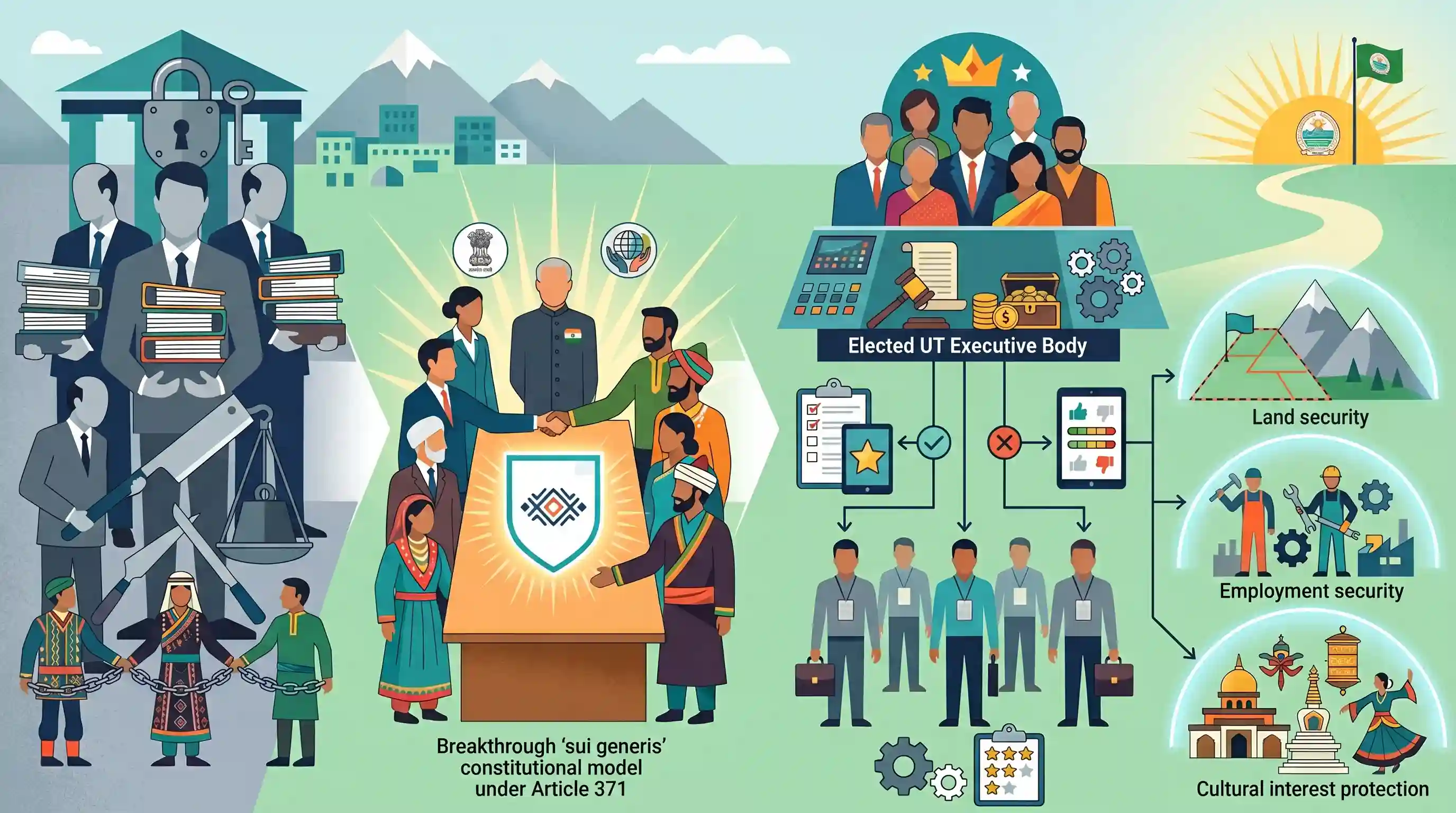
The Ministry of Home Affairs (MHA) has finalized the minutes of its breakthrough meeting with Ladakh's political and civil representatives (Apex Body, Leh and Kargil Democratic Alliance). In a major breakthrough addressing Ladakh's concerns over bureaucratic dominance, the MHA incorporated a clause giving the proposed elected UT-level executive body 'control and supervision, including Annual Performance Appraisal Report (APAR)' over civil servants in its jurisdiction. Both sides have agreed on a 'sui generis' constitutional model under Article 371 to secure Ladakh's land, employment, and cultural interests, alongside a UT-level elected body with legislative, financial, and executive powers, while statehood remains their long-term goal.
Key Points
- The Ministry of Home Affairs (MHA) has finalized the revised minutes of its landmark meeting with Ladakh's civil society leaders, officially incorporating a mechanism for elected representatives to control civil servants.
- Under the finalized agreement, the proposed UT-level elected executive body will hold "control and supervision, including Annual Performance Appraisal Report (APAR)" powers, over civil servants handling subjects within its jurisdiction.
- Both sides have agreed to draft a customized, 'sui generis' constitutional safeguards model under Article 371, drawing from its various existing provisions to protect Ladakh's demographics, land, and culture.
- While full statehood and Sixth Schedule status remain Ladakh's long-term aspirations, the immediate step involves establishing a UT-level elected body endowed with executive, financial, and legislative powers.
- The finalization of these minutes successfully defuses a political standoff and regional shutdown triggered by draft minutes that Ladakh groups claimed omitted key oral understandings.
Important Terms
Article 371

A constitutional provision offering customized, special protections to specific Indian states or regions to safeguard their land rights, employment, unique cultural identities, and local governance.
UPSC context
GS Paper II (Indian Constitution - Federalism); tests understanding of asymmetric federalism and regional autonomy in India.
Sixth Schedule
A constitutional framework (Articles 244(2) and 275(1)) creating Autonomous District Councils with legislative, judicial, and executive powers to protect tribal cultures and land in Northeast India.
UPSC context
GS Paper II (Scheduled & Tribal Areas); tests local self-governing mechanisms and tribal administration models.
Transaction of Business Rules
Statutory rules defining the administrative procedures, power-sharing, and decision-making processes between the political executive, bureaucracy, and the Lieutenant Governor in Union Territories.
UPSC context
GS Paper II (Union Territories Administration); tests executive-legislative relations and administrative control over civil services.
Apex Body, Leh (ABL)
A prominent socio-political coalition in Ladakh representing Leh's civil society, religious groups, and politicians advocating for land, employment safeguards, and democratic empowerment.
UPSC context
GS Paper II (Pressure Groups); tests role of local civil society organizations in demanding regional rights and federal dialogue.
Kargil Democratic Alliance (KDA)
A coalition of political, social, and religious organizations in Kargil, Ladakh, working jointly with Leh groups to demand statehood, job security, and constitutional safeguards.
UPSC context
GS Paper II (Pressure Groups & Regionalism); tests mobilization for grassroots rights and asymmetric federal demands.
Prelims Trap
Ladakh has been formally included in the Sixth Schedule following the MHA's recent constitutional breakthrough.
Ladakh groups agreed to a 'sui generis' model under Article 371, not the Sixth Schedule (which currently only applies to AMTM states).
Static Concepts Connected
How does the Sixth Schedule differ from Article 371?
- Sixth Schedule Scope: Applies specifically to tribal areas in Assam, Meghalaya, Tripura, and Mizoram under Article 244(2).
- Article 371 Scope: Provides customized, state-specific constitutional safeguards for land, culture, and jobs across various non-AMTM states (Articles 371A to 371J).
- Administrative Tier: Sixth Schedule operates via local district-level ADCs, whereas Article 371 mechanisms typically function at the state legislative or executive level.
Who controls the civil services cadre in Union Territories?
- AGMUT Cadre: UTs without their own cadres are served by the Joint AGMUT (Arunachal Pradesh-Goa-Mizoram and Union Territory) cadre of IAS/IPS.
- MHA Jurisdiction: Under Article 239, the Ministry of Home Affairs (MHA) acts as the ultimate cadre controlling authority for AGMUT officers.
- Executive Delegation: Though Centre retains core control, local delegation (like APAR reporting) can be granted to UT-level elected executives via modified business rules.
Cross-Topic Patterns
Asymmetric Federalism and UT Services
The Ladakh breakthrough mirrors the Delhi-Centre services dispute, highlighting how executive control over bureaucracy remains a critical friction point in asymmetric federal UT administration.
Sixth Schedule vs Article 371 bargaining
It illustrates a constitutional shift from rigid tribal governance models (Sixth Schedule) to highly flexible, negotiated regional arrangements (Article 371) to defuse identity-based standoffs.

Mains 2026 may compare Delhi's GNCTD services dispute with Ladakh's new Article 371 model to evaluate asymmetric federalism in UTs.
Linked PYQs · 3
Linked PYQs · 3
- 2026PrelimsGS1
Consider the following statements about the provisions pertaining to the Scheduled Castes and the Scheduled Tribes in India : 1. Provisions regarding the administration of the Tribal Areas in the States of Assam, Meghalaya, Tripura and Mizoram are given in the Fifth Schedule of the Constitution of India. 2. Some tribes of India are entitled to exemption from paying Income Tax on certain incomes. 3. The Constitution of India provides for reservation of seats in Panchayats for women belonging to the Scheduled Castes and the Scheduled Tribes. Which one of the following conclusions based on the above statements is correct ?
- 2016MainsGS2
Discuss the essentials of the 69th Constitutional Amendment Act and anomalies, if any, that have led to recent reported conflicts between the elected representatives and the institution of the Lieutenant Governor in the administration of Delhi. Do you think that this will give rise to a new trend in the functioning of the Indian federal politics?
- 2019PrelimsGS1
Under which Schedule of the Constitution of India can the transfer of tribal land to private parties for mining be declared null and void?
