Ladakh Autonomous Body Laws Require Lieutenant Governor Assent Draft
Source:Indian Express ↗
কেন এটি গুরুত্বপূর্ণ
The article directly relates to the governance architecture of Union Territories, the dilution or preservation of regional autonomy, and the structural balance of power between elected bodies and central administrators (L-Gs), making it highly relevant for UPSC GS Paper II (Polity and Governance).
সারসংক্ষেপ
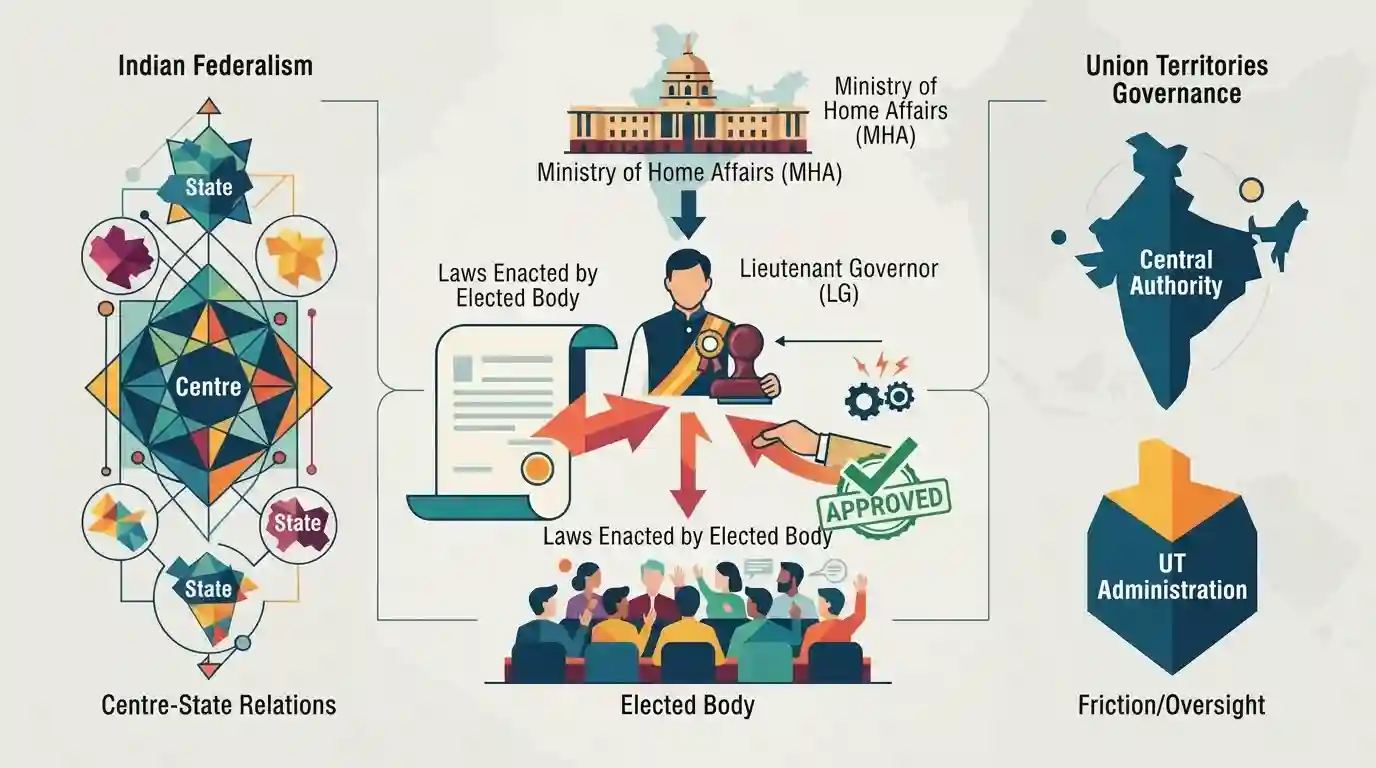
The Ministry of Home Affairs (MHA) has prepared a draft addressing demands from Ladakh for an elected body, proposing that laws enacted by such a body would require the assent of the Lieutenant Governor. This development touches upon core themes of Indian federalism, Union Territory governance structures, and the friction between elected representatives and central appointees.
মূল বিষয়
- The Ministry of Home Affairs (MHA) has drafted a proposal regarding Ladakh's governance demands, stipulating that laws passed by the elected body would require the Lieutenant Governor's (L-G) assent.
- This highlights ongoing tensions around regional autonomy, special status demands (such as the Sixth Schedule), and the extent of democratic decentralization in Union Territories without legislatures or with restricted legislative powers.
- The provisions mirror debates seen in other Union Territories like Delhi and Jammu and Kashmir regarding the balance of power between elected representatives and appointed L-Gs.
গুরুত্বপূর্ণ শব্দ
Jammu and Kashmir Reorganization Act

The 2019 legislation enacted by the Indian Parliament that reorganized the erstwhile state of Jammu and Kashmir into two distinct Union Territories: Jammu and Kashmir (with a legislature) and Ladakh (without a legislature).
UPSC context
UPSC Prelims/Mains (Polity): Tests federal provisions, reorganization of states, and Union Territory administration under Part VIII of the Constitution.
Ministry of Home Affairs
A key central ministry of the Government of India responsible for internal security, domestic policy, Centre-State relations, border management, and the overall governance and administration of Union Territories.
UPSC context
UPSC Mains (Governance/Internal Security): Tests the organizational role of central ministries in overseeing sub-national units and federal coordination.
MHA
The abbreviation for the Ministry of Home Affairs, the nodal union ministry handling matters concerning internal administration, security, and statutory frameworks for Union Territories like Ladakh.
UPSC context
UPSC Polity: Frequently encountered in policy initiatives, legislative drafts, and administrative disputes involving Union Territories.
প্রিলিমস ফাঁদ
Ladakh's Autonomous Hill Development Councils possess independent law-making powers equal to state legislatures under the Constitution.
Aspirants often assume Union Territories with Autonomous Hill Councils have full legislative powers equivalent to a state assembly, whereas LAHDCs operate primarily as advisory and developmental local bodies under specific statutes.
সংযুক্ত স্থির ধারণা
What are the constitutional differences between the Fifth and Sixth Schedules of the Indian Constitution?
- Geographic Scope: Fifth Schedule applies to tribal areas in states other than Assam, Meghalaya, Tripura, and Mizoram; Sixth Schedule applies specifically to tribal areas in those four Northeastern states.
- Autonomous Bodies: Fifth Schedule areas have Tribes Advisory Councils; Sixth Schedule areas establish autonomous districts and regional councils with specific legislative, judicial, and taxing powers.
- Legislative Powers: Governors of Fifth Schedule states have sweeping powers to direct that central/state acts do not apply; Sixth Schedule councils draft their own rules on land, marriage, and social customs subject to Governor assent.
আন্তঃবিষয় প্যাটার্ন
UT Governance vs. Federal Autonomy Debates
UT governance models without full statehood mirror debates on Centre-State legislative friction and executive overreach under Article 239AA and similar provisions across India's peripheries.
Sixth Schedule Extension & Tribal Rights
Demands for Sixth Schedule extension in Ladakh test the constitutional limits of Fifth and Sixth Schedule protections for fragile ecological and tribal border zones.

Ladakh's governance framework + Sixth Schedule criteria + UT administrative powers likely to be tested via statement-based MCQs.
সংযুক্ত PYQ · 3
সংযুক্ত PYQ · 3
- 2025MainsGS2
Discuss the nature of Jammu and Kashmir Legislative Assembly after the Jammu and Kashmir Reorganization Act, 2019. Briefly describe the powers and functions of the Assembly of the Union Territory of Jammu and Kashmir.
- 2016MainsGS2
Discuss the essentials of the 69th Constitutional Amendment Act and anomalies, if any, that have led to recent reported conflicts between the elected representatives and the institution of the Lieutenant Governor in the administration of Delhi. Do you think that this will give rise to a new trend in the functioning of the Indian federal politics?
- 2022MainsGS2
“While the national political parties in India favour centralisation, the regional parties are in favour of State autonomy.” Comment.
