UAPA individual terrorist designation and security implications
Source:The Hindu ↗
Why It Matters
This article illustrates the practical deployment of the 2019 amendment of the UAPA, which empowered the Union government to designate individuals as terrorists. It underscores the modern, technology-driven nature of cross-border terrorism (the use of drones, social media recruitment, and highly encrypted communication networks by educated individuals) which is a crucial area of focus for GS Paper 3 (Internal Security) and Essay papers.
Summary
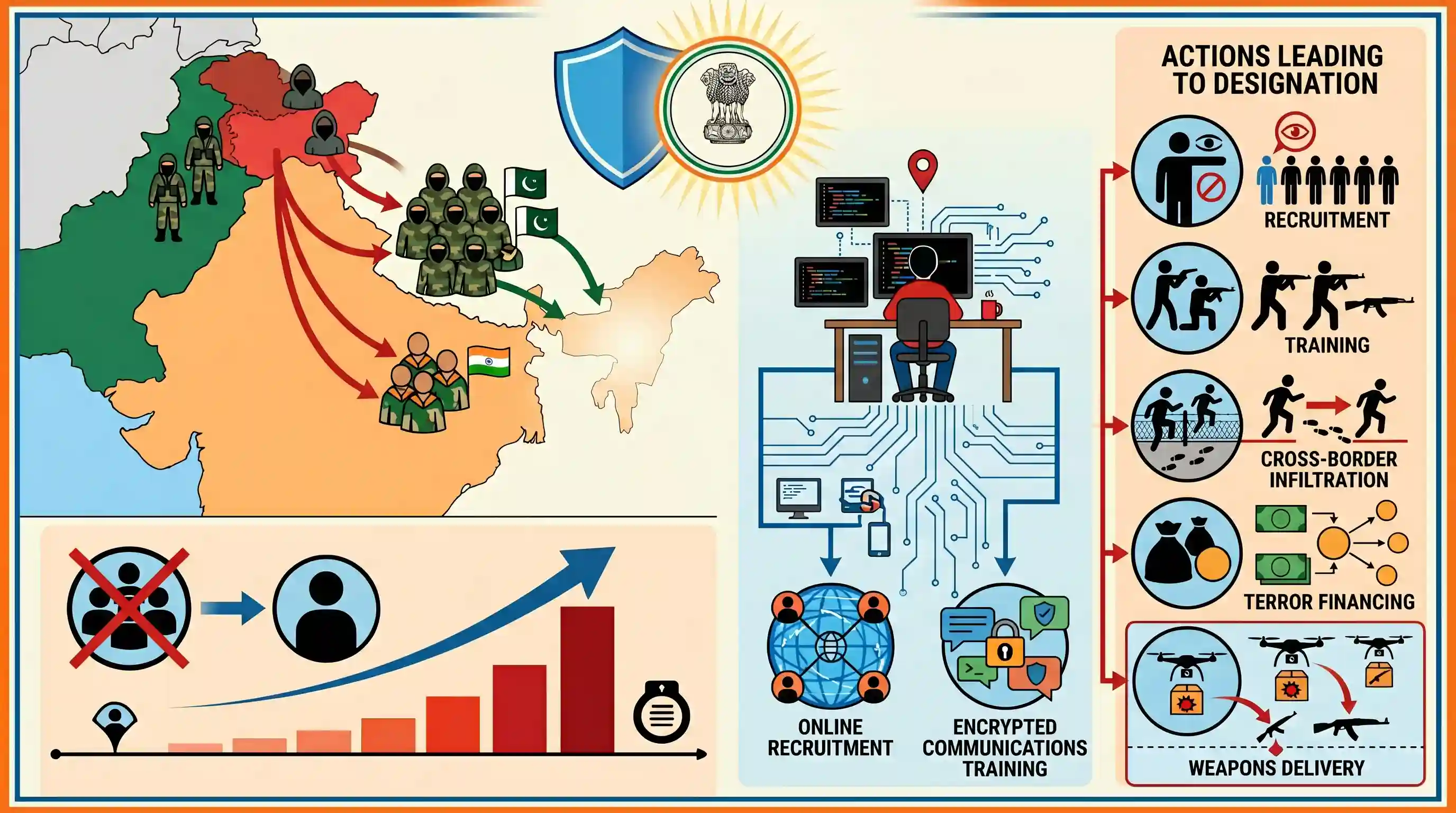
The Union Ministry of Home Affairs (MHA) has designated 23 individuals (17 Pakistani nationals and 6 Indian nationals) as 'terrorists' under the Unlawful Activities (Prevention) Act, 1967. Operating from Pakistan or Pakistan-occupied Jammu & Kashmir (PoJK), these individuals are accused of recruitment, training, cross-border infiltration, terror financing, and weapons delivery (including via drones). This includes Mohammed Shaheed Faisal, a software engineer from Bengaluru linked to the Rameshwaram Cafe blast module, who recruited youth online and trained them in encrypted communications. With these additions, the total number of individuals designated under the amended UAPA (which was modified in 2019 to target individuals rather than just organizations) has reached 80.
Key Points
- The Ministry of Home Affairs (MHA) has designated 23 individuals as terrorists under the Unlawful Activities (Prevention) Act, 1967 (UAPA). This takes the total number of individuals designated as terrorists under the Act to 80.
- The 23 designated individuals include 17 Pakistani nationals and 6 Indian nationals. While they are all currently residing/operating out of Pakistan or Pakistan-occupied Jammu and Kashmir (PoJK), the 6 Indians hail from Karnataka and Jammu & Kashmir.
- A notable Indian on the list is Mohammed Shaheed Faisal, an engineering graduate and techie from Bengaluru currently residing in Rawalpindi, Pakistan. He has links to LeT, JeM, Al-Qaeda, and ISIS, and is the suspected handler of the Rameshwaram Cafe blast module of March 2024.
- The designated terrorists are accused of playing various roles in asymmetric warfare against India, such as recruiting and radicalising youth online, arranging weapons training, raising terror funds, and imparting training in data encryption and fake identities to evade law enforcement.
- The designation highlights modern cross-border security challenges, including the use of Unmanned Aerial Vehicles (UAVs)/drones for weapons/ammunition delivery, cyber-recruitment, and the training of operatives in secure data communication to build remote, decentralized terror modules.
Important Terms
Unlawful Activities (Prevention) Act, 1967 (UAPA)

India's primary anti-terror legislation designed to prevent unlawful activities and associations that threaten the sovereignty and territorial integrity of India, providing special procedures and strict bail provisions.
UPSC context
GS Paper III (Internal Security): Tests understanding of anti-terror legislation, civil liberties trade-offs, and federal power dynamics.
Unlawful Activities (Prevention) Amendment Act, 2019
An amendment that empowers the Central Government to designate individuals as 'terrorists' without formal judicial processes and expands the investigative and property seizure powers of the NIA.
UPSC context
GS Paper III (Internal Security): Tests knowledge of counter-terrorism reforms, civil liberty implications, and federal investigative authority.
National Investigation Agency (NIA)
India's premier federal counter-terrorism law enforcement agency established under the NIA Act, 2008, with nationwide jurisdiction to investigate and prosecute security-related and scheduled offences.
UPSC context
GS Paper III (Internal Security): Tests knowledge of central investigative institutions, federal-state jurisdictional conflicts, and internal security mechanisms.
Ministry of Home Affairs (MHA)
The interior ministry of the Government of India, primarily responsible for the maintenance of internal security, domestic policy, federal policing, border management, and counter-terrorism coordination.
UPSC context
GS Paper II (Governance) & GS III (Security): Tests understanding of the executive coordination of internal stability and border security.
Lashkar-e-Taiba (LeT)
A Pakistan-based, UN-designated Islamist militant group active in Kashmir, responsible for several major attacks in India including the 2008 Mumbai attacks.
UPSC context
GS Paper III (Security): Tests awareness of cross-border terrorism, proxy warfare, and non-state actors destabilizing regional security.
Jaish-e-Mohammed (JeM)
A Pakistan-based Deobandi-jihadist militant organization active in Kashmir, aiming to integrate the region into Pakistan, and responsible for major strikes including the 2019 Pulwama bombing.
UPSC context
GS Paper III (Security): Tests understanding of regional asymmetric threats, terrorist funding, and challenges to India-Pakistan relations.
Prelims Trap
Under the amended UAPA, the NIA must obtain prior permission from the DGP of the concerned state to seize property.
The 2019 amendment explicitly bypassed state-level police consent, allowing the Director General of the NIA (DG NIA) to directly authorize property seizure in NIA-led investigations.
Static Concepts Connected
What are the key shifts introduced by the UAPA Amendment Act of 2019?
- Individual Designation: The MHA was empowered to designate individuals as terrorists under the Fourth Schedule; previously, only organisations could be proscribed.
- Property Seizure: If the case is investigated by the NIA, approval for property seizure is required only from the DG NIA, bypassing the State DGP.
- Investigating Ranks: Officers of the rank of Inspector or above in the NIA are authorized to investigate terrorism cases, easing human resource constraints.
What checks and balances exist for individuals designated as terrorists under UAPA?
- Administrative Redress: An individual must first apply to the Central Government for denotification; the government must decide on this within 45 days.
- Review Committee: If rejected, the individual can appeal to a Review Committee, which is chaired by a sitting or retired High Court Judge.
- Judicial Review: Individuals retain the right to approach the Constitutional Courts (High Court or Supreme Court) via writ petitions to challenge arbitrary listings.
Cross-Topic Patterns
Asymmetric tech warfare and border management
The shift from physical infiltration to drone-based payloads and encrypted decentralized modules links UAPA enforcement to India's cyber-defence and border infrastructure upgrades.
NIA empowerment vs State police jurisdiction
Bypassing state DGP consent for property seizure under UAPA reflects the ongoing constitutional debate between central national security powers and state police autonomy (Seventh Schedule).

UAPA 2019 provisions on individual designation, NIA property seizure powers, and HC judge-led Review Committees will dominate 2026 MCQs.
Linked PYQs · 4
Linked PYQs · 4
- 2019MainsGS3
Indian Government has recently strengthened the anti-terrorism laws by amending the Unlawful Activities (Prevention) Act (UAPA), 1967 and the NIA Act. Analyze the changes in the context of prevailing security environment while discussing the scope and reasons for opposing the UAPA by human rights organizations.
- 2023MainsGS3
The use of unmanned aerial vehicles (UAVs) by our adversaries across the borders to ferry arms/ammunitions, drugs, etc., is a serious threat to the internal security. Comment on the measures being taken to tackle this threat.
- 2021MainsGS3
Analyse the multidimensional challenges posed by external state and non-state actors, to the internal security of India. Also discuss measures required to be taken to combat these threats.
- 2024MainsGS3
Social media and encrypting messaging services pose a serious security challenge. What measures have been adopted at various levels to address the security implications of social media? Also suggest any other remedies to address the problem.
