MHA Security Advisory To States Ahead Of Nationwide May Day Protests
Source:Indian Express ↗
Why It Matters
The article is highly relevant for UPSC as it bridges Internal Security (LWE capitalizing on civil unrest) with Governance and Economy (the role of trade unions/farmers as pressure groups, and the ongoing debate over the four Labour Codes). It exemplifies the friction between economic reforms and democratic mobilization.
Summary
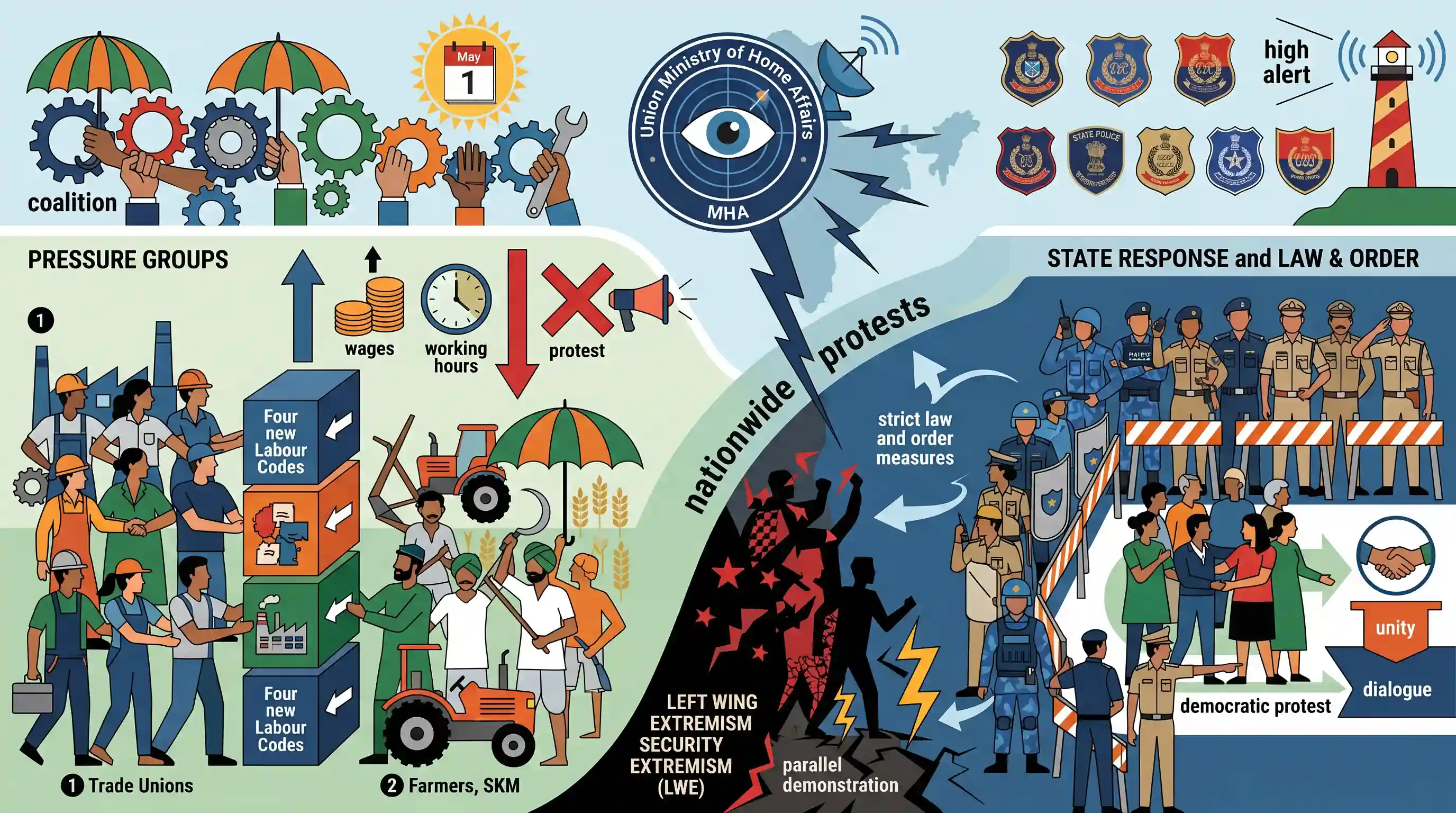
The Union Ministry of Home Affairs (MHA) has directed state governments to remain highly alert ahead of planned nationwide protests on May Day. A coalition of central trade unions, supported by the farmers' umbrella body Samyukt Kisan Morcha (SKM), is mobilizing to protest against the central government's four new Labour Codes and to demand improved wages and working hours. The MHA advisory highlights internal security concerns, warning that pro-ultra Left groups may attempt to organize parallel demonstrations to incite unrest, necessitating strict law and order measures during the democratic protests.
Key Points
- The Ministry of Home Affairs (MHA) issued an advisory to state governments to maintain high vigilance ahead of May Day (International Labour Day) protests.
- Central trade unions, joined by the Samyukt Kisan Morcha (SKM), plan nationwide mobilisations demanding the withdrawal of the four new Labour Codes, higher wages, and better working conditions.
- The convergence of farmers' groups (SKM) and trade unions reflects a unified approach by pressure groups to influence national economic and labour policies.
- The MHA warned that pro-ultra Left outfits might organize parallel processions to exploit the situation, posing potential law and order and internal security challenges.
Important Terms
Four Labour Codes

A landmark reform consolidating 29 central laws into four codes (Wages, Industrial Relations, Social Security, and Occupational Safety) to modernize governance and simplify compliance.
UPSC context
GS Paper 3 (Economy/Labour); tests knowledge of structural reforms, formalization of workforce, and balance between employer flexibility and worker security.
Samyukt Kisan Morcha (SKM)
An umbrella coalition of over 400 farmers' unions formed in 2020 to lead protests against farm laws; it remains a powerful agrarian pressure group.
UPSC context
GS Paper 2 (Pressure Groups) and GS Paper 3 (Agriculture); tests understanding of collective bargaining and its impact on policy decisions.
Central Trade Unions (CTUs)
National-level federations (e.g., AITUC, CITU) representing labor interests; status requires 5 lakh+ verified members across at least four states and industries.
UPSC context
GS Paper 2 (Pressure Groups) and GS Paper 3 (Economy); tests role of organized labor in industrial relations and social security advocacy.
Left Wing Extremism (LWE)
Also known as Naxalism, it is an armed Maoist insurgency aiming to overthrow the government through violence, primarily active in central India's tribal belts.
UPSC context
GS Paper 3 (Internal Security); tests knowledge of domestic security challenges, the SAMADHAN doctrine, and the development-security nexus.
Ministry of Home Affairs (MHA)
The nodal Union Ministry responsible for maintaining internal security, public order, and coordinating between Center and States, particularly regarding law enforcement.
UPSC context
GS Paper 2 (Executive/Ministries) and GS Paper 3 (Security); tests institutional framework for national stability and federal security coordination.
Pressure Groups
Organized collectives (e.g., unions, associations) that attempt to influence public policy and legislation through advocacy and mobilization without contesting for political power.
UPSC context
GS Paper 2 (Polity); tests understanding of participative democracy and the role of non-state actors in shaping the legislative agenda.
Prelims Trap
"The MHA lacks jurisdiction to issue security advisories on protests as 'Public Order' is strictly a State subject."
While 'Public Order' is a State List subject, Article 355 mandates the Union to protect states against "internal disturbance," validating MHA security advisories.
Static Concepts Connected
What is the constitutional basis for MHA security advisories to states?
- State List: 'Public Order' and 'Police' fall squarely under the State List (List II, Schedule VII).
- Article 355: Mandates the Union to protect states against external aggression and "internal disturbance," providing the constitutional backing for MHA advisories and interventions.
Which four Labour Codes were enacted to consolidate India's 29 central labour laws?
- Code on Wages: Universalizes minimum wages and timely payment for all workers across sectors.
- Industrial Relations Code: Streamlines dispute resolution and alters the employee thresholds for standing orders, retrenchment, and layoffs.
- Social Security Code: Aims to extend comprehensive social security networks to unorganised, gig, and platform workers.
- OSH Code: Regulates occupational safety, health, and working conditions, standardizing leave and maximum working hours.
Cross-Topic Patterns
Convergence of Pressure Groups
The alliance between trade unions and farmers (SKM) illustrates the evolution of pressure groups relying on joint mass mobilizations to actively challenge macroeconomic and structural state policies.
Democratic Protests vs. LWE Threats
The potential exploitation of legitimate trade union protests by Left Wing Extremism (LWE) outfits highlights the complex challenge of securing Article 19 freedoms while preventing internal disturbance.

Expect a GS-2 Mains question analyzing the changing tactics of pressure groups, specifically the convergence of agrarian and labour unions.
Linked PYQs · 5
Linked PYQs · 5
- 2024MainsGS3
Discuss the merits and demerits of the four 'Labour Codes' in the context of labour market reforms in India. What has been the progress so far in this regard?
- 2019MainsGS2
What are the methods used by the farmers' organisations to influence the policy-makers in India and how effective are these methods?
- 2022MainsGS3
Naxalism is a social, economic and developmental issue manifesting as a violent internal security threat. In this context, discuss the emerging issues and suggest a multilayered strategy to tackle the menace of Naxalism.
- 2018MainsGS3
Left Wing Extremism (LWE) is showing a downward trend, but still affects many parts of the country. Briefly explain the Government of India's approach to counter the challenges posed by LWE.
- 2020MainsGS3
What are the determinants of left-wing extremism in Eastern part of India? What strategy should Government of India, civil administration and security forces adopt to counter the threat in the affected areas?
