Mexican army neutralizes notorious cartel leader in military raid
Source:Indian Express ↗
Why It Matters
The elimination of a high-profile cartel leader provides a real-world case study on the intense operational challenges posed by organized crime syndicates. For UPSC aspirants, it highlights the nexus between drug trafficking, money laundering, and violence, offering a comparative perspective on internal security threats and the role of well-armed non-state actors in undermining state authority.
Summary
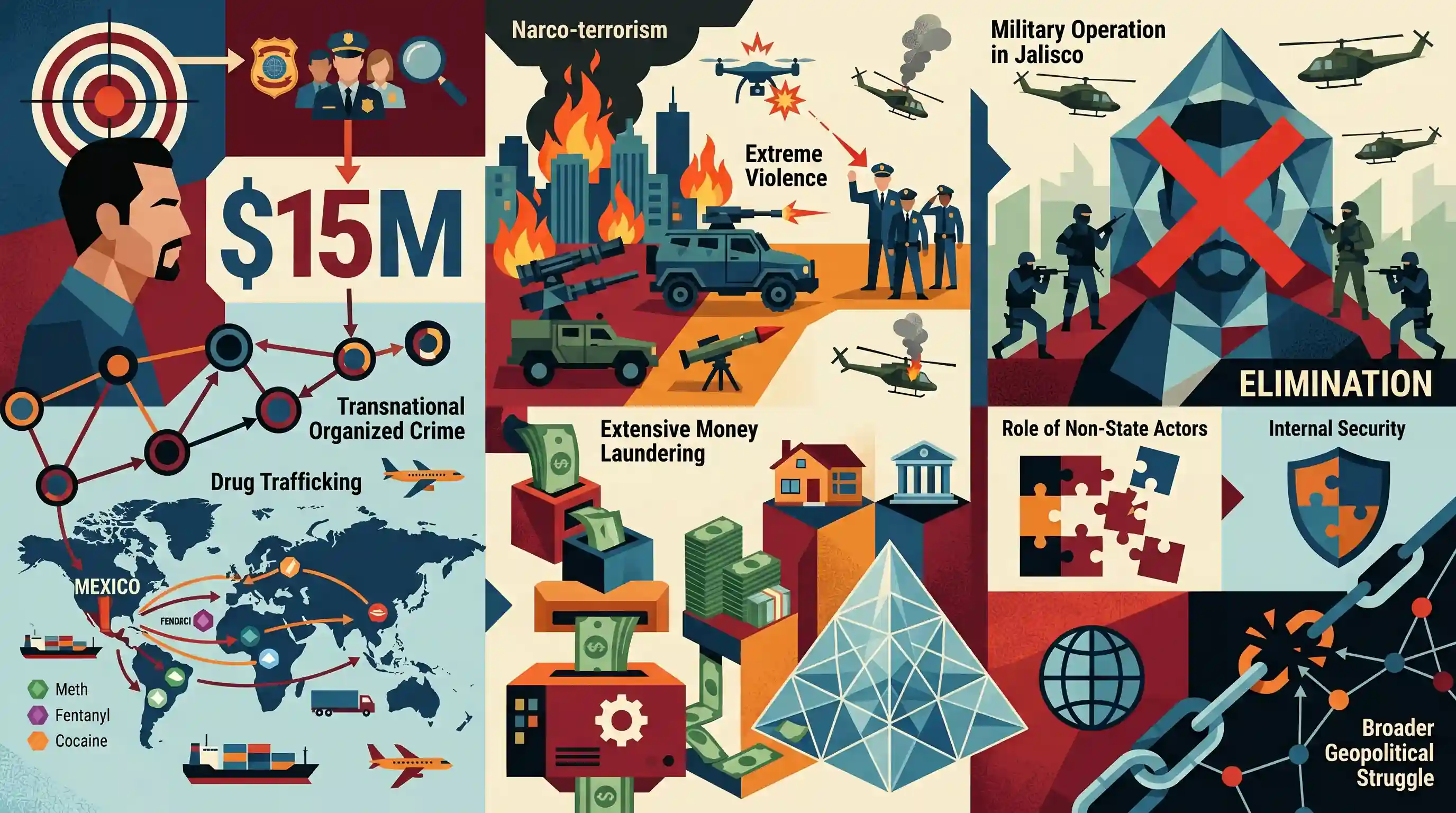
Nemesio Oseguera Cervantes, alias 'El Mencho', the notorious leader of Mexico's powerful Jalisco New Generation Cartel (CJNG), was killed during a military operation in Jalisco. Operating with a $15 million US bounty on his head, El Mencho was a primary target for international law enforcement due to his cartel's deep involvement in transnational drug trafficking, extreme violence, and extensive money laundering networks. His elimination marks a significant tactical victory in the broader geopolitical struggle against heavily armed non-state actors and organized crime syndicates.
Key Points
- Nemesio Oseguera Cervantes, known as 'El Mencho', the leader of the highly violent Jalisco New Generation Cartel (CJNG), was killed in a targeted Mexican army raid in the state of Jalisco.
- The CJNG has been heavily involved in transnational organized crime, expanding its operations globally and becoming a major supplier of deadly narcotics, including fentanyl and methamphetamine, to the US.
- The United States had placed a massive $15 million bounty on El Mencho, reflecting the severity of the cartel's threat to international security and public health.
- The takedown highlights the extreme operational challenges sovereign states face when combating highly armed and resourceful non-state actors involved in narco-terrorism.
- The event underscores the necessity for intelligence-led operations and international cooperation to disrupt sophisticated drug trafficking, extortion, and money laundering syndicates.
Important Terms
Jalisco New Generation Cartel (CJNG)

A powerful Mexican criminal syndicate known for extreme militarization and international drug trafficking (primarily fentanyl and methamphetamine). It was led by Nemesio Oseguera Cervantes until his death in 2026.
UPSC context
GS III (Internal Security); case study for non-state actors and the security challenges posed by well-armed criminal syndicates.
Transnational Organized Crime
Illegal activities coordinated across national borders by structured groups seeking financial gain. It encompasses smuggling, human trafficking, and narcotics, posing significant threats to global and national security.
UPSC context
GS III (Internal Security); relates to organized crime and its links with terrorism, a core syllabus topic.
Narco-terrorism
The symbiotic relationship between drug trafficking and terrorism, where criminal groups use narcotics proceeds to fund violence and intimidate governments to achieve political or economic goals.
UPSC context
GS III (Internal Security); essential for understanding the financing of terror and the security-narcotics nexus.
Drug Enforcement Administration (DEA)
A United States federal law enforcement agency tasked with combating drug smuggling and distribution through both domestic investigations and international cooperation with foreign partners like India.
UPSC context
GS II (International Relations); relevant for bilateral security cooperation and global efforts against drug trafficking.
Money Laundering
The process of concealing the criminal origins of illegally obtained money by routing it through legitimate businesses or foreign banks to make it appear legal.
UPSC context
GS III (Internal Security); specific syllabus keyword regarding the prevention of crime financing and national security.
Non-State Actors
Individuals or groups that hold significant political or military influence but operate independently of any sovereign state, such as insurgent groups or criminal syndicates.
UPSC context
GS III (Internal Security); analyzes challenges to sovereign authority posed by insurgent or criminal organizations.
Prelims Trap
"Fentanyl and methamphetamine are highly addictive plant-based narcotics."
Fentanyl and meth are purely synthetic, laboratory-produced drugs. They are not plant-based opiates like heroin, which makes their production much harder to track using satellite imagery.
Static Concepts Connected
What are the primary illicit drug trafficking regions threatening India's internal security?
- Golden Crescent: Encompasses Iran, Afghanistan, and Pakistan, deeply impacting India's northwestern borders (Punjab, J&K, Gujarat).
- Golden Triangle: Comprises Myanmar, Laos, and Thailand, primarily affecting India's Northeastern states via porous borders.
- Synthetic Transit Routes: The Golden Peacocks (Myanmar) and evolving dark-net syndicates are now pushing lab-based synthetics, bypassing traditional routes.
What characterizes "Narco-Terrorism" in the context of non-state actors?
- Symbiotic Alliance: Terrorist groups provide safe transit and protection, while drug cartels supply weapons and massive illicit funding.
- State Subversion: The immense financial clout of cartels challenges the sovereign state's monopoly on violence, destabilizing legitimate governance.
- Money Laundering Networks: Reliance on hawala, shell companies, and crypto to integrate illicit drug profits into the formal financial system.
Cross-Topic Patterns
Synthetic Drugs & API Regulation
The shift to lab-produced fentanyl connects GS3 border security with GS2/GS3 pharma regulations, as dual-use precursor chemicals cross borders legally before diversion.
FATF & Cartel Financing
Dismantling multi-billion-dollar transnational cartels directly ties into the Financial Action Task Force's (FATF) mandate on tracking global illicit money laundering networks.

Mains 2026 GS3 will likely feature a question linking the global shift toward synthetic drugs with evolving narco-terrorism challenges.
Linked PYQs · 4
Linked PYQs · 4
- 2022MainsGS3
Discuss the types of organised crimes. Describe the linkages between terrorists and organised crime that exist at the national and transnational levels.
- 2024MainsGS3
Explain how narco-terrorism has emerged as a serious threat across the country. Suggest suitable measures to counter narco-terrorism.
- 2018MainsGS3
India's proximity to two of the world's biggest illicit opium-growing states has enhanced her internal security concerns. Explain the linkages between drug trafficking and other illicit activities such as gunrunning, money laundering and human trafficking. What counter-measures should be taken to prevent the same?
- 2021MainsGS3
Analyse the multidimensional challenges posed by external state and non-state actors, to the internal security of India. Also discuss measures required to be taken to combat these threats.
