Supreme Court Ruling on AI-Generated Precedents in Judgments
Source:The Hindu ↗
Why It Matters
This landmark judgment sets a legal precedent regarding the boundaries of Artificial Intelligence in public decision-making. It directly addresses the threat of AI 'hallucinations' subverting the rule of law and provides a strong framework for technology-related ethics and regulatory oversight in the Indian judicial system.
Summary
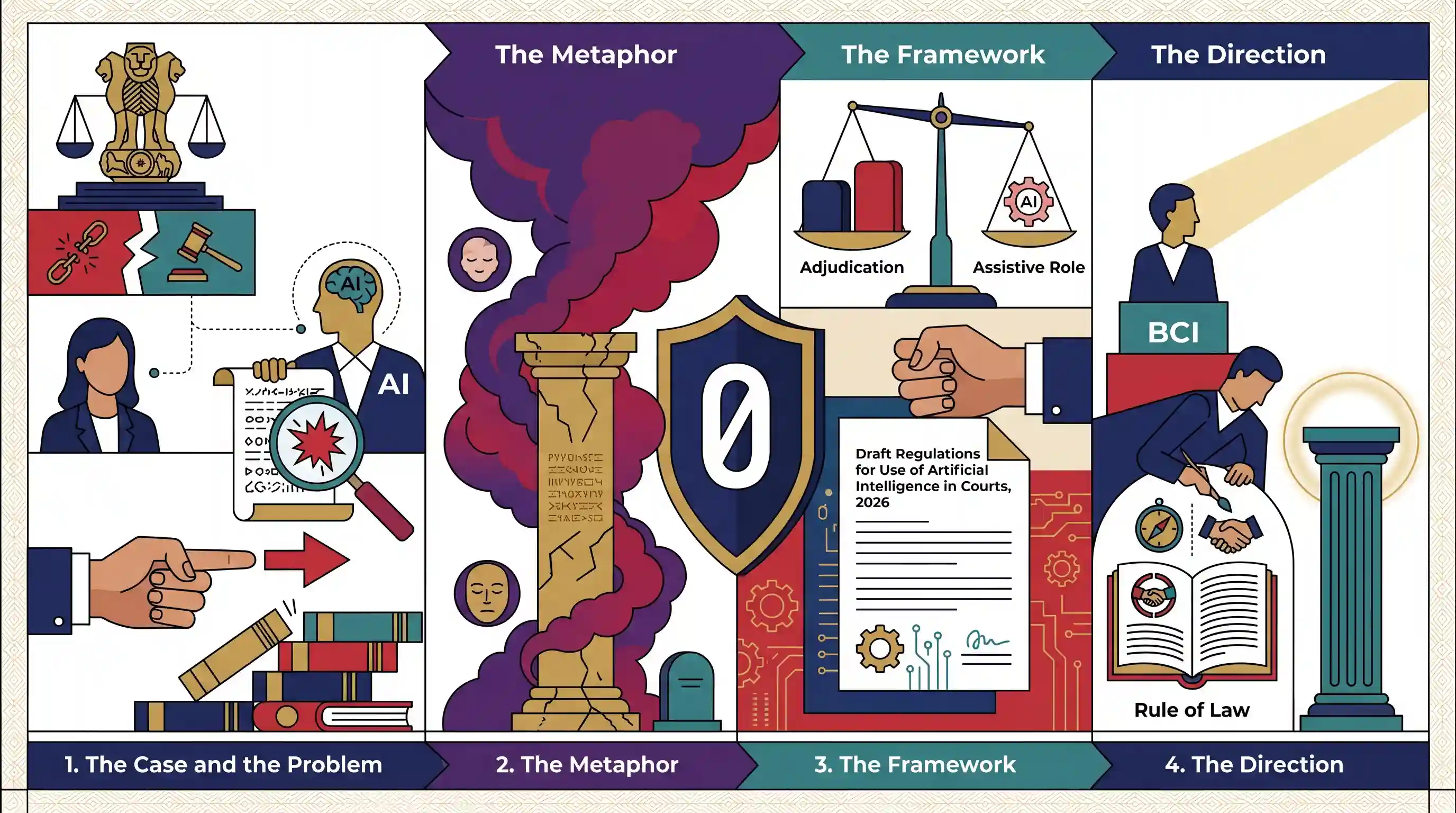
On July 2, 2026, the Supreme Court of India in 'Pooja Ramesh Singh v. Jammu & Kashmir Bank' quashed an NCLT insolvency order that relied on fictitious AI-generated case laws. Comparing hallucinated AI precedents to 'methyl isocyanate'—invisible, insidious, and catastrophic—the Court established a 'zero-tolerance' rule for unverified AI citations. It emphasized that AI must only play an assistive role, highlighting the 'Draft Regulations for Use of Artificial Intelligence in Courts, 2026' and directing the Bar Council of India (BCI) to formulate disciplinary and professional guidelines to safeguard the sanctity of judicial determination.
Key Points
- The Supreme Court of India quashed a National Company Law Tribunal (NCLT) Mumbai Bench order and a subsequent NCLAT order because the NCLT had relied on fictitious, AI-generated/hallucinated judicial precedents sourced from its 'own research'.
- The SC Bench compared fake AI-generated legal precedents to 'methyl isocyanate' in the province of law and justice: invisible, insidious, and catastrophic by the time anyone notices.
- The Court declared a 'zero-tolerance' policy for both the Bar and the Bench regarding the citation or reliance on AI-generated precedents without strict, independent human verification.
- The judgment warned against the growing habit of delegating human 'thinking' and 'reasoning' to machine algorithms, stating that uniquely human cognitive attributes must not be relinquished.
- The ruling highlighted the Draft Regulations for Use of Artificial Intelligence in Courts, 2026, which mandate that AI can only assist and never supplant judges, prohibit AI usage in final judicial outcomes (like sentencing or bail), and require disclosure of AI-assisted filings.
- The SC directed the Bar Council of India (BCI) to constitute a committee to examine the issue, formulate appropriate norms/guiding principles, and prescribe disciplinary actions for using unverified AI-generated content in courts.
Important Terms
Draft Regulations for Use of Artificial Intelligence in Courts, 2026

A regulatory framework released by the Supreme Court of India's AI Committee in June 2026 to govern AI's assistive role in legal tasks while prohibiting its use in core judicial decision-making.
UPSC context
GS Paper II (Governance) & GS Paper III (Science & Tech): Technology in governance, ethics of AI, and judicial reforms.
National Company Law Tribunal (NCLT)
A specialized quasi-judicial body in India, constituted under Section 408 of the Companies Act, 2013, to adjudicate corporate disputes, restructuring, and insolvency cases.
UPSC context
GS Paper II (Polity & Governance) & GS Paper III (Economy): Regulatory bodies, corporate governance, and insolvency resolution.
National Company Law Appellate Tribunal (NCLAT)
A quasi-judicial body established under the Companies Act, 2013, to hear appeals against the decisions of the National Company Law Tribunal (NCLT) and the Insolvency and Bankruptcy Board of India.
UPSC context
GS Paper II (Polity) & GS Paper III (Economy): Appeal mechanisms, specialized tribunals, and corporate dispute resolution.
Insolvency and Bankruptcy Code (IBC)
A comprehensive 2016 law that consolidates and amends the legal framework for the time-bound insolvency resolution of corporate persons, partnership firms, and individuals in India.
UPSC context
GS Paper III (Indian Economy): Debt recovery mechanisms, non-performing assets (NPAs), and ease of doing business.
Bar Council of India (BCI)
A statutory body created under Section 4 of the Advocates Act, 1961, to regulate legal practice, standards of professional conduct, and legal education across India.
UPSC context
GS Paper II (Polity): Statutory bodies, professional regulation, and the administration of the judicial system.
Prelims Trap
The Draft Regulations for Use of AI in Courts, 2026, permit AI tools to predict recidivism and assess bail eligibility.
The draft regulations strictly prohibit courts from using opaque 'black-box' AI tools or algorithmic risk-scoring systems for assessing recidivism, bail, or final sentencing.
Static Concepts Connected
What are the constitutional limits on delegating judicial discretion?
- Non-delegation Doctrine: Judicial power is inherently non-delegable. A judge cannot legally sub-delegate active intellectual reasoning to an external tool, agency, or automated algorithm.
- Application of Mind: Every judicial/quasi-judicial order must reflect an active, independent application of mind to the specific facts, statutory provisions, and verified case laws.
- Natural Justice violation: Relying on fictional, unverified precedents deprives the opposing party of a fair chance to counter, violating procedural fairness and natural justice.
What is the statutory role of the Bar Council of India (BCI)?
- Statutory status: Established under the Advocates Act, 1961, as a representative and regulatory body for legal practice and professional standards in India.
- Disciplinary powers: Empowered to lay down standards of professional conduct and etiquette, and to exercise disciplinary jurisdiction over advocates for misconduct.
- Legal Education standardizer: Prescribes and standardizes legal education, granting recognition to universities whose law degrees serve as qualification for enrolment.
Cross-Topic Patterns
AI Ethics + Article 21 Rights
Algorithmic hallucinations in judicial decision-making directly threaten the right to a fair trial under Article 21, linking digital public infrastructure to basic constitutional protections.
Global AI Regulation + Judicial Sovereignty
The SC's defensive stance mirrors global tech regulation, showing how India's judicial rules align with international risk-based frameworks like the EU AI Act.

GS-2 2026 is highly likely to frame a question on 'human-in-the-loop' constitutional safeguards against AI bias in the judiciary.
Linked PYQs · 2
Linked PYQs · 2
- 2024MainsGS4
The application of Artificial Intelligence as a dependable source of input for administrative rational decision-making is a debatable issue. Critically examine the statement from the ethical point of view.
- 2021MainsGS4
Impact of digital technology as reliable source of input for rational decision making is a debatable issue. Critically evaluate with suitable example.
