Paddy Cultivation Methane Reduction and Agricultural Carbon Credits
Source:Indian Express ↗
Why It Matters
It illustrates the vital intersection of agriculture, climate change mitigation, and carbon finance. Understanding how sustainable farming practices like AWD and DSR can reduce methane emissions while providing economic benefits to farmers via carbon credits is highly relevant for GS-3 topics on both agriculture and environmental conservation.
Summary
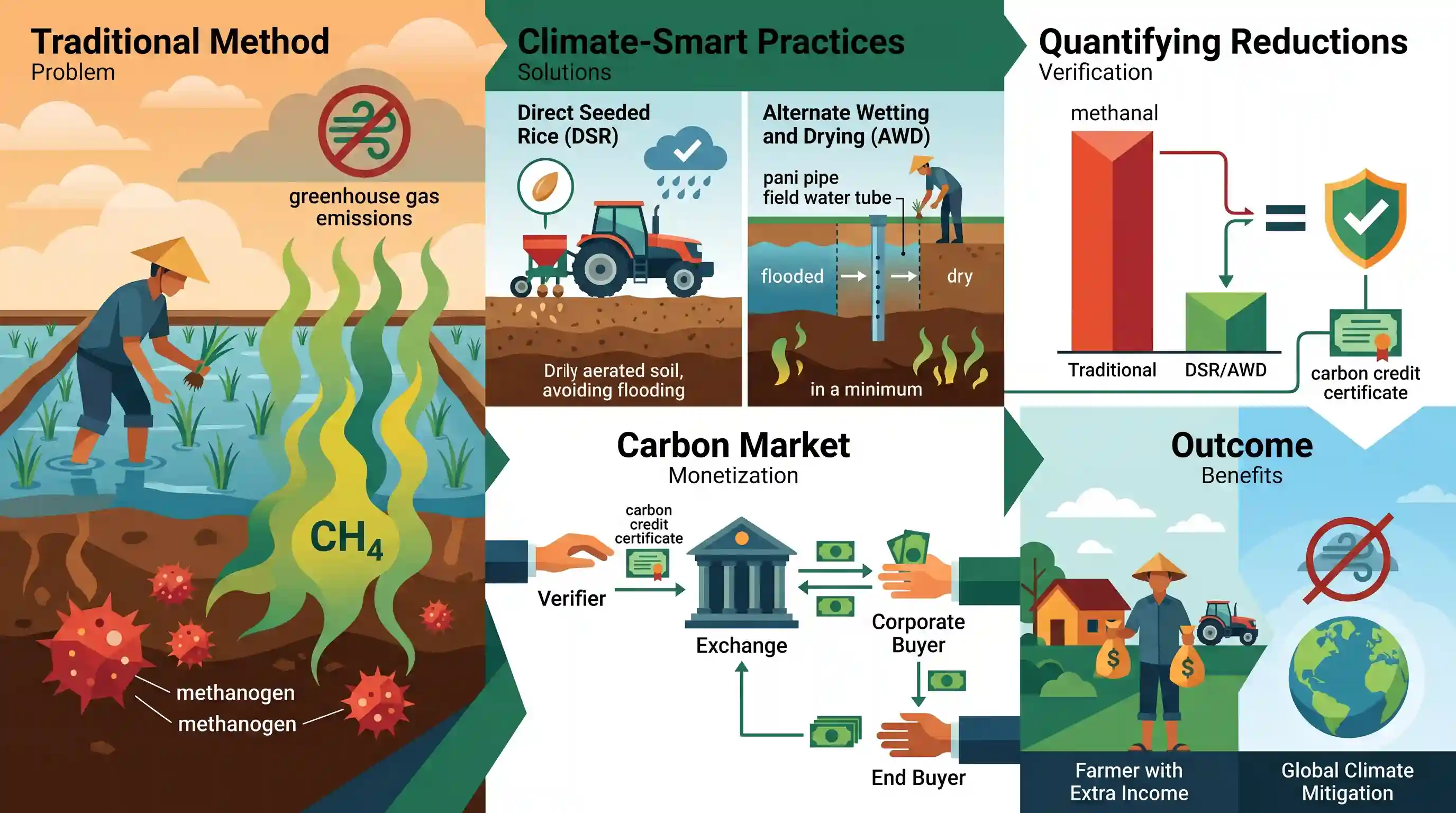
The article explores how farmers can earn extra income by reducing methane emissions in paddy cultivation through climate-smart agricultural practices. Traditional flooded rice fields are significant contributors to methane, a potent greenhouse gas. By shifting to water-saving techniques like Direct Seeded Rice (DSR) and Alternate Wetting and Drying (AWD), farmers can substantially cut down these emissions. These verifiable emission reductions can be monetized as carbon credits and sold on voluntary carbon markets, providing a financial incentive for sustainable farming while contributing to global climate mitigation efforts.
Key Points
- Traditional paddy cultivation in flooded fields creates anaerobic conditions, leading to the emission of methane, a potent greenhouse gas.
- Adopting climate-smart agricultural practices like Alternate Wetting and Drying (AWD) and Direct Seeded Rice (DSR) significantly reduces water usage and curbs methane emissions.
- The reduction in greenhouse gas emissions achieved through these sustainable farming methods can be quantified and converted into carbon credits.
- Farmers can trade these carbon credits on voluntary carbon markets, generating a supplementary source of income and boosting agricultural profitability.
- Integrating carbon finance with agriculture incentivizes environmentally friendly farming, offering a dual benefit of climate change mitigation and rural economic upliftment.
Prelims Trap
Alternate Wetting and Drying (AWD) eliminates all greenhouse gas emissions from paddy fields.
While AWD drastically slashes methane (anaerobic), the periodic drying introduces oxygen, which can actually increase nitrous oxide (N2O) emissions through aerobic nitrification.
Static Concepts Connected
How do AWD and DSR techniques reduce methane emissions in agriculture?
- Anaerobic avoidance: Continuous flooding creates oxygen-starved soil conditions, which are ideal for methanogenic archaea (methane-producing bacteria).
- AWD aeration: Periodic drying of the field introduces oxygen into the soil, halting the activity of methane-producing microbes.
- DSR mechanism: Directly sowing seeds into the field bypasses the prolonged, water-intensive flooded puddling phase entirely.
What distinguishes Voluntary Carbon Markets (VCM) from Compliance Markets?
- Compliance markets: Driven by mandatory national or international cap-and-trade regulations (e.g., EU ETS).
- Voluntary markets: Corporations and individuals optionally purchase credits to meet private Net-Zero, ESG, or CSR targets.
- Independent verification: VCMs rely on independent standard-setters and registries (like Verra or Gold Standard) to verify emission reductions.
Cross-Topic Patterns
Carbon Farming & Groundwater Conservation
DSR adoption for carbon credits aligns with state-level groundwater conservation schemes (like Punjab's 'Mera Pani Meri Virasat'), offering dual financial incentives to farmers while reducing ecological stress.
Global Methane Pledge vs Domestic Policy
India rejected the Global Methane Pledge to protect agricultural livelihoods. Voluntary carbon markets offer a domestic, non-punitive, market-driven alternative to achieve methane mitigation without international mandates.

Expect a multi-statement question linking paddy techniques (AWD/DSR) with their specific GHG trade-offs (Methane vs Nitrous Oxide) in 2026.
Linked PYQs · 4
Linked PYQs · 4
- 2022PrelimsGS1
Among the following crops, which one is the most important anthropogenic source of both methane and nitrous oxide?
- 2010PrelimsGS1
Due to their extensive rice cultivation, some regions may be contributing to global warming. To what possible reason/reasons is this attributable ? 1. The anaerobic conditions associated with rice cultivation cause the emission of methane. 2. When nitrogen based fertilizers are used, nitrous oxide is emitted from the cultivated soil. Which of the statements given above is/are correct ?
- 2022PrelimsGS1
"System of Rice Intensification" of cultivation, in which alternate wetting and drying of rice fields is practised, results in : 1. Reduced seed requirement 2. Reduced methane production 3. Reduced electricity consumption Select the correct answer using the code given below:
- 2022MainsGS3
Discuss global warming and mention its effects on the global climate. Explain the control measures to bring down the level of greenhouse gases which cause global warming, in the light of the Kyoto Protocol, 1997.
