Meta Launches AI Powered Short Video Platform Vibes
Source:The Hindu ↗
Why It Matters
Highlights the rapid commercialization and integration of Generative AI into mainstream social media platforms. It raises critical policy issues regarding the proliferation of synthetic content (deepfakes), algorithmic accountability, intellectual property, and the ongoing challenge of regulating Big Tech.
Summary
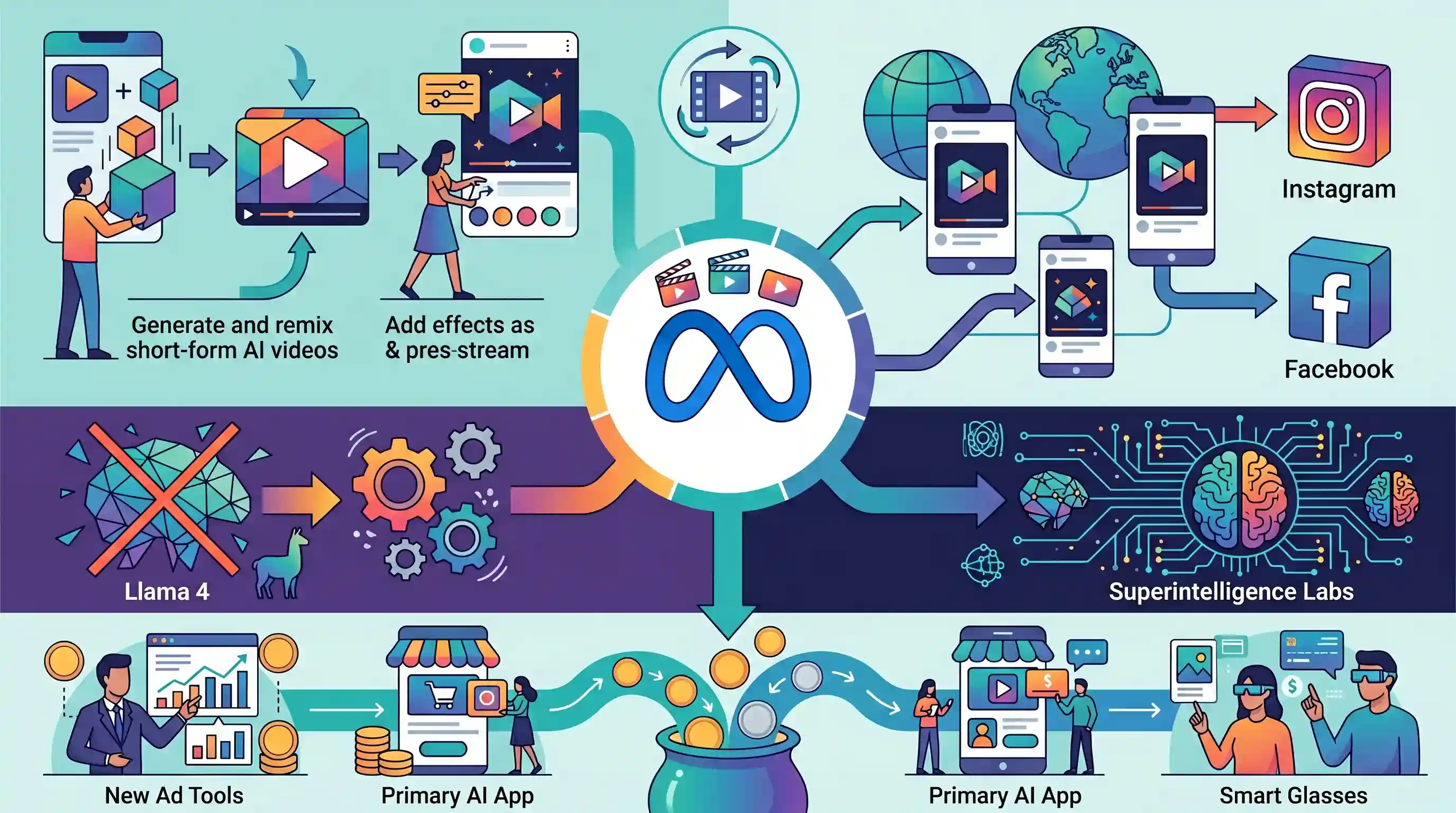
Meta has unveiled "Vibes," a new AI-powered video feed allowing users to create, remix, and share short-form, AI-generated videos. Integrated into the Meta AI app and website, Vibes content can also be cross-posted to Instagram and Facebook. The rollout follows Meta's June restructuring of its AI division into "Superintelligence Labs" after encountering challenges with its Llama 4 open-source model. The company aims to monetize these technological advancements through new ad tools, its primary AI app, and smart glasses.
Key Points
- Meta has launched 'Vibes', a new feed and platform for creating, remixing, and sharing short-form, AI-generated videos.
- Vibes content can be natively cross-posted to Instagram and Facebook stories and reels.
- The launch follows Meta's recent internal restructuring, consolidating its AI division under 'Superintelligence Labs' after setbacks with its Llama 4 open-source model.
- Meta hopes these generative AI capabilities will drive new revenue streams via image-to-video ad tools, the Meta AI app, and smart glasses.
Important Terms
Meta AI

Meta's suite of artificial intelligence tools and assistants integrated across its platforms. It enables users to generate text, images, and videos, serving as a hub for the company's consumer-facing AI features.
UPSC context
GS-3: Science and Technology. Tests awareness of major technological ecosystems and their role in the digital transformation of social media.
Vibes
An AI-powered video feed within the Meta AI app where users create, remix, and share short-form videos generated entirely by artificial intelligence, competing with platforms like TikTok and YouTube Shorts.
UPSC context
GS-3: Emerging Technologies. Relevant for understanding the shift toward synthetic media and its impact on content creation and misinformation.
Superintelligence Labs
A specialized division at Meta focused on advanced AI research, infrastructure, and products. It was recently restructured into four groups to accelerate the pursuit of superintelligence and product development.
UPSC context
GS-3: Science and Technology. Illustrates corporate R&D structures and the competitive landscape of global AI development.
Generative AI
A category of artificial intelligence capable of creating new content, such as text, images, or videos, based on patterns learned from training data, rather than just analyzing existing information.
UPSC context
GS-3: IT and Computers. A core concept in modern technology papers; tests understanding of synthetic media and automation.
Llama 4
The upcoming iteration of Meta's Large Language Model (LLM) family. Meta follows an open-source approach with Llama, making the model weights available for researchers and developers to build upon.
UPSC context
GS-3: IT and Computers. Relevant for discussing open-source vs. proprietary AI development and its implications for digital sovereignty.
Artificial General Intelligence (AGI)
A theoretical form of AI that possesses the ability to understand, learn, and apply knowledge across a wide range of tasks at a human or superhuman level.
UPSC context
GS-3: Science and Technology. Tests foresight on the evolution of AI and the long-term ethical and socio-economic risks.
Prelims Trap
Open-source AI models require companies to make all their underlying training datasets completely public.
UPSC traps confuse open-source software with open-source AI. 'Open-source' in AI usually means the model's weights are available, but training datasets remain proprietary.
Static Concepts Connected
What differentiates open-source AI models from proprietary AI models?
- Open Weights: Developers can download, modify, and run the model's weights and architecture locally (e.g., Meta's Llama series).
- Proprietary Data: Even in open-source AI, the original training datasets are rarely disclosed fully due to copyright, privacy, and competitive concerns.
- Closed Models: Proprietary models (like OpenAI's GPT-4) only allow access via APIs, keeping both the internal weights and training data completely hidden.
How does the DPDP Act 2023 impact AI data scraping in India?
- Purpose Limitation: Platforms cannot use user data collected for a specific purpose (like social networking) to train AI models without explicit, affirmative consent.
- Public Data Exemption: Personal data voluntarily made publicly available by users falls outside the Act's protection, potentially creating a legal loophole for AI web scrapers.
Cross-Topic Patterns
Deepfakes & Internal Security (GS3)
Accessible AI video-generation platforms lower the technical barrier for deepfakes, amplifying 'cognitive warfare' and enabling non-state actors to weaponize social media.
AI Monetization & Competition Law
Big Tech's bundling of generative AI tools into existing dominant platforms (Instagram, Facebook) is triggering antitrust scrutiny worldwide regarding unfair market concentration.

Expect a 2026 Prelims question contrasting open-source AI models with proprietary ones, paired with DPDP Act consent provisions.
Linked PYQs · 3
Linked PYQs · 3
- 2023MainsGS3
Introduce the concept of Artificial Intelligence (AI). How does Al help clinical diagnosis? Do you perceive any threat to privacy of the individual in the use of Al in healthcare?
- 2024MainsGS3
Social media and encrypting messaging services pose a serious security challenge. What measures have been adopted at various levels to address the security implications of social media? Also suggest any other remedies to address the problem.
- 2020PrelimsGS1
With the present state of development, Artificial Intelligence can effectively do which of the following? 1. Bring down electricity consumption in industrial units 2. Create meaningful short stories and songs 3. Disease diagnosis 4. Text-to-Speech Conversion 5. Wireless transmission of electrical energy Select the correct answer using the code given below:
