Meta Faces Legal Action Over AI Data Scraping
Source:The Hindu ↗
Why It Matters
As Artificial Intelligence systems require massive amounts of data for training, the tension between technological innovation and data privacy has become a major governance issue. For UPSC aspirants, this highlights the practical challenges of implementing data protection laws (like the EU's GDPR or India's DPDP Act, 2023) and the ethical dilemmas surrounding AI, which are highly relevant for GS Paper 2 (Polity/Governance) and GS Paper 3 (Science & Tech).
Summary
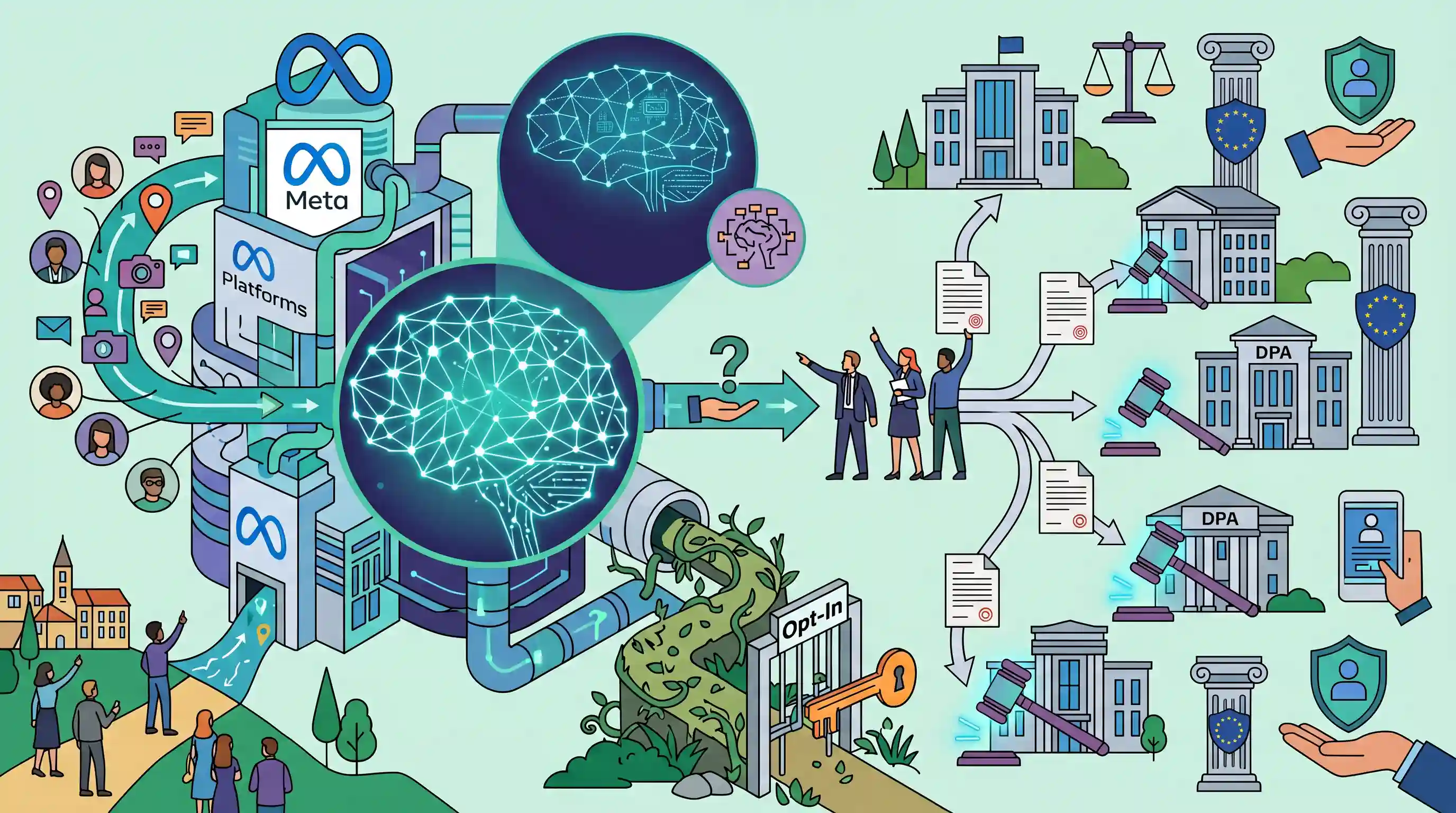
Austrian privacy advocacy group NOYB has initiated legal action against Meta Platforms, seeking injunctions over the tech giant's plans to use European users' personal data for training its Artificial Intelligence (AI) models. Meta intends to use data without securing explicit opt-in consent, citing "legitimate interest" as its legal basis. NOYB argues that this approach violates the General Data Protection Regulation (GDPR) and that opting out is overly complicated for users. The advocacy group has filed complaints across 11 countries, demanding intervention by Data Protection Authorities. This legal challenge underscores the growing global conflict between large technology corporations' demand for vast datasets to build AI systems and individuals' fundamental right to digital privacy.
Key Points
- Meta faces potential legal injunctions in Europe over its plans to use users' personal data to train Artificial Intelligence models without securing explicit opt-in consent.
- Austrian privacy advocacy group NOYB has filed complaints in 11 European countries, urging Data Protection Authorities to halt Meta's data scraping plans.
- Meta claims a legitimate interest in using the data to develop AI, which bypasses the need for users to actively opt in, instead offering an opt-out mechanism.
- Privacy advocates argue the opt-out process is deliberately complicated and that explicit consent is required under the GDPR for such extensive data usage.
- The conflict highlights a critical global regulatory challenge: balancing rapid AI innovation with the fundamental right to digital privacy and personal data protection.
Important Terms
General Data Protection Regulation (GDPR)

A comprehensive EU regulation governing data protection and privacy. It grants individuals control over their personal data and harmonizes laws across the European Union, serving as a global benchmark for privacy legislation.
UPSC context
GS Paper II & III; vital for comparing international privacy frameworks with India’s Digital Personal Data Protection (DPDP) Act, 2023.
Legitimate Interest
A legal basis under Article 6 of the GDPR allowing data processing without explicit consent if the controller's interest is valid and does not override the individual's fundamental rights.
UPSC context
GS Paper II (Governance); highlights a key legal divergence as India’s DPDP Act lacks this flexible private-sector provision.
European Data Protection Board (EDPB)
An independent European body that ensures the consistent application of data protection rules (GDPR) across the EU and mediates disputes between national data protection authorities.
UPSC context
GS Paper II (International Institutions); relevant for studying global regulatory architectures and enforcement of digital rights.
NOYB (None of Your Business)
A Vienna-based non-profit (None of Your Business) that uses strategic litigation to enforce privacy rights and hold technology companies accountable under European data protection laws.
UPSC context
GS Paper II (Civil Society); demonstrates the role of NGOs in upholding fundamental rights against large technology corporations.
EU Collective Redress Directive
An EU directive allowing 'qualified entities' to bring representative legal actions on behalf of groups of consumers who have suffered common infringements of their rights.
UPSC context
GS Paper II; important for understanding collective justice mechanisms and legal standing in mass-harm digital privacy cases.
Prelims Trap
"Under India's DPDP Act 2023, Data Fiduciaries must obtain explicit consent for all forms of personal data processing without exception."
The DPDP Act 2023 includes several exemptions under "Certain Legitimate Uses" (e.g., medical emergencies, state subsidies, employment purposes) where explicit consent is not required.
Static Concepts Connected
What are the core pillars of India's Digital Personal Data Protection (DPDP) Act, 2023?
- Data Principal & Fiduciary: Defines the individual whose data is collected (Principal) and the entity determining the purpose and means of data processing (Fiduciary).
- Legitimate Uses: Allows specific data processing without explicit consent for defined scenarios like state welfare provisions, legal compliance, and medical emergencies.
- Data Protection Board: Establishes the Data Protection Board of India (DPBI) to act as an independent adjudicatory body for grievance redressal and penalizing breaches.
How is the Right to Privacy constitutionally protected in India?
- Puttaswamy Judgment (2017): A 9-judge bench declared the Right to Privacy as a fundamental right intrinsic to life and liberty under Article 21 of the Constitution.
- Reasonable Restrictions: Privacy is not absolute; state restrictions must pass a triple test: legality (existence of law), legitimate state aim, and proportionality.
Cross-Topic Patterns
AI data scraping vs. Copyright Law
The unauthorized harvesting of public data to train Large Language Models connects fundamental privacy rights with Intellectual Property Rights (IPR), heavily testing the traditional boundaries of the "fair use" doctrine.
GDPR extraterritoriality & India's IT sector
The EU's GDPR acts as a global standard (the 'Brussels Effect'), deeply influencing both the foundational architecture of India's DPDP Act and the international compliance requirements for Indian IT exporters.

A question contrasting 'explicit consent' with exemptions for 'certain legitimate uses' under India's DPDP Act is highly likely in 2026.
Linked PYQs · 4
Linked PYQs · 4
- 2024MainsGS3
Describe the context and salient features of the Digital Personal Data Protection Act, 2023.
- 2023MainsGS3
Introduce the concept of Artificial Intelligence (AI). How does Al help clinical diagnosis? Do you perceive any threat to privacy of the individual in the use of Al in healthcare?
- 2018MainsGS3
Data security has assumed significant importance in the digitized world due to rising cyber crimes. The Justice B. N. Srikrishna Committee Report addresses issues related to data security. What, in your view, are the strengths and weaknesses of the Report relating to protection of personal data in cyber space?
- 2017MainsGS2
Examine the scope of Fundamental Rights in the light of the latest judgement of the Supreme Court on Right to Privacy.
