Meta Teen Accounts Expansion and Children Online Safety Rules
Source:Indian Express ↗
Why It Matters
The expansion of parental controls and default privacy settings by global tech giants highlights the escalating international consensus on regulating children's online safety. For UPSC aspirants, this illustrates the practical implications of data protection frameworks and provides global comparatives (like KOSA) for India's own initiatives, such as the DPDP Act and NCPCR interventions regarding minors in the digital era.
Summary
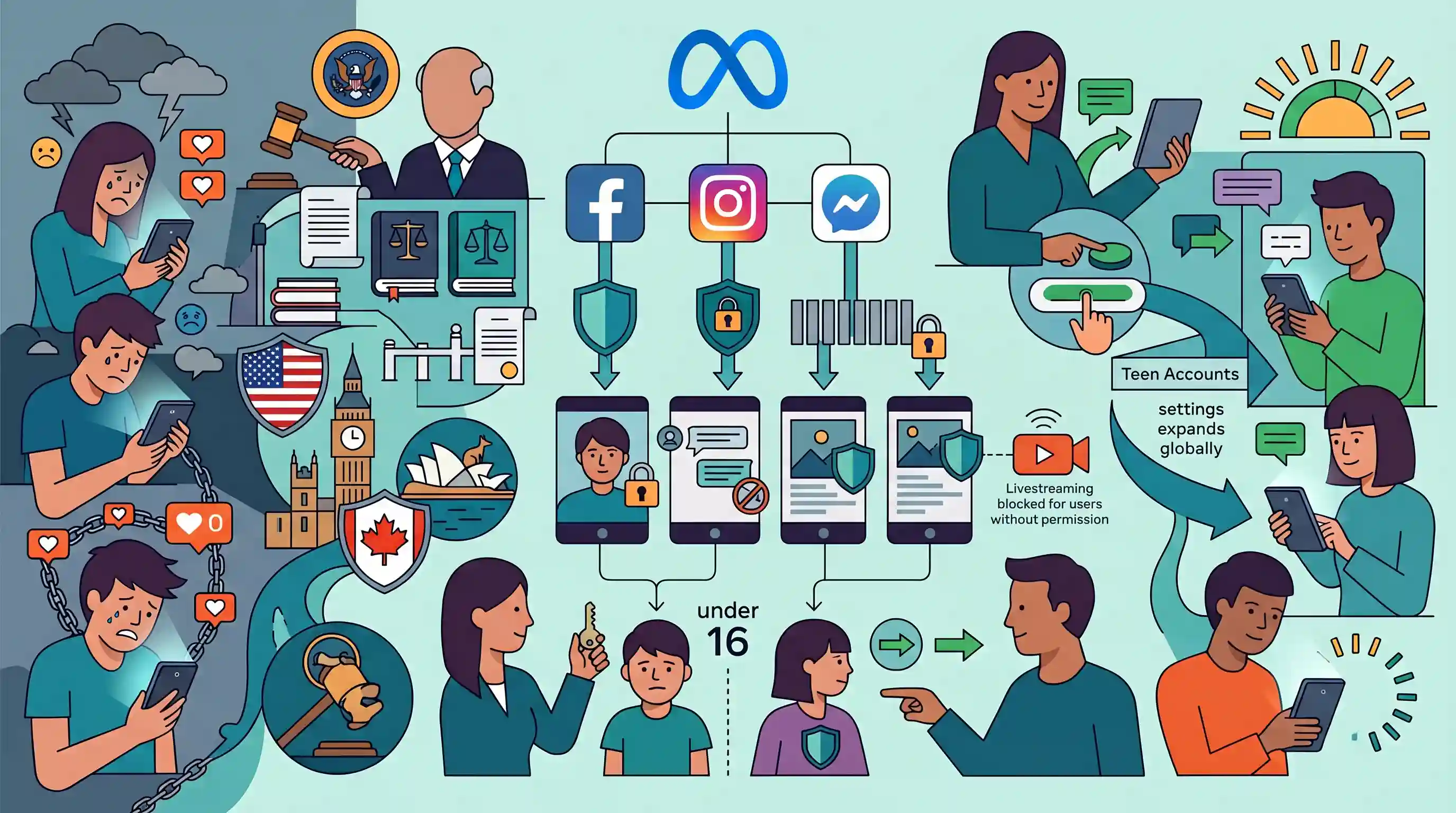
Meta is expanding its 'Teen Accounts' settings—initially introduced on Instagram—to Facebook and Messenger across the US, UK, Canada, and Australia. These accounts enforce restrictive defaults on messaging, sensitive content, and privacy for users under 18. Notably, children under 16 will require explicit parental consent to bypass these restrictions, such as to host live streams or disable anti-nudity image blurring. This development follows intense regulatory scrutiny and state-led lawsuits regarding social media addiction and its impact on youth mental health. Lawmakers globally are aggressively pushing for robust online guardrails, evident in legislations like the US Kids Online Safety Act (KOSA), the UK's Online Safety Act, and Australia's impending social media age limits.
Key Points
- Meta is expanding its restrictive 'Teen Accounts' to Facebook and Messenger, applying strict default settings for underage users.
- Users under 16 must obtain explicit parental permission via a supervision dashboard to alter settings, go Live, or disable nudity-blurring features.
- The expansion responds to growing global regulatory pressure, including laws like the US Kids Online Safety Act (KOSA) and the UK Online Safety Act.
- Social media giants are facing numerous lawsuits from state attorneys general regarding youth mental health harms and platform addiction.
- This global regulatory push mirrors India's own concerns over children's online safety, as seen in the verifiable parental consent provisions of the DPDP Act and the mandate of the NCPCR.
Important Terms
Kids Online Safety Act (KOSA)

A bipartisan U.S. bill mandating a "duty of care" for platforms to protect minors from harms like addiction and suicide. It requires default high-privacy settings and robust parental supervision tools.
UPSC context
GS Paper 2 (Governance/International Relations). Useful for comparative analysis of global child safety and data privacy legislations.
Online Safety Act (UK)
A landmark 2023 legislation regulated by Ofcom, requiring platforms to proactively remove illegal content and protect children from harmful material like self-harm and cyberbullying. It carries significant financial penalties for non-compliance.
UPSC context
GS Paper 2 (International Governance). Compares with India’s IT Rules and proposed Digital India Act on platform accountability.
Digital Personal Data Protection (DPDP) Act, 2023
India’s primary data privacy law requiring "verifiable parental consent" for processing data of users under 18. It prohibits targeted advertising, behavioral tracking, and harmful data processing of minors.
UPSC context
GS Paper 2 & 3 (Governance/Security). Core topic for data sovereignty, privacy rights, and child protection in India.
Duty of Care (Digital)
A legal obligation shifting the burden of safety from users to platforms. It requires tech companies to proactively identify and mitigate foreseeable risks, such as algorithmic harms or addictive designs.
UPSC context
GS Paper 3 (Cyber Security/Ethics). Crucial concept in discussions on intermediary liability and corporate accountability for online harms.
Age Assurance / Age Verification
Technical methods (such as facial analysis, ID checks, or credit card verification) used to determine a user's age. It is the primary mechanism for enforcing age-gated restrictions on digital platforms.
UPSC context
GS Paper 2 & 3. Tests understanding of the technical challenges and privacy trade-offs in implementing digital safety laws.
Social Media Minimum Age Act (Australia)
World-first legislation enacted in late 2024 that mandates a strict minimum age of 16 for social media access, holding platforms—rather than parents—responsible for enforcement under heavy fines.
UPSC context
GS Paper 2 (Policy/Global Trends). Relevant for the debate on "age-gating" vs. "consent-gating" in digital governance.
Prelims Trap
"Under the DPDP Act, platforms can serve targeted advertisements to minors if they obtain verifiable parental consent."
Aspirants often assume parental consent permits all data usage. However, Section 9 of the DPDP Act completely prohibits targeted advertising and behavioral monitoring of minors, regardless of parental consent.
Static Concepts Connected
How does India's DPDP Act 2023 regulate children's digital privacy?
- Verifiable Consent: Data fiduciaries must obtain explicit, verifiable consent from a parent or lawful guardian before processing the personal data of anyone under 18 years of age.
- Total Prohibition: The Act strictly prohibits tracking, behavioral monitoring, and targeted advertising directed at children, aiming to curb digital addiction.
- Government Exemptions: The Central Government may lower the age of consent or exempt certain platforms if their data processing practices are deemed 'verifiably safe' for children.
What role does the NCPCR play in protecting children online?
- Statutory Mandate: Established under the CPCR Act 2005, it ensures child rights extend to digital spaces, addressing modern threats like tech addiction and online exploitation.
- Grievance Redressal: The Commission utilizes mechanisms like the e-Baal Nidan portal to directly receive, track, and act on complaints regarding child rights violations in the cyber domain.
Cross-Topic Patterns
DPDP Act + Global 'Duty of Care'
The UK Online Safety Act and India's DPDP Act signal a shift from tech self-regulation to statutory 'safety by design' and strict algorithmic accountability.
Algorithms + Youth Mental Health
GS-2 often intersects technology with social issues. The psychological impact of engagement-maximizing algorithms on children's socialization is prime Mains essay material.

Expect a 2026 Prelims statement testing the DPDP Act's absolute ban on targeted ads for minors, even with verifiable parental consent.
Linked PYQs · 3
Linked PYQs · 3
- 2025MainsGS2
The National Commission for Protection of Child Rights has to address the challenges faced by children in the digital era. Examine the existing policies and suggest measures the Commission can initiate to tackle the issue.
- 2023MainsGS1
Child cuddling is now being replaced by mobile phones. Discuss its impact on the socialization of children.
- 2024MainsGS3
Social media and encrypting messaging services pose a serious security challenge. What measures have been adopted at various levels to address the security implications of social media? Also suggest any other remedies to address the problem.
