Meta Delays Generative AI Model Rollout Due to Performance Gaps
Source:The Hindu ↗
Why It Matters
The article is relevant for UPSC aspirants as it touches upon the rapid advancements and intense corporate race in Artificial Intelligence, including the pursuit of AGI (Artificial General Intelligence). It also highlights critical internal security and ethical issues related to AI, such as the proliferation of deepfakes and the misuse of social media platforms, which are frequent themes in GS Paper 3.
Summary
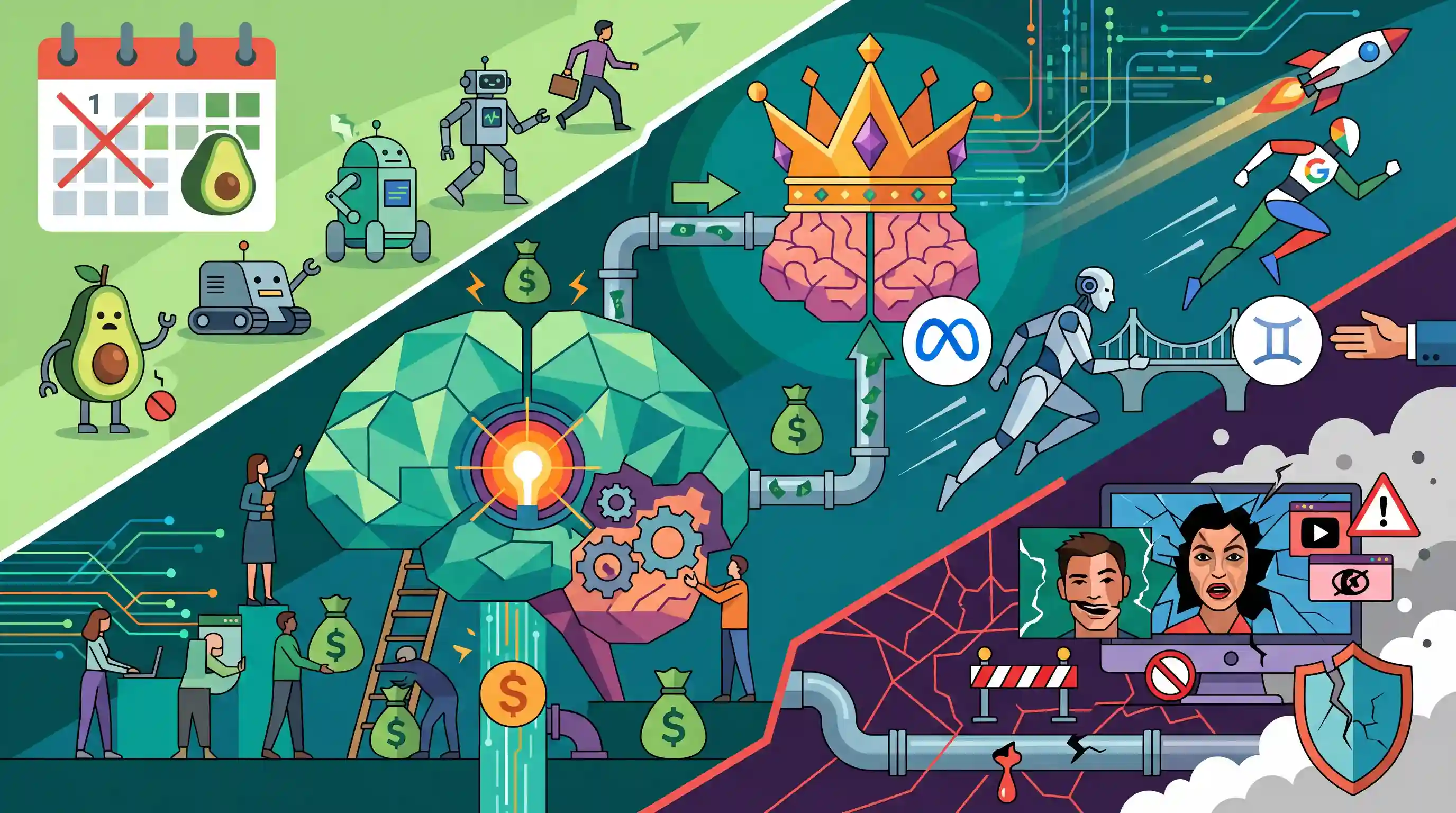
Meta has postponed the release of its new, highly anticipated AI model, code-named 'Avocado', from the first quarter to at least May 2026, as the model's performance has fallen short of competitor offerings. The company is injecting massive capital into AI development in pursuit of 'superintelligence' or AGI. However, its current AI tools have been criticized for generating deepfakes and explicit content, highlighting the ongoing regulatory and ethical challenges of rapid AI advancement. The fierce competition in the AI sector may even prompt Meta to temporarily license Google's Gemini model.
Key Points
- Meta has delayed the launch of its new AI model, code-named 'Avocado', to at least May 2026 due to performance lagging behind rival models.
- The company is investing heavily in AI infrastructure, allocating between $115 billion and $135 billion, with the ultimate goal of achieving Artificial General Intelligence (AGI) or 'superintelligence'.
- The delay highlights the intense corporate competition in the generative AI space, leading Meta to consider licensing Google's Gemini to power its AI products in the interim.
- Meta's existing AI features, such as 'Vibes', have faced criticism for flooding social media platforms with explicit deepfakes and inappropriate content, raising severe regulatory and security concerns regarding AI misuse.
Important Terms
Artificial General Intelligence (AGI)

Hypothetical AI capable of performing any intellectual task a human can, involving reasoning, abstract thinking, and learning from new experiences without task-specific training.
UPSC context
GS Paper III (Science & Tech); tests understanding of advanced AI frontiers and future technological impacts.
Deepfakes
AI-generated synthetic media where a person's likeness is replaced or manipulated to appear real, often using Generative Adversarial Networks (GANs) to spread misinformation.
UPSC context
GS Paper III (Internal Security); tests awareness of cyber threats and challenges to social cohesion.
Generative AI
A branch of AI focused on creating original content—including text, images, and code—by learning patterns from massive existing datasets.
UPSC context
GS Paper III (Science & Tech); tests knowledge of current IT developments and their socio-economic applications.
AI Ethics
Principles ensuring AI is developed responsibly, addressing critical dilemmas like algorithmic bias, data privacy, human oversight, and accountability.
UPSC context
GS Paper IV (Ethics); tests ability to evaluate moral implications of emerging technologies.
Large Language Models (LLMs)
AI systems trained on vast datasets to understand and generate natural language; they serve as the foundation for modern chatbots and reasoning tools.
UPSC context
GS Paper III (S&T); focuses on the mechanics and applications of foundational AI technology.
Information Technology (IT) Rules, 2021
Regulatory framework under the IT Act, 2000, that mandates social media intermediaries to identify originators of harmful content and remove deepfakes.
UPSC context
GS Paper II (Governance); tests knowledge of statutory regulations managing digital platforms.
Prelims Trap
Frontier models like Google Gemini and Meta Avocado are examples of Artificial General Intelligence (AGI).
Current advanced models are Generative AI (which falls under Narrow/Weak AI). AGI is a theoretical concept where AI equals or surpasses human intellect.
Static Concepts Connected
How does Generative AI differ from Artificial General Intelligence (AGI)?
- Generative AI: A subset of machine learning that creates new data (text, images) based on trained patterns. It remains a form of 'Narrow AI' limited to specific tasks.
- AGI (Superintelligence): A theoretical stage of AI capable of understanding, learning, and applying intelligence to solve any problem a human can, without domain-specific training.
How does Indian law regulate deepfakes and intermediary liability?
- Section 79 (IT Act): Provides 'safe harbour' immunity to social media intermediaries against user-generated content, provided they observe prescribed due diligence.
- IT Rules 2021: Requires platforms to remove explicit or non-consensual deepfake content within 24 hours of receiving a complaint to maintain their safe harbour status.
Cross-Topic Patterns
AI Oligopolies & Digital Sovereignty
The massive capital required for AGI restricts development to a few Western tech giants, amplifying concerns over data colonization and necessitating sovereign initiatives like the IndiaAI Mission.
Deepfakes as Cognitive Warfare
The misuse of commercial GenAI to flood platforms with synthetic explicit content links corporate tech developments directly to internal security and electoral integrity challenges.

Expect a 2026 Prelims statement differentiating AGI from Narrow AI, or a Mains question on whether IT Rules 2021 can handle deepfakes.
Linked PYQs · 5
Linked PYQs · 5
- 2023MainsGS3
Introduce the concept of Artificial Intelligence (AI). How does Al help clinical diagnosis? Do you perceive any threat to privacy of the individual in the use of Al in healthcare?
- 2024MainsGS3
Social media and encrypting messaging services pose a serious security challenge. What measures have been adopted at various levels to address the security implications of social media? Also suggest any other remedies to address the problem.
- 2024PrelimsGS1
Consider the following statements: I. It is expected that Majorana 1 chip will enable quantum computing. II. Majorana 1 chip has been introduced by Amazon Web Services (AWS). III. Deep learning is a subset of machine learning. Which of the statements given above are correct?
- 2020PrelimsGS1
With the present state of development, Artificial Intelligence can effectively do which of the following? 1. Bring down electricity consumption in industrial units 2. Create meaningful short stories and songs 3. Disease diagnosis 4. Text-to-Speech Conversion 5. Wireless transmission of electrical energy Select the correct answer using the code given below:
- 2020MainsGS3
Discuss different types of cyber crimes and measures required to be taken to fight the menace.
