Mass Adoption and Governance Challenges of Meta AI
Source:The Hindu ↗
Why It Matters
The mass adoption of Generative AI on ubiquitous platforms like WhatsApp and Instagram fundamentally alters the digital landscape. For UPSC aspirants, this highlights the urgent need for regulatory frameworks to address AI-driven misinformation, deepfakes, and data privacy, which are critical themes in GS Paper 3 (Science & Technology and Internal Security).
Summary
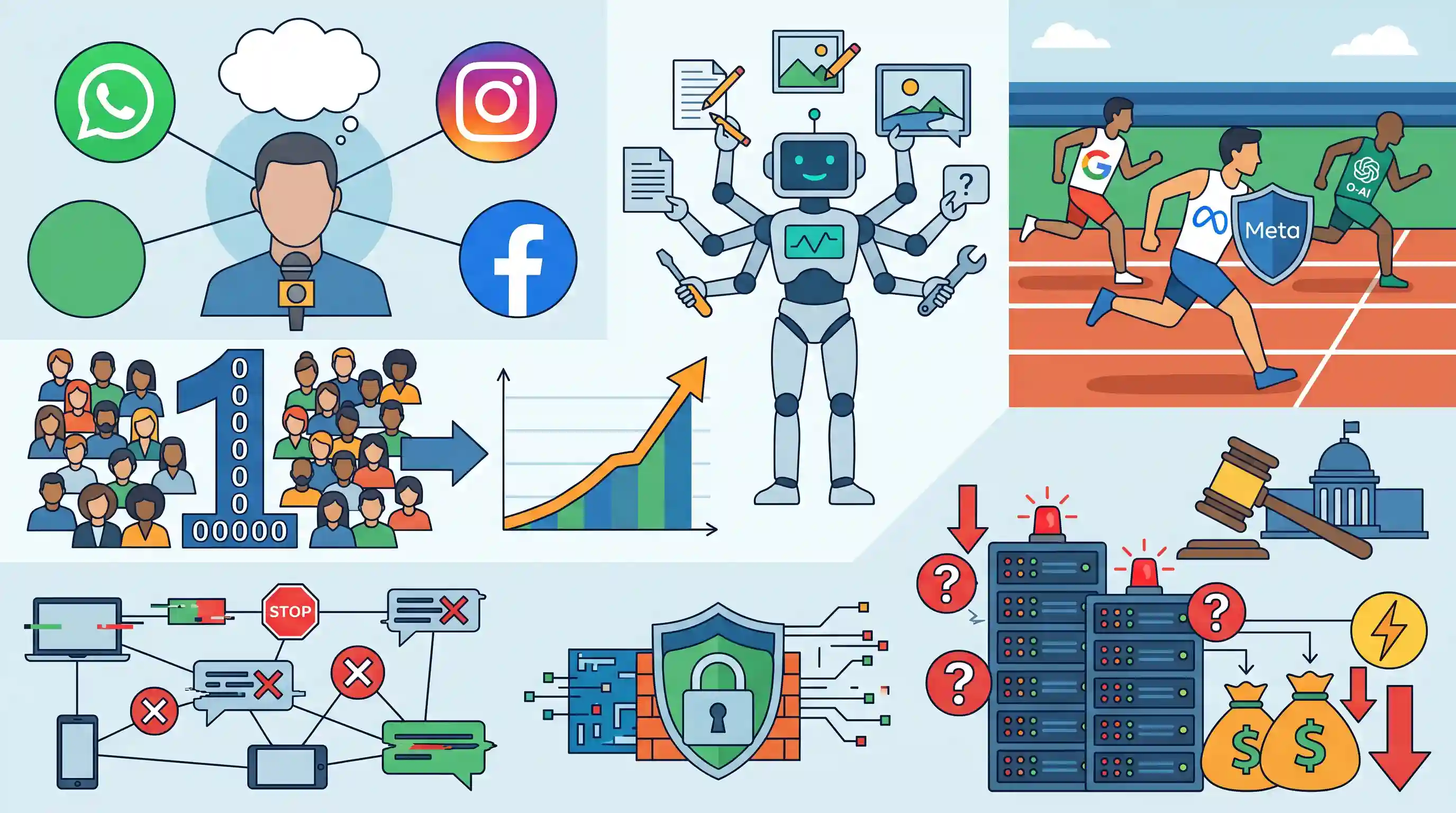
Mark Zuckerberg has announced that the Meta AI assistant has reached over 1 billion monthly active users across platforms such as WhatsApp, Instagram, and Facebook. This milestone highlights the massive scale and rapid adoption of generative AI technologies, placing Meta in tight competition with rivals like Google and Microsoft-backed OpenAI. However, the swift rollout of these AI tools across major digital platforms continues to raise concerns regarding their potential to spread misinformation and the lack of established monetization strategies for the computationally expensive technology.
Key Points
- Meta AI assistant has crossed 1 billion monthly active users across WhatsApp, Instagram, and Facebook.
- Meta's AI adoption rate competes directly with Google's AI Overviews (1.5 billion users) and Gemini (over 400 million monthly users).
- The rapid scaling of Generative AI applications has outpaced the establishment of clear business models and robust safeguards against misinformation.
- The widespread deployment of AI on social media platforms raises governance and regulatory concerns regarding deepfakes and automated content moderation.
Important Terms
Generative AI

A branch of AI capable of creating original content—such as text, images, and code—by learning patterns from existing data, rather than merely identifying or categorizing it.
UPSC context
GS-3 (Science & Technology); focuses on emerging technologies, industrial applications, and socio-economic challenges.
Meta Platforms Inc.
The US-based multinational tech conglomerate owning Facebook, Instagram, and WhatsApp. It is leveraging its massive user base to scale "Meta AI" across its global communication platforms.
UPSC context
GS-3 (Science & Technology/Economy); tests knowledge of global tech dominance and its impact on the digital landscape.
OpenAI
An AI research and deployment company that popularized generative AI through ChatGPT. It operates under a "capped-profit" structure to fund capital-intensive development of advanced AI models.
UPSC context
GS-3 (Science & Technology); highlights the role of private innovation in setting global technological standards and AI benchmarks.
Misinformation
False or inaccurate information shared without a deliberate intent to deceive. It is a critical challenge for platforms, distinguished from "disinformation," which involves intentional deception.
UPSC context
GS-2 (Governance) and GS-3 (Security); relevant to social media regulation and information integrity.
Digital Governance
The framework of rules and technological systems used to manage the digital ecosystem, balancing innovation with ethics, accountability, and the protection of constitutional rights.
UPSC context
GS-2 (Governance); essential for understanding "Minimum Government, Maximum Governance" and regulation of disruptive technologies.
Large Language Models (LLM)
Advanced AI systems trained on massive datasets to understand and generate human-like text. They form the foundation of most modern conversational AI assistants like GPT-4 and Llama.
UPSC context
GS-3 (Science & Technology); tests technical awareness of the infrastructure driving the AI revolution.
Prelims Trap
"Generative Adversarial Networks (GANs) are the primary architecture used for text generation in large language models."
GANs are primarily used to generate synthetic visual or audio media (deepfakes). Text-based AI assistants (LLMs like Meta AI) rely on Transformer neural network architectures, not GANs.
Static Concepts Connected
What are the core mechanisms behind Generative Adversarial Networks (GANs)?
- Two Networks: Consists of two neural networks: a 'Generator' that creates synthetic data and a 'Discriminator' that evaluates its authenticity.
- Adversarial Training: The networks compete against each other. The generator continuously improves its output until the discriminator can no longer distinguish fake from real data.
- Key Applications: They are the primary technology behind deepfakes, synthetic media, and voice cloning, posing severe challenges for digital forensics.
What is the 'Liar's Dividend' in the context of digital governance?
- Plausible Deniability: A phenomenon where malicious actors escape accountability by falsely claiming that genuine, incriminating digital evidence against them is merely an AI-generated deepfake.
- Epistemic Uncertainty: The widespread normalization of deepfakes undermines public trust in all digital media, severely complicating evidence admissibility in legal frameworks.
Cross-Topic Patterns
AI Regulation & the EU AI Act
The EU AI Act's risk-based categorization sets a global template for India's upcoming Digital India Act, focusing on algorithmic accountability and safeguards against AI-driven misinformation.
E2E Encryption vs. AI Data Scraping
Integrating AI into platforms like WhatsApp tests the legal boundaries between end-to-end encryption privacy guarantees and the continuous data harvesting required to train large language models.

Expect a 2026 prelims question distinguishing Generative AI architectures: GANs for deepfakes vs Transformer models for text generation.
Linked PYQs · 3
Linked PYQs · 3
- 2023MainsGS3
Introduce the concept of Artificial Intelligence (AI). How does Al help clinical diagnosis? Do you perceive any threat to privacy of the individual in the use of Al in healthcare?
- 2016MainsGS3
Use of Internet and social media by non-state actors for subversive activities is a major security concern. How have these been misused in the recent past? Suggest effective guidelines to curb the above threat.
- 2020PrelimsGS1
With the present state of development, Artificial Intelligence can effectively do which of the following? 1. Bring down electricity consumption in industrial units 2. Create meaningful short stories and songs 3. Disease diagnosis 4. Text-to-Speech Conversion 5. Wireless transmission of electrical energy Select the correct answer using the code given below:
