Weather office issues high alert as heavy downpours block highways
Source:The Hindu ↗
Why It Matters
This article highlights the recurring issues of extreme weather, landslides, and flash floods in Himachal Pradesh. For HPAS Prelims, understanding the state's geography, climatic zones, rainfall distribution, and vulnerability to natural disasters is a frequent focus, alongside knowledge of IMD weather alerts and their local impacts.
Summary
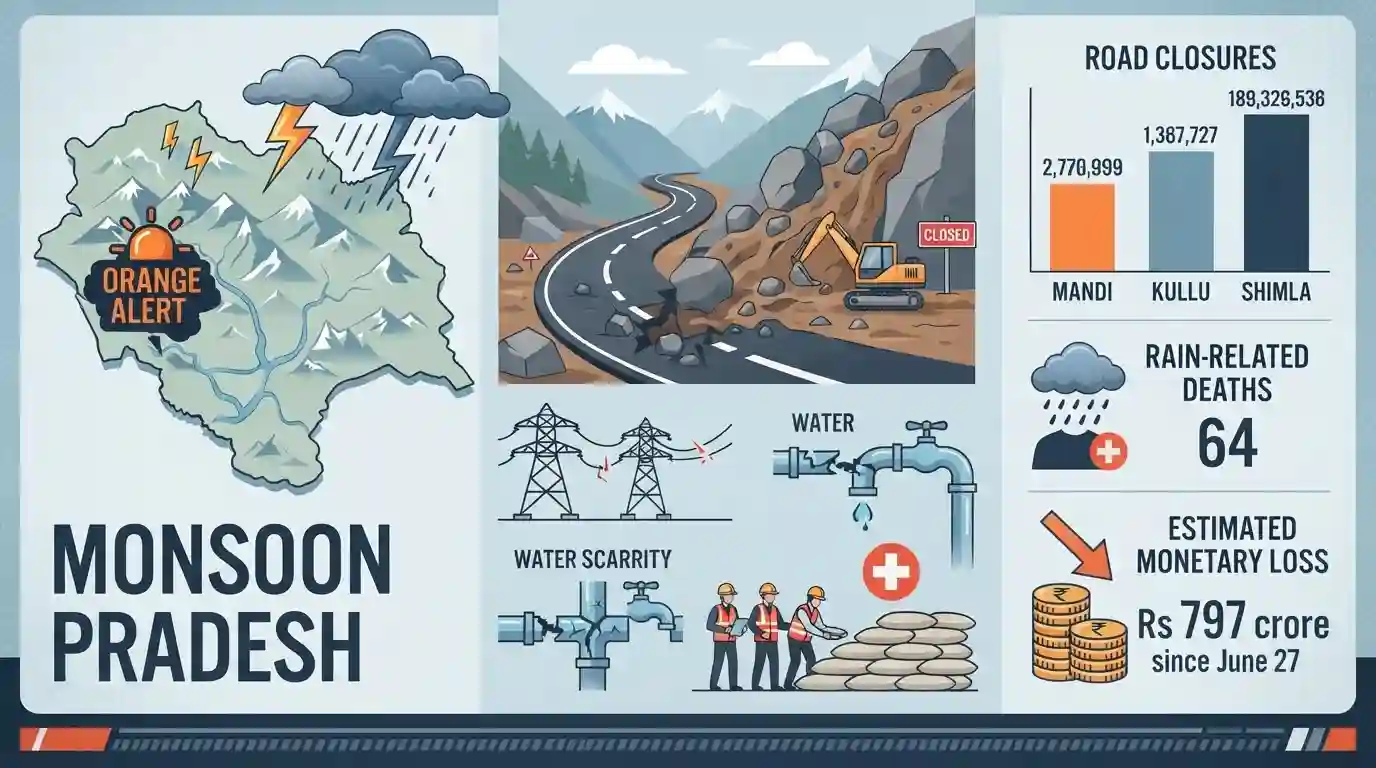
The Meteorological office in Himachal Pradesh issued an 'orange' alert, warning of heavy to very heavy rainfall, thunderstorms, and lightning. The ongoing active monsoon has severely impacted infrastructure, leading to the closure of 145 roads, predominantly in Mandi, Kullu, and Shimla districts. Additionally, electricity and water supply schemes have faced significant disruptions. The state has reported 64 rain-related deaths, primarily from landslides and flash floods, and suffered an estimated monetary loss of Rs 797 crore since the monsoon began on June 27. The situation highlights the region's acute vulnerability to extreme weather and geographical hazards.
Key Points
- The MeT office issued an 'orange' alert for heavy to very heavy rains across Himachal Pradesh, with ongoing active monsoon conditions.
- A total of 145 roads were closed due to weather conditions, with Mandi experiencing the maximum closures, followed by Kullu and Shimla.
- Heavy rains caused the disruption of 14 water supply schemes and 224 transformers across the state.
- Since the monsoon\'s onset, the state has witnessed 64 fatalities due to rain-related incidents like landslides and flash floods, and incurred economic losses amounting to Rs 797 crore.
Important Terms
India Meteorological Department (IMD)

The nodal agency under the Ministry of Earth Sciences responsible for meteorological observations, weather forecasting, and issuing early warnings for climate-related hazards across India.
UPSC context
Crucial for GS 1 (Geography) and GS 3 (Disaster Management) to understand India's early warning systems and monsoon tracking.
State Emergency Operation Centre (SEOC)
A centralized 24/7 coordination hub at the state level that monitors emergency situations, disseminates warnings, and coordinates disaster response efforts among multiple state and national agencies.
UPSC context
Relevant for GS 3 (Disaster Management), testing knowledge of the institutional framework and crisis response mechanisms under the Disaster Management Act.
Orange Alert
A colour-coded weather warning issued by the IMD signaling authorities and the public to "be prepared" for severe weather that could cause significant disruptions or damage.
UPSC context
Key for GS 3 (Disaster Management), demonstrating practical knowledge of India’s graded risk communication and disaster preparedness protocols.
Meteorological Centre (MeT office)
Regional and state-level divisions of the IMD that provide localized weather forecasts, agrometeorological advisories, and specific hazard warnings directly to local administrations and the public.
UPSC context
Relates to GS 3 (Disaster Management). Important for understanding the decentralized nature of India's weather forecasting and local disaster risk reduction.
Flash Floods
Rapid and destructive inundations of water in low-lying areas or dry streams, typically triggered by intense, localized rainfall or cloudbursts within a very short duration.
UPSC context
Highly relevant for GS 1 and GS 3, frequently tested in the context of Himalayan states' vulnerability to climate extremes and natural hazards.
Prelims Trap
"An \'Orange\' alert issued by the IMD means citizens and authorities must take immediate action and evacuate."
\'Orange\' strictly means "Be prepared" for disruptions. The mandate to "Take immediate action" is designated solely for \'Red\' alerts. Aspirants often confuse these tiers.
Static Concepts Connected
Why are the Himalayas more prone to landslides than the Western Ghats?
- Young Fold Mountains: The Himalayas consist of immature, easily erodible sedimentary rocks lacking solid consolidation compared to the hard shield rocks of the Western Ghats.
- Tectonic Instability: Situated on an active continental collision zone, frequent seismic activity inherently destabilizes the steep Himalayan slopes.
- Glacial Action: Melting glaciers and rapid snowmelt during monsoons heavily saturate the unconsolidated soils, triggering massive mass wasting.
What meteorological phenomenon drives catastrophic extreme precipitation in the Western Himalayas?
- 2-System Interaction: Catastrophic rainfall often occurs when the active South-West monsoon trough collides and merges with moisture-laden mid-latitude Western Disturbances.
- Orographic Uplift: The towering Himalayan topography forces this combined moisture-heavy air to rise rapidly, causing intense, localized downpours often culminating in cloudbursts.
Cross-Topic Patterns
Infrastructure vs Himalayan Geology
Disaster reports frequently test alongside the \'Carrying Capacity\' debate, linking aggressive road expansion and hydropower tunneling to Himalayan slope destabilization.
Early Warning Systems (EWS)
IMD\'s color-coded alerts connect directly to Mains GS3 topics on Disaster Risk Reduction and the efficacy of last-mile communication in hilly terrains.

Expect a Prelims statement testing the exact IMD definition of a cloudburst (>100mm/hr) paired with Western Disturbance-Monsoon interaction.
Linked PYQs · 3
Linked PYQs · 3
- 2024HPAS_PRELIMSGS1
Arrange the following climatic zones of Himachal Pradesh according to rainfall amount from lowest to highest : (1) Frigid aridic zone (2) Wet temperate zone (3) Humid sub-tropical zone (4) Sub-humid sub-tropical zone Choose the correct answer from the options given below :
- 2023HPAS_PRELIMSGS1
Consider the following statements : (1) The rainiest district in Himachal Pradesh is Kangra. (2) Rainfall in the Alpine region of Himachal Pradesh varies between 300-600 mm. (3) Winter season in Himachal Pradesh extends from October to March. (4) Mandi is the hottest place in Himachal Pradesh. Choose the correct answer from the options given below :
- 2025HPAS_PRELIMSGS1
Match List I with List II : | List-I (Code) | List-II (District) | |---|---| | (a) Highest Rainfall (2018 Data) | (i) Shimla | | (b) Second Most Incidents Reported (2024 Crime Data) | (ii) Mandi | | (c) Fourth Highest Population (2011 Census) | (iii) Kangra | | (d) Fourth Largest Area | (iv) Solan | Choose the correct answer from the options given below : Code: (a) (b) (c) (d)
