Andhra Pradesh to Present Shining Star Awards to Meritorious Students
Source:The Hindu ↗
ఇది ఎందుకు ముఖ్యం
This scheme reflects the AP state government's targeted policy to incentivize secondary education while ensuring affirmative action and representation for marginalized communities and special-needs children. Questions on state-specific welfare initiatives, their beneficiaries, and monetary allocations are a staple in APPSC Group 1 Prelims.
సారాంశం
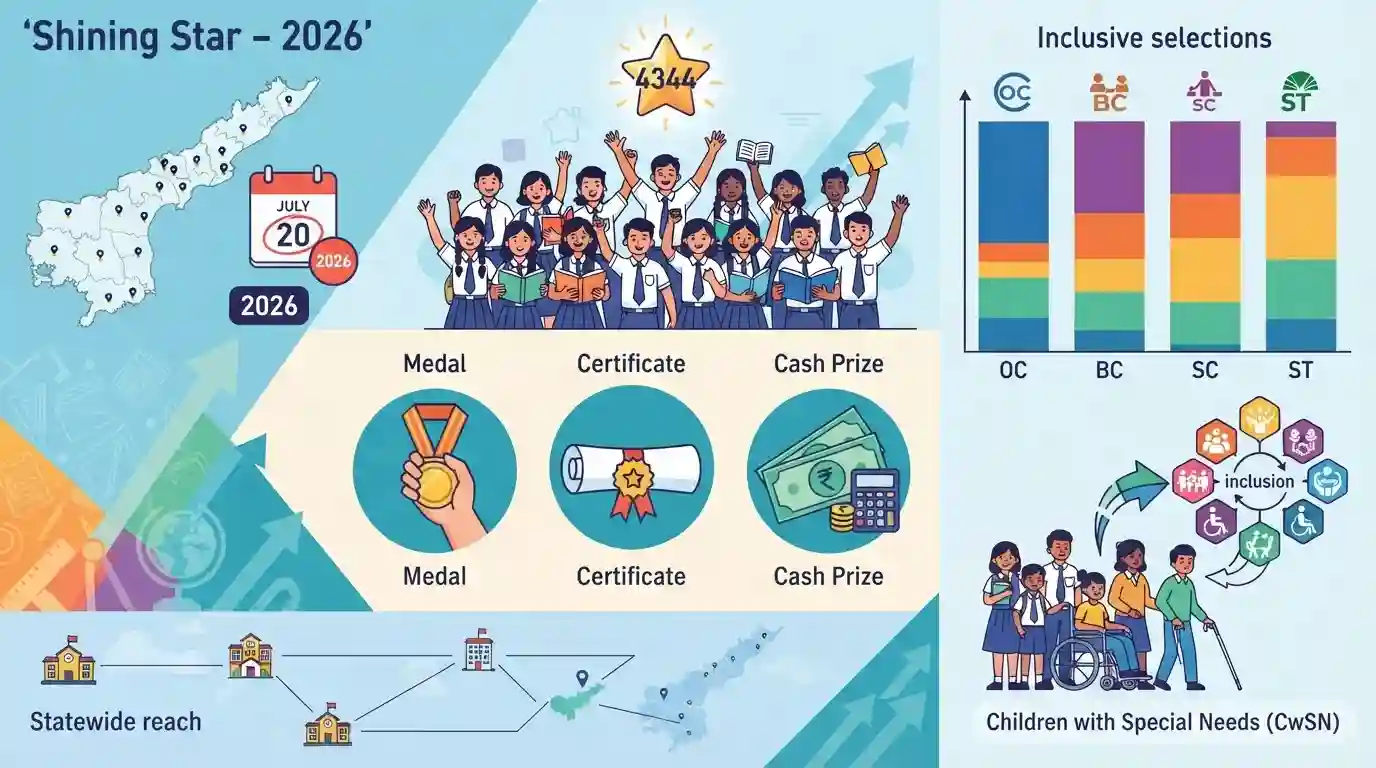
The Government of Andhra Pradesh is set to present the 'Shining Star – 2026' awards to 4,344 meritorious SSC (Class X) students across all 28 districts on July 20. The scheme aims to recognize academic excellence by awarding students with a medal, certificate, and a ₹20,000 cash prize. The merit-based selection enforces inclusivity by allocating specific quotas per mandal for OC, BC, SC, and ST categories, along with provisions for Children with Special Needs (CwSN) at the district level.
ముఖ్య అంశాలు
- The Andhra Pradesh government will honour 4,344 meritorious SSC (Class X) students with 'Shining Star - 2026' awards on July 20, 2026.
- The scheme, introduced in June 2025, provides each awardee with a medal, a certificate of appreciation, and a cash prize of ₹20,000.
- Girls constitute the majority of the selected students, accounting for 68.14% (2,960) against 31.86% (1,384) boys.
- Selections are made per mandal to ensure inclusivity: two students each from OC and BC categories, and one each from SC and ST categories, provided they scored at least 83.33%.
- Three Children with Special Needs (CwSN) scoring 70% or above are selected from each district.
ముఖ్యమైన పదాలు
Shining Star Awards Scheme

An Andhra Pradesh government initiative rewarding meritorious Class X students with a medal, certificate, and ₹20,000. It employs mandal-level quotas across social categories (OC, BC, SC, ST) to ensure inclusive recognition of academic excellence.
UPSC context
GS Paper 2 (Education/Welfare). Highlights state-led affirmative action in meritocratic educational interventions and promotion of social justice.
School Education Department, Andhra Pradesh
The state administrative body responsible for implementing educational policies, curricula, and welfare schemes—such as the Shining Star awards—across public and private schools in all 28 districts of Andhra Pradesh.
UPSC context
GS Paper 2 (Governance). Demonstrates the role of state departments in executing targeted educational interventions and ensuring grassroots policy delivery.
Children with Special Needs (CwSN)
A policy classification for students requiring adapted educational support due to physical or cognitive disabilities. The Shining Star scheme specifically reserves district-level quotas to appropriately recognize the academic achievements of these students.
UPSC context
GS Paper 2 (Vulnerable Sections). Relevant to inclusive education mandates and specific state welfare mechanisms designed for empowering persons with disabilities.
Mandal
An administrative and revenue tier used in Andhra Pradesh, positioned below a district. In the Shining Star scheme, mandals serve as the decentralized unit for allocating social category quotas for student awards.
UPSC context
GS Paper 2 (Local Administration). Highlights decentralized policy implementation and equitable distribution of welfare benefits at the sub-district governance level.
ప్రిలిమ్స్ ఉచ్చు
The AP Shining Star award is a targeted, means-tested financial aid program restricted only to students from government schools.
UPSC often tests if state/central incentive schemes are strictly means-tested or restricted to public schools. This scheme is income-neutral and open to both government and private school managements.
అనుసంధానమైన స్థిర భావనలు
What are the key constitutional provisions driving inclusive education and affirmative action in India?
- Article 15(4): Enables the State to make special provisions for the educational advancement of socially and educationally backward classes, SCs, and STs.
- Article 46: Directs the State to promote with special care the educational and economic interests of the weaker sections, protecting them from injustice.
- RPwD Act, 2016: Statutorily mandates reservations and relaxation of eligibility thresholds (e.g., lower cutoffs) in educational institutions for disabled students.
How does decentralization improve social justice delivery in welfare schemes?
- Sub-district targeting: Localizing beneficiary selection to mandals or blocks prevents urban bias, ensuring spatial equity and preventing resource hoarding by advanced districts.
- Granular inclusivity: Enforcing demographic quotas within small administrative units guarantees that marginalized groups in remote rural areas gain direct access to benefits.
అంతర-అంశ నమూనాలు
Gender parity vs. employment paradox
Female students securing 68.14% of merit awards highlights the "education-employment paradox" where rising academic achievement does not automatically translate into higher female labor force participation (FLFPR).
Qualified meritocracy in welfare
Combining merit thresholds with decentralized social quotas represents a policy shift toward "qualified meritocracy", balancing raw academic excellence with grassroots structural representation.

Mains 2026 may ask how sub-district targeting (mandal-level quotas) in educational incentives balances meritocracy with social justice.
అనుసంధాన PYQలు · 3
అనుసంధాన PYQలు · 3
- 2023APPSC_PRELIMSGS1
Government of Andhra Pradesh is implementing YSR Rythu Bharosa - PM Kisan Scheme for the benefit of farmers of Andhra Pradesh. Which of the following statements are correct about the above scheme ?
- 2024APPSC_PRELIMSGS1
Which of the following statements are valid regarding the interventions of the Government of Andhra Pradesh in the context of Healthcare ? I. Telemedicine facility is available in all Ayushman Bharat Health and Wellness Centres (AB-HWCs) to avail specialist services through district hub. II. The Family Doctor Programme has been planned to be implemented as a standalone project without the need to be integrated with Primary Health Centres (PHCs). III. Dr. YSR Aarogyasri Scheme has been revamped, by increasing the income limit from ₹ 2.5 lakh to ₹ 5 lakh per annum per family. IV. 'Aarogya Aasara' Scheme is intended to provide post-operative sustenance allowance with certain eligible conditions complied with. Select the correct answer using the codes given below :
- 2024APPSC_PRELIMSGS1
Which of the following statement/statements is/are valid regarding the socio-economic status of Andhra Pradesh ? I. Andhra Pradesh won the Best State Award of ICAR - National Research Center for Banana (NRCB) for export promotion. II. Andhra Pradesh GSDP growth rate has been registering a decline in recent times owing to repeated lower returns in certain sub-sectors of the Service Sector. III. For the FY 2024 - 25, the Revenue Deficit is budgeted higher than the Fiscal Deficit in terms of percentage of Andhra Pradesh GSDP. IV. The technology used by the Government of Andhra Pradesh while conducting resurvey of landholdings is referred to as 'Continuously Operating Reference Stations (CORS)' technology. Select the correct answer using the codes given below :
