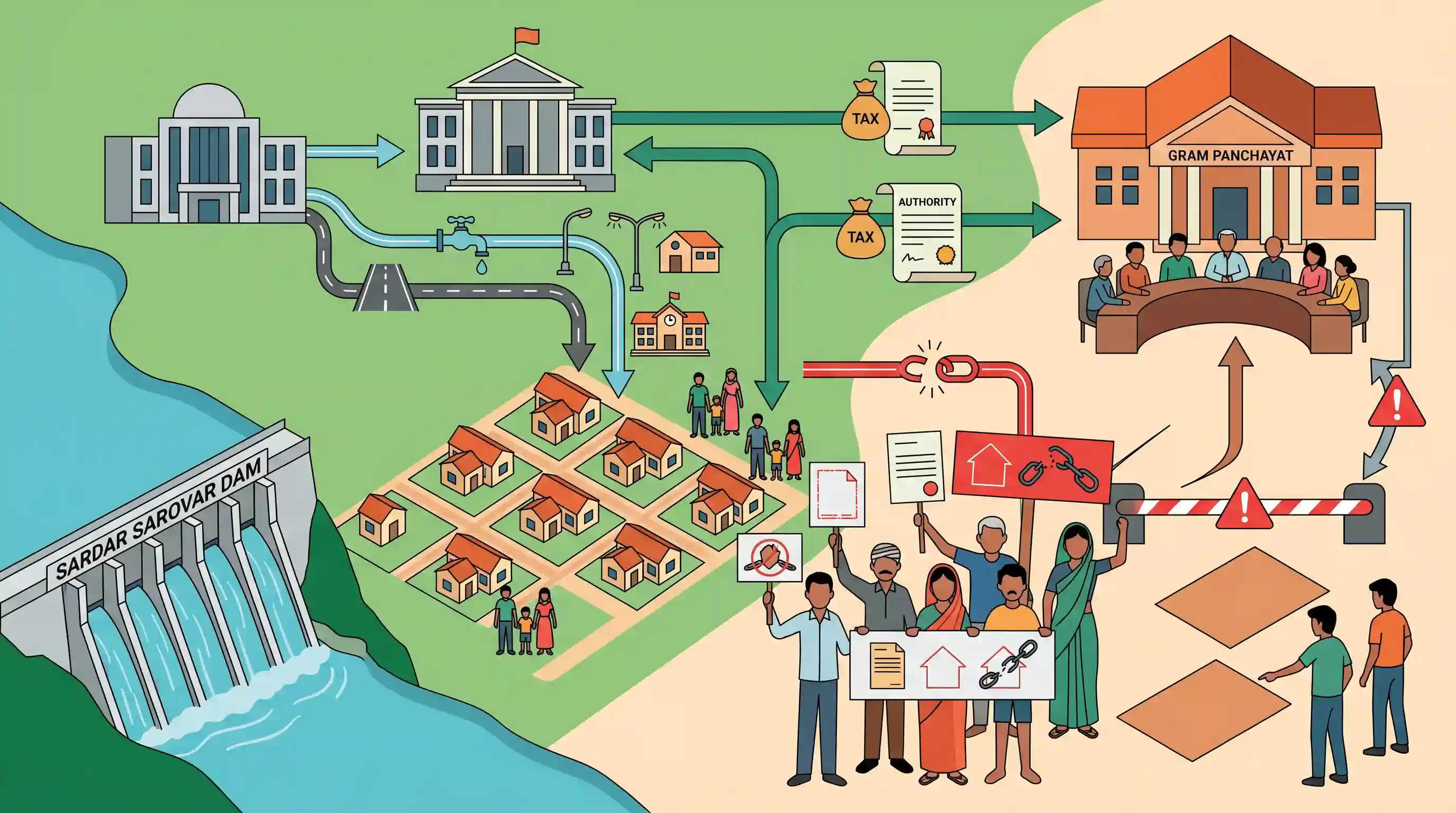
Integration of Dam Oustee Colonies into Gram Panchayats
Source:Indian Express ↗
Why It Matters
This development serves as a contemporary case study on the post-resettlement phase of large-scale infrastructure projects. It highlights the intersection of local governance (empowering gram panchayats via devolution of amenities and taxation) and the lingering socio-economic grievances of project-displaced communities.
Summary
The Gujarat government has passed a resolution finalizing the merger of 127 Narmada dam oustee colonies (vasahats) into local gram panchayats. Under the Gujarat Panchayats Act, 1993, local bodies will take over basic civic responsibilities and tax collection, whilst the Sardar Sarovar Punarvasat Agency (SSPA) hands over public infrastructure assets. However, displaced families have threatened protests against the merger, arguing that pending rehabilitation issues—including land allocation for 'major sons'—must be resolved before integrating these settlements into the standard local self-government framework.
Key Points
- The Gujarat government has finalised the policy to merge 127 'vasahats' (colonies of Narmada dam oustees) with local gram panchayats to provide them with basic civic amenities.
- Under the merger, gram panchayats will be empowered to collect taxes from these settlements, while taking over responsibilities like street lighting, water supply, roads, and drainage.
- The Sardar Sarovar Punarvasat Agency (SSPA) will retain ownership of unallocated plots but transfer ownership records of public infrastructure (like schools and health centers) to the panchayats.
- Many project-affected people oppose the merger, citing unfulfilled rehabilitation promises and demanding a revised cutoff date for allotting compensatory land to 'major sons' of displaced families.
Important Terms
Sardar Sarovar Project

A multipurpose concrete gravity dam on the Narmada River, providing irrigation, drinking water, and hydroelectric power to Gujarat, Madhya Pradesh, Maharashtra, and Rajasthan.
UPSC context
GS I (Geography) and GS III (Infrastructure); significant for understanding interstate water sharing and large-scale development-induced displacement.
Sardar Sarovar Punarvasat Agency (SSPA)
The specialized state body responsible for managing the resettlement and rehabilitation (R&R) of families displaced by the Sardar Sarovar Project in Gujarat.
UPSC context
GS II (Governance/Welfare); tests knowledge of institutional mechanisms for protecting project-affected persons (PAPs) and executing rehabilitation policies.
Gram Panchayat
The primary unit of rural local self-government at the village level, empowered by the 73rd Amendment to manage local civic duties, infrastructure, and welfare schemes.
UPSC context
GS II (Polity/Decentralization); fundamental to the study of Panchayati Raj Institutions (PRIs) and the devolution of administrative and financial powers.
Gujarat Panchayats Act, 1993
The state legislation that established Gujarat's three-tier Panchayati Raj structure (Village, Taluka, District) to fulfill the mandates of the 73rd Constitutional Amendment Act.
UPSC context
GS II (Local Self-Government); tests understanding of how states operationalize constitutional provisions for democratic decentralization.
Major Sons (R&R Entitlement)
A legal entitlement under the Narmada Water Disputes Tribunal (NWDT) where adult sons of oustees are treated as independent families for separate land and housing allocations.
UPSC context
GS II (Social Justice); critical for understanding specific legal nuances and human rights protections in rehabilitation and resettlement (R&R) laws.
Rehabilitation and Resettlement (R&R)
A policy framework to assist project-affected families through land-for-land compensation, housing, and livelihood support to restore their socio-economic status after forced displacement.
UPSC context
GS II (Welfare Schemes) and GS III (Environmental Impact); relevant for issues of social justice and the rights of tribal/marginalized communities.
Prelims Trap
"The Constitution explicitly mandates all Gram Panchayats to levy and collect local taxes to ensure financial autonomy."
Under Article 243H, empowering Panchayats to levy taxes is a voluntary provision, not mandatory. It is left entirely to the discretion of the State legislature.
Static Concepts Connected
How does the Constitution enable Gram Panchayats to manage basic civic amenities?
- Article 243G: State legislatures may endow Panchayats with powers to implement schemes for economic development and social justice, including subjects listed in the 11th Schedule.
- Article 243H: State legislatures may voluntarily authorize Panchayats to levy, collect, and appropriate local taxes, tolls, and fees to generate revenue.
- 11th Schedule: Lists 29 functional items, explicitly covering rural electrification, safe drinking water, roads, and community asset maintenance.
How does the LARR Act 2013 define a family for rehabilitation benefits?
- Core definition: Includes a person, his or her spouse, minor children, minor brothers, and minor sisters who are dependent on him.
- Adult dependents: An adult of either gender, whether married or unmarried (like a 'major son' or daughter), is considered a separate family for distinct rehabilitation entitlements.
Cross-Topic Patterns
Devolution vs. Rehabilitation Rights
The article highlights a recurring friction: states using local governance integration (Polity) to conclude administrative duties, while displaced communities leverage unfulfilled LARR resettlement clauses (Social Justice) to resist.
Tribal displacement and PESA contrast
Standard integration of displaced colonies into normal PRIs often contrasts with the autonomy, land alienation protections, and Gram Sabha empowerment required under the PESA Act for tribal rehabilitation.

Expect a 2026 question linking Art 243H voluntary tax powers with PRI integration of displaced communities or LARR provisions.
Linked PYQs · 3
Linked PYQs · 3
- 2025MainsGS1
Does tribal development in India centre around two axes, those of displacement and of rehabilitation? Give your opinion.
- 2022MainsGS2
To what extent, in your opinion, has the decentralisation of power in India changed the governance landscape at the grassroots?
- 2016MainsGS3
Rehabilitation of human settlements is one of the important environmental impacts which always attracts controversy while planning major projects. Discuss the measures to be adopted to mitigate the impact of the recent incidents of cloudbursts in many places of Uttarakhand.
