Supreme Court Review of Menstrual Hygiene Policy Response
Source:The Hindu ↗
हे का महत्त्वाचे आहे
It highlights judicial activism in public health, women's health rights, and the structural friction in implementing national welfare schemes across federal units due to apathy or non-responsiveness from State governments.
सारांश
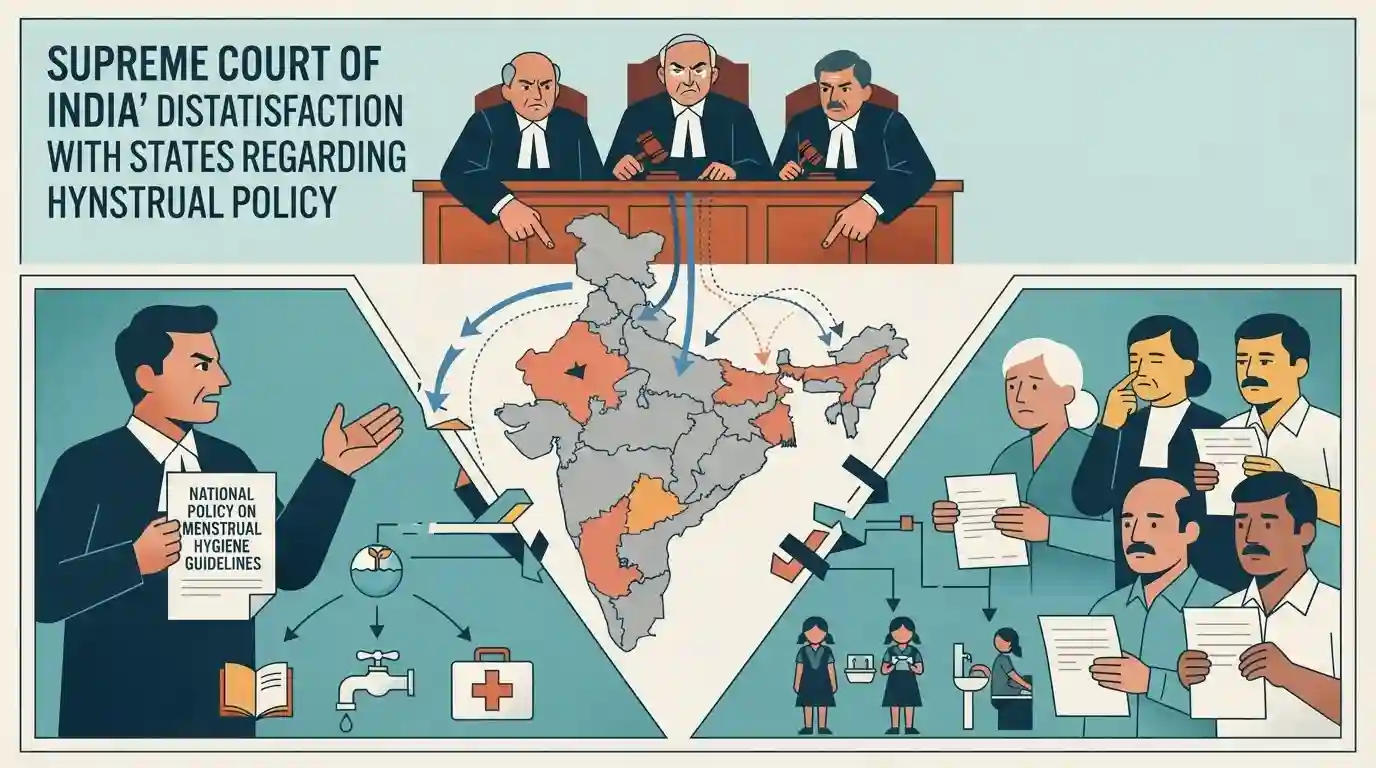
The Supreme Court of India expressed strong dissatisfaction with various States and Union Territories for failing to respond to the Central government regarding a comprehensive national policy on menstrual hygiene. Emphasizing the importance of menstrual health, sanitation, and education for adolescent girls, the Court's strict observation underscores institutional bottlenecks in cooperative federalism and public health governance.
मुख्य मुद्दे
- The Supreme Court expressed strong displeasure over the failure of several States and Union Territories to respond to the Centre's communication regarding a national policy on menstrual hygiene.
- The apex court is monitoring the formulation of a uniform national policy and standard operating procedures (SOPs) for menstrual hygiene management, focusing on school-going girls and rural areas.
- The case highlights persistent challenges in cooperative federalism, particularly regarding the implementation of social welfare and public health schemes across states.
- Lack of uniform state responses impedes effective nationwide public health interventions for adolescent reproductive health and sanitation.
महत्त्वाच्या संज्ञा
Supreme Court

The apex judicial body of India, which has ruled that menstrual health and hygiene are integral parts of the fundamental right to life with dignity under Article 21.
UPSC context
UPSC GS Paper II (Indian Constitution & Polity) - tests judicial review, judicial activism, and the enforcement of fundamental rights.
Centre
The Central Government of India, tasked with formulating a comprehensive national policy on menstrual hygiene and coordinating its implementation across various States and UTs.
UPSC context
UPSC GS Paper II (Governance and Federalism) - tests center-state relations, cooperative federalism, and policy implementation bottlenecks.
पूर्वपरीक्षा सापळा
Uniform national policy on menstrual hygiene is formulated and executed entirely through Central legislation without state consultation.
Aspirants often assume public health and sanitation are exclusively Central subjects, whereas 'Public Health and Sanitation' is under the State List (List II), making Central-State coordination essential.
संबंधित स्थिर संकल्पना
What is the constitutional distribution of legislative powers regarding public health and sanitation in India?
- Entry 6 List II: State List: Public health, sanitation, hospitals, and dispensaries fall under Entry 6 of List II (State List) of the Seventh Schedule.
- List III Concurrent: Concurrent List: Population control, family planning, and medical education fall under the Concurrent List (List III), enabling joint legislation.
- Union Role: Union Role: Parliament legislates via Union List (Entry 81/International health) or coordinates national standards through policy frameworks and Centrally Sponsored Schemes.
आंतर-विषय नमुने
Menstrual Hygiene + Fiscal Federalism & Centrally Sponsored Schemes
Menstrual hygiene policies require synchronized funding between the Centre and States, intersecting with discussions on fiscal federalism, tied grants, and the use of the Nirbhaya Fund or Health Sector grants.
Judicial Activism + Public Health Governance
Judicial monitoring of administrative inertia in public health bridges public interest litigation (PIL) jurisprudence with the enforcement of socio-economic rights under the Directive Principles of State Policy.

Menstrual hygiene and Art. 21 right to health linked with federal friction or directive compliance will feature in Prelims/Mains.
संबंधित PYQ · 4
संबंधित PYQ · 4
- 2024MainsGS2
In a crucial domain like the public healthcare system the Indian State should play a vital role to contain the adverse impact of marketisation of the system. Suggest some measures through which the State can enhance the reach of public healthcare at the grassroots level.
- 2020MainsGS2
In order to enhance the prospects of social development, sound and adequate health care policies are needed particularly in the fields of geriatric and maternal health care. Discuss.
- 2017MainsGS2
To ensure effective implementation of policies addressing water, sanitation and hygiene needs the identification of the beneficiary segments is to be synchronized with the anticipated outcomes." Examine the statement in the context of the WASH scheme.
- 2015MainsGS2
The concept of cooperative federalism has been increasingly emphasized in recent years. Highlight the drawbacks in the existing structure and the extent to which cooperative federalism would answer the shortcomings.
