Bombay High Court questions Melghat healthcare and state priorities
Source:Indian Express ↗
Why It Matters
It provides an excellent contemporary case study for Mains answers regarding the debate on 'freebies vs. welfare', the dire need for public healthcare infrastructure in tribal regions, and the role of the judiciary in holding the executive accountable for public health mandates.
Summary
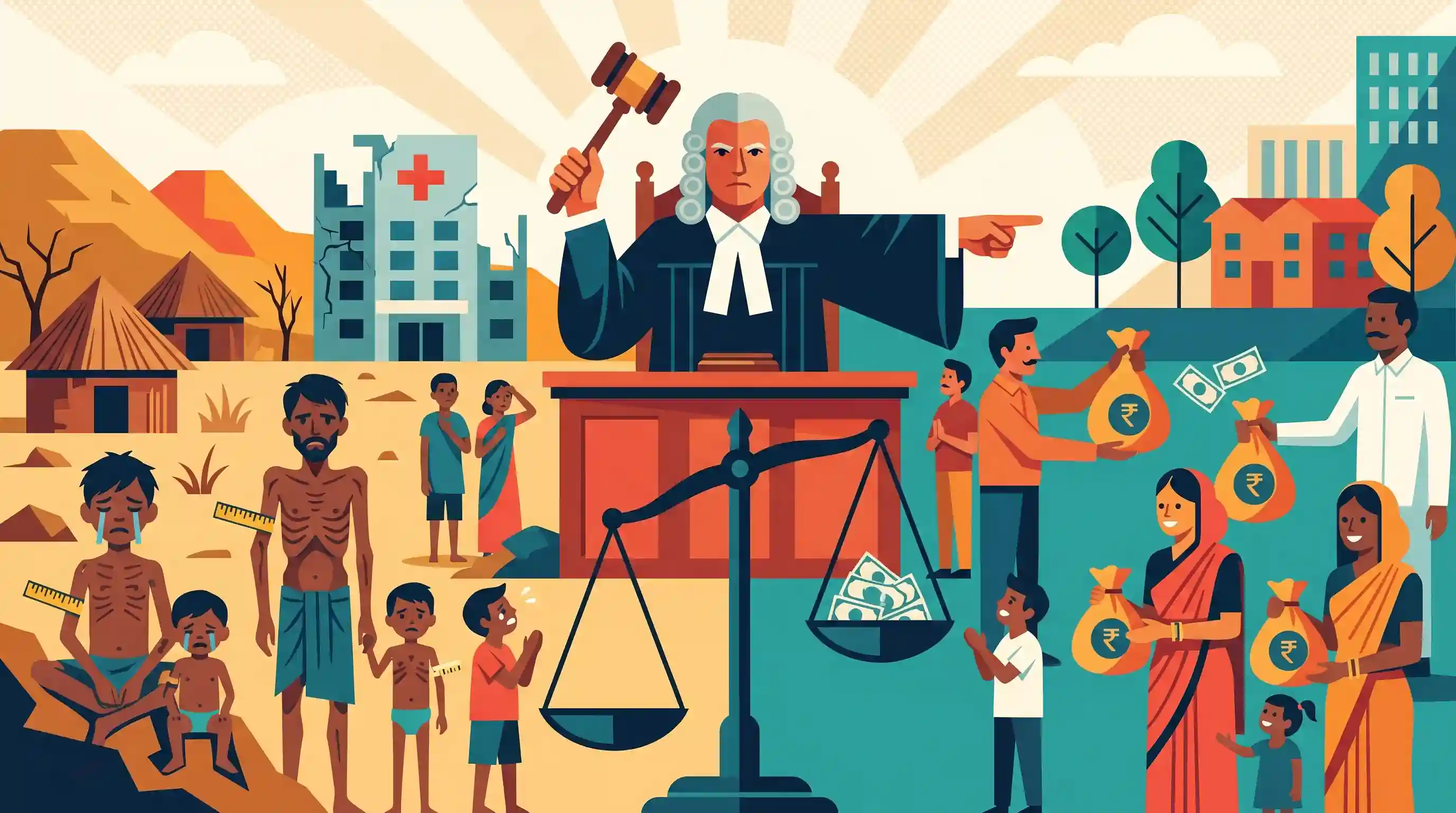
The Bombay High Court has strongly criticized the Maharashtra government for its failure to establish a much-needed hospital in the tribal region of Melghat, an area infamous for child malnutrition deaths. Highlighting a skew in policy priorities, the Court noted that while the state claims to lack funds for essential health infrastructure, it readily implements massive cash-transfer schemes like the 'Ladki Bahin Yojana' for "non-working people." This intervention spotlights the ongoing debate over state resource allocation—specifically, the trade-off between funding populist freebie schemes and investing in crucial human capital infrastructure like public health facilities for vulnerable populations.
Key Points
- The Bombay High Court reprimanded the Maharashtra government for continuous delays in establishing a well-equipped hospital in the tribal region of Dharni, Melghat, to treat malnutrition.
- The Court drew a sharp contrast between the state's inability to fund critical primary healthcare infrastructure and its readiness to finance expensive cash-transfer schemes like the 'Ladki Bahin Yojana'.
- The persistent malnutrition crisis in Melghat underscores the structural failures in ensuring accessible healthcare and basic nutritional security for marginalized tribal communities.
- The observation raises important governance questions regarding the prioritization of populist public expenditure over essential long-term capacity building in the health sector.
Important Terms
Mukhyamantri Majhi Ladki Bahin Yojana

A Maharashtra government social security scheme providing a monthly cash transfer of ₹1,500 to eligible women aged 21-65 to ensure financial independence and improve health and nutrition.
UPSC context
GS 2 (Welfare schemes); explores the debate between populist cash transfers and capital investment in essential health infrastructure.
Melghat
A tribal-dominated region in Maharashtra's Amravati district, primarily home to the Korku tribe, historically plagued by severe child malnutrition and high infant mortality rates.
UPSC context
GS 2 (Vulnerable sections); serves as a case study for regional disparity, tribal health crises, and administrative accountability.
Severe Acute Malnutrition (SAM)
The most dangerous form of malnutrition, characterized by very low weight-for-height (wasting) or nutritional edema, requiring urgent medical intervention to prevent child mortality.
UPSC context
GS 2 (Hunger/Health); tests knowledge of SDG 2 (Zero Hunger) and evaluating the on-ground efficacy of the POSHAN Abhiyaan.
Right to Health (Article 21)
An integral part of the 'Right to Life' under the Indian Constitution, obligating the government to provide medical care and ensure the survival of its citizens.
UPSC context
GS 2 (Fundamental Rights); core concept for judicial intervention and enforcing state accountability in public health crises.
Public Interest Litigation (PIL)
A legal mechanism allowing individuals or groups to file petitions in courts for the protection of public interest or the rights of marginalized communities.
UPSC context
GS 2 (Judiciary); critical tool for judicial oversight of executive failure in sectors like public health and tribal welfare.
Prelims Trap
Right to Health is explicitly enumerated as a Fundamental Right under Part III of the Constitution.
Right to Health is inferred under Article 21, not explicitly stated. Public health and raising nutrition levels are explicitly mentioned as Directive Principles of State Policy under Article 47.
Static Concepts Connected
What is the distinction between Public Goods, Merit Goods, and Freebies?
- Public Goods: Non-rivalrous and non-excludable (e.g., national defense, street lighting). Consumption by one does not reduce availability for others, and nobody can be effectively excluded.
- Merit Goods: Goods with significant positive societal externalities (e.g., primary healthcare, basic education). The state provides them because free markets typically under-invest in these areas.
- Freebies (Non-Merit): Non-merit subsidies or direct cash transfers aimed at short-term relief or electoral gains, often lacking sustainable long-term economic returns or human capital formation.
What are the key Constitutional provisions regarding public health and nutrition?
- Article 21: The Supreme Court has broadly interpreted the Right to Life to implicitly include the fundamental right to health and access to medical care.
- Article 47: A Directive Principle explicitly mandating the state to consider raising the level of nutrition, standard of living, and improving public health as among its primary duties.
- Local Governance Schedules: The 11th and 12th Schedules empower local self-governments (Panchayats and Municipalities) with direct responsibilities relating to health, sanitation, and family welfare.
Cross-Topic Patterns
Judicial review vs. Executive fiscal policy
Courts questioning state budget allocations (hospitals over cash schemes) touches upon the separation of powers, highlighting the fine line between judicial activism for human rights and judicial overreach into executive budgeting.
Geography, Tribal vulnerability, and Malnutrition
The persistence of SAM in Melghat connects physical geography (isolation) to social vulnerabilities, demonstrating why tribal health requires localized physical infrastructure rather than just generalized state-wide financial transfers.

Mains 2026 will likely feature a GS-2 question on the 'freebies vs merit goods' debate, contrasting cash transfers with health investment.
Linked PYQs · 5
Linked PYQs · 5
- 2024MainsGS2
Poverty and malnutrition create a vicious cycle, adversely affecting human capital formation. What steps can be taken to break the cycle ?
- 2024MainsGS2
In a crucial domain like the public healthcare system the Indian State should play a vital role to contain the adverse impact of marketisation of the system. Suggest some measures through which the State can enhance the reach of public healthcare at the grassroots level.
- 2021MainsGS2
“Besides being a moral imperative of a Welfare State, primary health structure is a necessary precondition for sustainable development.” Analyze.
- 2020MainsGS2
Judicial Legislation is antithetical to the doctrine of separation of powers as envisaged in the Indian Constitution. In this context justify the filing of large number of public interest petitions praying for issuing guidelines to executive authorities.
- 2024MainsGS3
Examine the pattern and trend of public expenditure on social services in the post-reforms period in India. To what extent this has been in consonance with achieving the objective of inclusive growth?
