MeitY Plan to Boost National Computing Capacity for AI Inference
Source:The Hindu ↗
Why It Matters
Important for understanding India's strategic push in artificial intelligence infrastructure, compute capacity expansion, and support for the domestic tech ecosystem under the India AI Mission.
Summary
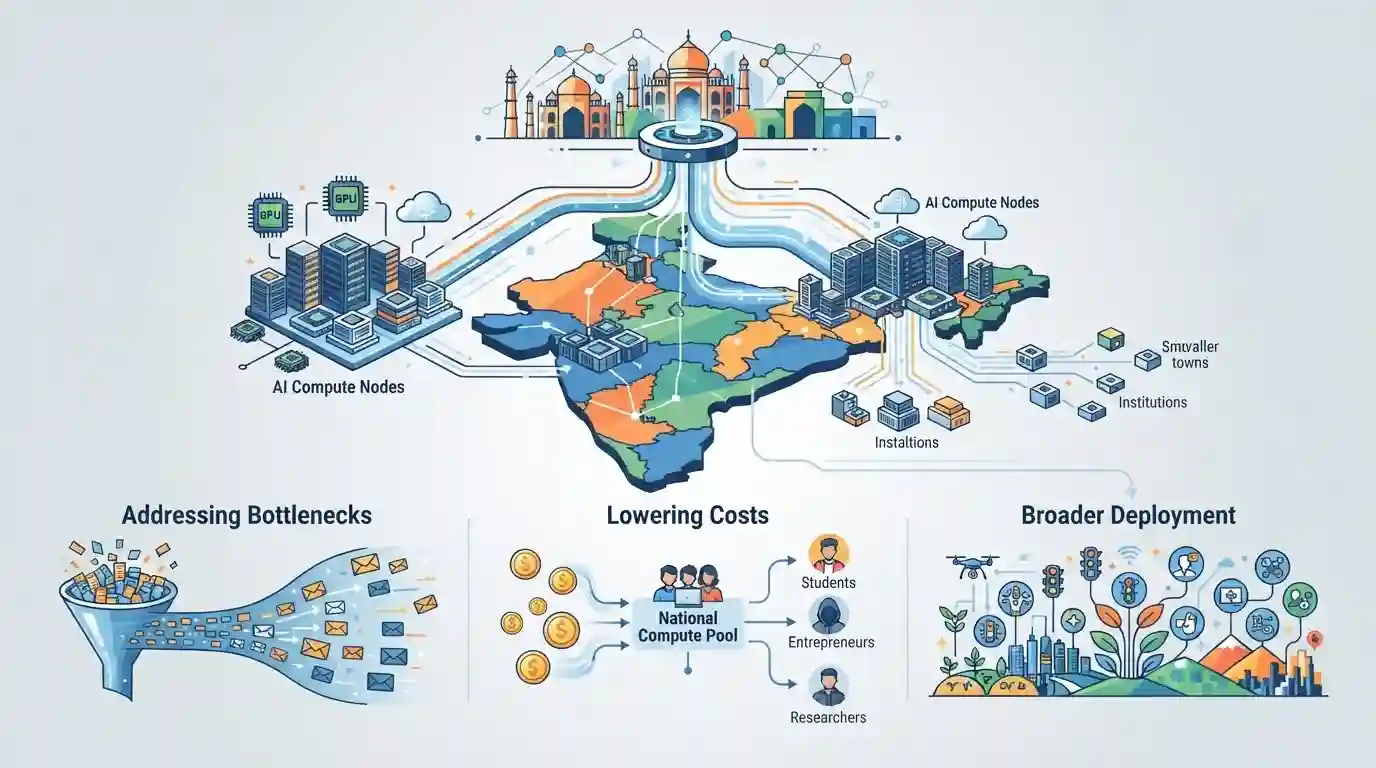
The Ministry of Electronics and Information Technology (MeitY) is planning an expansion of national computing infrastructure targeted at AI inference. This move addresses infrastructure bottlenecks, lowers costs for startups and researchers, and supports the broader deployment of artificial intelligence applications across India under national digital frameworks.
Key Points
- MeitY is planning to significantly expand national computing capacity specifically focused on AI inference to support domestic applications.
- The initiative aims to address high costs and limited access to specialized hardware like GPUs for startups, researchers, and public sector projects.
- It complements existing efforts under the India AI Mission, shifting focus from pure model training to scalable operational deployment (inference).
Important Terms
India AI Mission

A comprehensive national initiative approved with an outlay of ₹10,370 crore to build robust computing infrastructure, democratize access to AI compute, and foster sovereign artificial intelligence innovation in India.
UPSC context
GS Paper III (Science & Technology - IT & Computers, AI), testing understanding of government interventions for critical technology development.
Ministry of Electronics and Information Technology (MeitY)
The Union Ministry responsible for formulating and implementing policies related to information technology, electronics, internet governance, and national digital infrastructure development in India.
UPSC context
GS Paper II & III (Governance and Technology), testing role of nodal ministries in digital transformation and regulatory frameworks.
AI Inference
The phase of artificial intelligence deployment where a trained machine learning model runs live on new data to make predictions, decisions, or classifications.
UPSC context
GS Paper III (Science & Technology - Emerging Technologies), testing fundamental concepts in AI applications and infrastructure requirements.
Prelims Trap
IndiaAI Mission is exclusively restricted to foundational model training and does not support inference infrastructure.
Aspirants often confuse AI model training with AI inference; the IndiaAI Mission now actively funds and expands both, not just training.
Static Concepts Connected
What are the key pillars and implementing mechanisms of the IndiaAI Mission?
- Implemented by MeitY with a significant financial outlay of over ₹10,000 crore to build a sovereign AI ecosystem.: Outlay & Nodal Ministry,label:
- Aims to build scalable public computing infrastructure exceeding 10,000+ GPUs via public-private partnerships for startups and researchers.: Compute Capacity,label:
- Includes IndiaAI Compute Capacity, IndiaAI Innovation Centre, Datasets Platform, Application Development Initiative, and FutureSkills.: Core Pillars,label:
Cross-Topic Patterns
AI Compute Infrastructure meets Semiconductor Missions
The IndiaAI compute grid directly mirrors semiconductor fab incentives under ISM, linking digital public infrastructure with hardware manufacturing self-reliance.
Sovereign AI Compute & DPIIT Startups
Public cloud subsidies for startups bridge the gap between capital-intensive deep-tech research and Atmanirbhar Bharat's domestic innovation goals.

IndiaAI Mission compute targets + AI inference vs. training distinction is a prime target for a multi-statement prelims question.
Linked PYQs · 2
Linked PYQs · 2
- 2025MainsGS3
India aims to become a semiconductor manufacturing hub. What are the challenges faced by the semiconductor industry in India? Mention the salient features of the India Semiconductor Mission.
- 2023MainsGS3
Introduce the concept of Artificial Intelligence (AI). How does Al help clinical diagnosis? Do you perceive any threat to privacy of the individual in the use of Al in healthcare?
