MeitY Notifies New Rules to Regulate Online Gaming Industry
Source:The Hindu ↗
Why It Matters
The rapid expansion of the online gaming industry has raised significant concerns regarding gambling addiction, money laundering, and the safety of minors. These rules represent a pivotal governance step in clearly distinguishing skill-based esports from chance-based gambling, ensuring user protection, and creating a structured regulatory environment for India's digital economy.
Summary
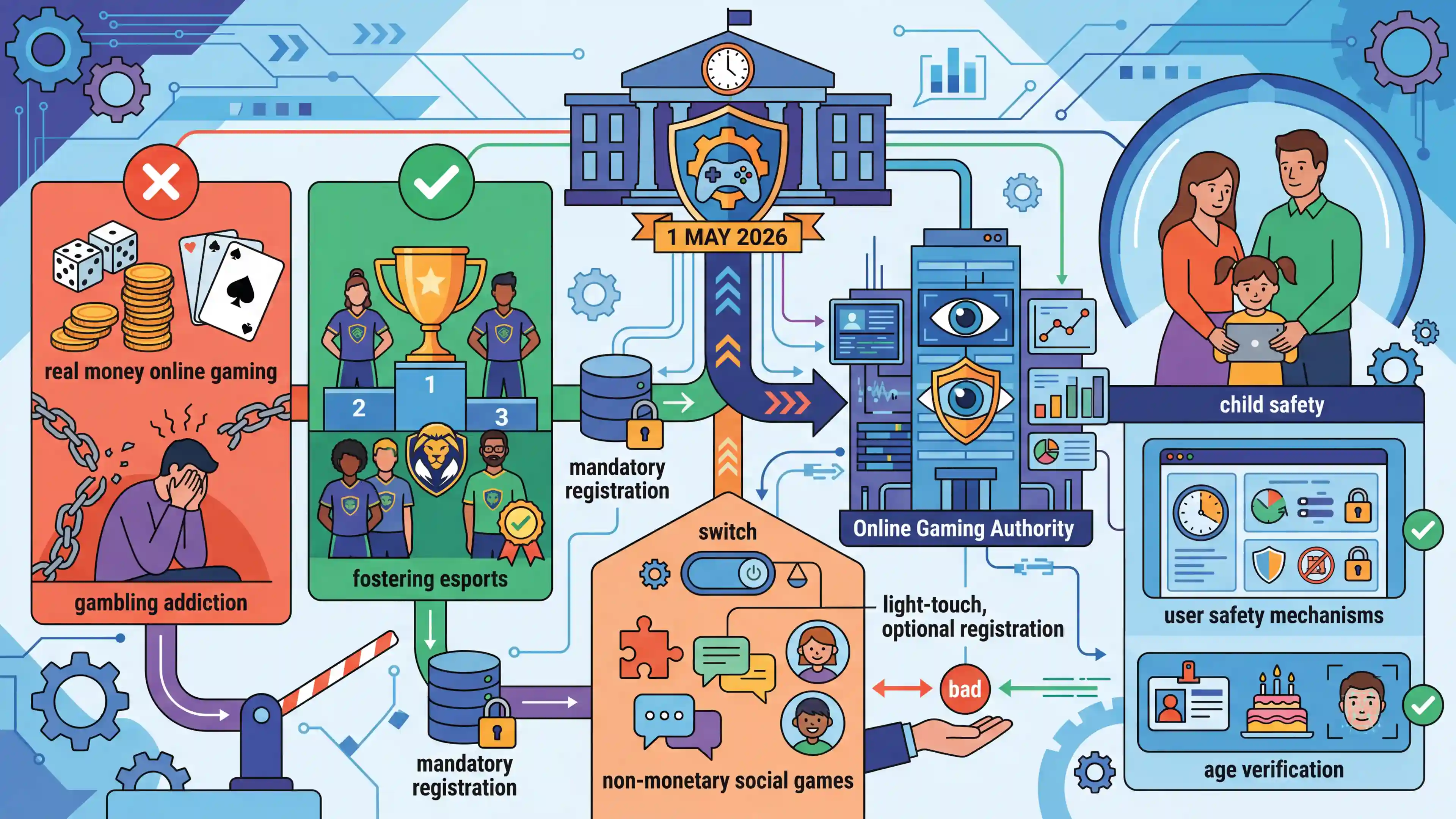
The Ministry of Electronics and Information Technology (MeitY) has notified rules under the Promotion and Regulation of Online Gaming Act, set to take effect on May 1, 2026. The regulatory framework explicitly bans real money online gaming to prevent financial fraud and gambling addictions, while fostering legitimate esports through a mandatory registration process. Non-monetary social games will be subject to a light-touch, optional registration model unless specifically flagged. The rules also establish an Online Gaming Authority and mandate stringent user safety mechanisms—such as parental controls and age verification—to protect minors in the digital landscape.
Key Points
- MeitY has notified new rules to operationalize the Promotion and Regulation of Online Gaming Act, which will come into effect on May 1, 2026.
- The rules explicitly ban online real money games to curb gambling and financial fraud, while adopting a light-touch regulatory approach for non-monetary social games.
- Esports are officially recognized as a distinct category requiring mandatory registration with the newly proposed Online Gaming Authority.
- The framework mandates robust user safety features, including age verification and parental controls, to ensure the digital wellbeing of minors.
Important Terms
Promotion and Regulation of Online Gaming (PROG) Act, 2025

Legislation providing a national framework to regulate India's online gaming sector, distinguishing between permissible social games/esports and prohibited money games to prevent financial fraud and addiction.
UPSC context
GS Paper II (Government Policies) and Paper III (Digital Economy). Tests knowledge of legislative frameworks for emerging technologies.
Online Gaming Authority of India (OGAI)
A digital-first central regulator under MeitY tasked with classifying games, handling grievances, and ensuring compliance. It includes representatives from Home, Finance, and Sports ministries.
UPSC context
GS Paper II (Regulatory Bodies). Tests understanding of sectoral regulators and inter-ministerial coordination in e-governance.
Online Money Games
Games where users deposit money or pay fees in expectation of monetary winnings. These are explicitly banned under the PROG Act to curb gambling-related harm and financial fraud.
UPSC context
GS Paper III (Internal Security/Money Laundering). Relevant for topics on digital gambling risks and consumer protection.
Online Social Games
Non-monetary digital games played for entertainment without financial stakes. They fall under a "light-touch" regulatory model, generally exempt from mandatory registration unless specifically flagged.
UPSC context
GS Paper III (Digital Economy). Tests understanding of the balance between industry growth and regulatory oversight.
Esports
Organised competitive gaming involving physical dexterity and strategy. Under the 2026 rules, these require mandatory registration to be recognized as legitimate sporting activities.
UPSC context
GS Paper II (Government Policies). Important for topics on promoting India as a hub for digital innovation.
User Safety Features
Mandatory safeguards—including age-gating, parental controls, and time restrictions—designed to protect users, particularly minors, from digital harm and addiction.
UPSC context
GS Paper II (Social Justice). Tests awareness of child safety and mental health protections in the digital era.
Prelims Trap
Esports and online gaming regulation fall under the Ministry of Youth Affairs and Sports.
While sports generally fall under Youth Affairs, esports and online gaming regulation—including the new Online Gaming Authority—are strictly under the ambit of MeitY.
Static Concepts Connected
What is the legal difference between 'games of skill' and 'games of chance' in India?
- Game of Skill: Outcome relies predominantly on player knowledge, training, or experience. Historically enjoys protection as a legitimate profession or business under Article 19(1)(g) of the Constitution.
- Game of Chance: Outcome is determined entirely by luck. It legally qualifies as gambling and falls under State legislative jurisdiction (Entry 34 of the State List).
How does this new framework alter the IT intermediary guidelines?
- Shift from SRBs: Earlier IT Rule amendments proposed industry-led Self-Regulatory Bodies (SRBs) for verification. The new Act shifts power to a centralized statutory regulator, the Online Gaming Authority.
- Safe Harbour compliance: Gaming platforms must enforce the real-money ban and user safety mandates to retain their Section 79 safe harbour protections under the Information Technology Act.
Cross-Topic Patterns
DPDP Act crossover on child data
The mandate for age-gating and parental controls directly intersects with the DPDP Act 2023, which requires verifiable parental consent before processing any personal data belonging to children.
Federalism and 7th Schedule friction
Betting and gambling are State List subjects. A central law banning real-money gaming under MeitY raises classic GS2 federalism debates regarding overlapping jurisdictions between Centre and States.

Expect a multi-statement Q in 2026 contrasting 'Esports' (mandatory registry) and 'real-money games' (banned) under MeitY vs State laws.
Linked PYQs · 4
Linked PYQs · 4
- 2025MainsGS2
The National Commission for Protection of Child Rights has to address the challenges faced by children in the digital era. Examine the existing policies and suggest measures the Commission can initiate to tackle the issue.
- 2023MainsGS3
What is the status of digitalization in the Indian economy? Examine the problems faced in this regard and suggest improvements.
- 2021MainsGS3
Discuss how emerging technologies and globalisation contribute to money laundering. Elaborate measures to tackle the problem of money laundering both at national and international levels.
- 2020MainsGS3
Discuss different types of cyber crimes and measures required to be taken to fight the menace.
