Unregulated Himalayan Infrastructure Exacerbates Floods
Source:Indian Express ↗
Why It Matters
This topic is highly relevant for UPSC as it directly addresses the persistent conflict between infrastructure development (like roads, tunnels, and dams) and environmental conservation in fragile ecosystems like the Himalayas. It touches upon core syllabus areas in GS-1 (Geography: Himalayas, Landslides) and GS-3 (Environment and Disaster Management: EIA, Cloudbursts, Flash floods).
Summary
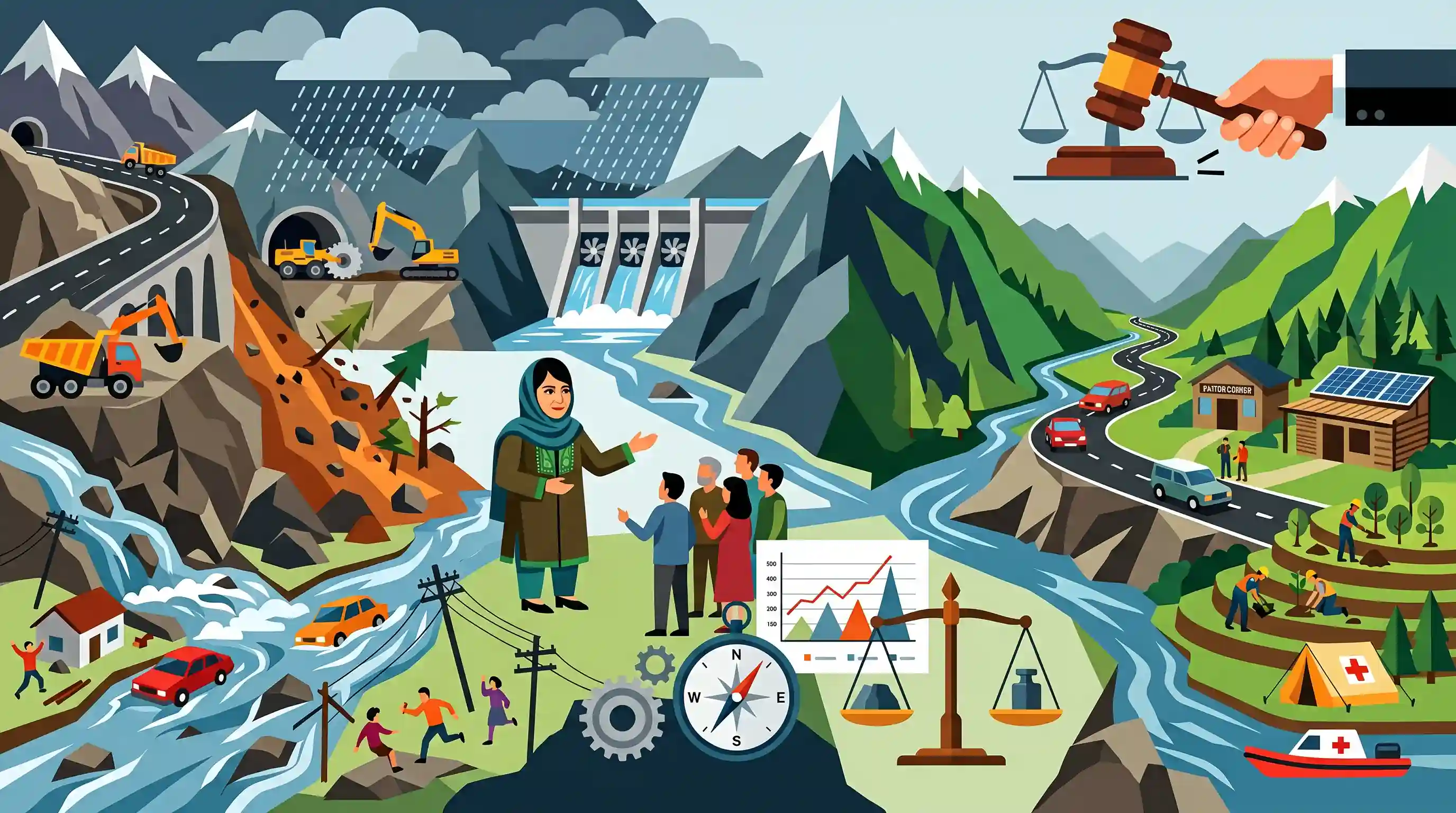
PDP President Mehbooba Mufti visited flood-affected regions in Jammu, where she criticized the Central government for allowing uncontrolled infrastructure development in the fragile Himalayan ecosystem. She argued that handing over forests, mountains, and rivers to private contractors for mega projects—such as six-lane highways, tunnels, and hydel plants in the Chenab Valley—is the primary cause of frequent cloudbursts, flash floods, and landslides. Pointing to similar devastation near the Char Dham routes, she stressed the need to strictly regulate tourism based on the carrying capacity of the hills and urged the Supreme Court to take suo motu cognizance of the environmental destruction in the region.
Key Points
- Mehbooba Mufti alleged the Centre is handing over the natural resources (forests, mountains, rivers) of Jammu and Kashmir to contractors, leading to ecological disaster.
- She linked large-scale deforestation for infrastructure projects like tunnels and roads to recent extreme weather events, including flash floods and cloudbursts.
- The Chenab Valley was highlighted as highly vulnerable due to ongoing mega hydel power projects.
- Emphasized the urgent need to regulate tourism and assess the carrying capacity of Himalayan regions, drawing parallels with the ecological damage around the Char Dham routes.
Important Terms
Carrying Capacity

The maximum population size or level of resource use an ecosystem can support indefinitely without degrading its natural resources or ecological integrity.
UPSC context
GS Paper 3: Essential for sustainable development planning and environmental conservation in fragile regions like the Himalayas.
Suo Motu Cognizance
The authority of a court to initiate legal proceedings on its own initiative, based on information from media or other sources, without a formal petition.
UPSC context
GS Paper 2: Illustrates judicial activism and the court's role as a protector of fundamental rights and environmental safety.
Environmental Impact Assessment (EIA)
A statutory process that evaluates the potential environmental, social, and economic consequences of a proposed development project before implementation.
UPSC context
GS Paper 3: Vital for environmental governance and balancing infrastructure development with ecological preservation.
Cloudburst
A sudden, highly localized, and intense rainfall event (typically exceeding 100 mm/hour over a small area) often leading to flash floods and landslides.
UPSC context
GS Paper 1 & 3: Key geophysical phenomenon and disaster management challenge in India's hilly regions.
Char Dham Project
A 900-km highway widening project in Uttarakhand meant to provide all-weather connectivity to four shrines; criticized for its ecological impact on the fragile Himalayas.
UPSC context
GS Paper 3: Often cited in debates concerning national security vs. environmental conservation and disaster vulnerability.
Himalayan Ecosystem
An ecologically sensitive mountain range susceptible to seismic activity, landslides, and flash floods due to its geologically young and unstable terrain.
UPSC context
GS Paper 3: Focus of National Mission for Sustaining the Himalayan Ecosystem (NMSHE) under India's climate action plan.
Prelims Trap
A cloudburst is officially defined as any unexpected torrential rainfall exceeding 50 mm per hour in mountainous terrains.
The IMD strictly defines a cloudburst as rainfall of 100 mm or more per hour over a small geographical area (20-30 sq km).
Static Concepts Connected
What are Run-of-the-River (ROR) hydroelectric projects?
- Flow reliance: They generate power using the natural flow and elevation drop of a river, requiring little to no water storage.
- Ecological impact: While generally greener than large storage dams, "bumper-to-bumper" ROR cascades disrupt continuous sediment flow, aquatic migration, and natural river ecology.
- Treaty provisions: Under the Indus Water Treaty, India is permitted to construct ROR power projects on western rivers (Chenab, Jhelum, Indus) subject to specific design criteria.
What defines the "Carrying Capacity" of an ecosystem?
- Definition: The maximum population size, tourism influx, or infrastructure load an environment can sustain indefinitely without irreversible ecological degradation.
- Himalayan context: In hill stations, it is evaluated by assessing slope stability, seismicity, water availability, and waste disposal limits before approving mega-projects.
Cross-Topic Patterns
Indus Water Treaty + Chenab hydropower
Hydel projects on the Chenab (Kiru, Ratle) frequently face objections from Pakistan under the Permanent Indus Commission regarding pondage and spillway designs.
Judicial review of strategic infrastructure
The Supreme Court frequently utilizes High-Powered Committees (e.g., Ravi Chopra committee) to balance strategic defense infrastructure needs with the ecological carrying capacity of fragile regions.

Expect a 2026 question assessing the cumulative ecological impact of 'bumper-to-bumper' run-of-the-river projects in the Himalayas.
Linked PYQs · 4
Linked PYQs · 4
- 2015MainsGS1
The states of Jammu and Kashmir, Himachal Pradesh and Uttarakhand are reaching the limits of their ecological carrying capacity due to tourism. Critically evaluate.
- 2016MainsGS3
Rehabilitation of human settlements is one of the important environmental impacts which always attracts controversy while planning major projects. Discuss the measures to be adopted to mitigate the impact of the recent incidents of cloudbursts in many places of Uttarakhand.
- 2021MainsGS3
Describe the various causes and the effects of landslides. Mention the important components of the National Landslide Risk Management Strategy.
- 2016MainsGS1
The Himalayas are highly prone to landslides. Discuss the causes and suggest suitable measures of mitigation.
