Illegal Coal Mining and Occupational Safety Risks in Northeast India
Source:Indian Express ↗
Why It Matters
Provides a critical case study on the failure of environmental governance, the socioeconomic complexities of illegal mining, and the devastating ecological and human costs of unregulated resource extraction.
Summary
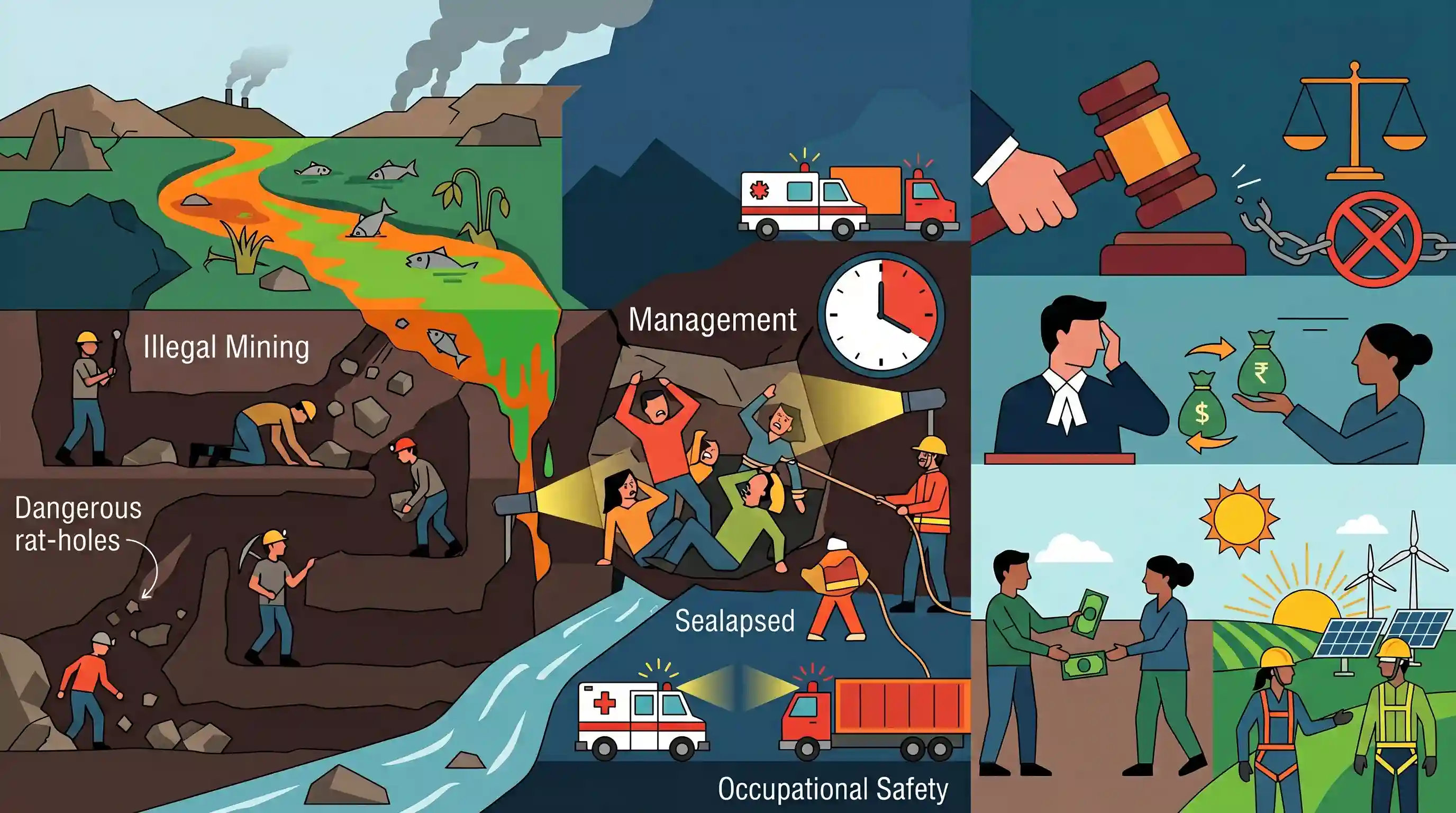
The article highlights the tragic death of 25 workers trapped in Meghalaya’s illegal rat-hole coal mines, characterizing it as a 'disaster long foretold.' Despite the National Green Tribunal's (NGT) 2014 ban on the unscientific and hazardous practice, illegal mining has persisted due to weak law enforcement, local political apathy, and the heavy reliance of the local economy on informal coal extraction. The disaster underscores the severe risks faced by marginalized laborers working without safety gear in narrow, flood-prone shafts. Furthermore, it brings attention to the devastating environmental fallout of rat-hole mining, which has caused severe acid mine drainage and destroyed local rivers. The tragedy acts as a stark reminder of the urgent need for effective governance, strict enforcement of environmental laws, and the creation of alternative, sustainable livelihoods to dismantle the illegal mining ecosystem.
Key Points
- Rat-hole mining is an unscientific and hazardous method of coal extraction involving narrow, deep tunnels, heavily prevalent in Meghalaya.
- The National Green Tribunal (NGT) banned rat-hole mining in 2014 due to its severe environmental consequences, including acid mine drainage that pollutes local water bodies.
- Despite the ban, illegal mining continues due to lax enforcement, political complicity, and the socioeconomic dependence of the local population on the coal economy.
- The recent disaster resulting in 25 deaths exposes the extreme lack of safety protocols, lack of disaster response capabilities, and the urgent need for alternative livelihoods and strict regulatory enforcement.
Important Terms
Rat-hole Mining

A hazardous, manual coal extraction method involving narrow horizontal tunnels (3-4 feet high) dug into hillsides or vertical pits. It is predominantly practiced in Meghalaya and Assam.
UPSC context
GS Paper 3: Environment and Disaster Management. Tests knowledge of unscientific mining, occupational safety, and environmental degradation in Northeast India.
National Green Tribunal (NGT)
A specialized statutory body established under the NGT Act, 2010, for the effective and expeditious disposal of cases relating to environmental protection and forest conservation.
UPSC context
GS Paper 2: Statutory Bodies. Tests understanding of judicial mechanisms for environmental justice and the NGT's role in banning illegal mining.
Acid Mine Drainage (AMD)
The outflow of highly acidic water, often rich in heavy metals, from coal or metal mines. It occurs when sulfide minerals are exposed to air and water.
UPSC context
GS Paper 3: Environment. Tests technical understanding of mining-induced pollution and its impact on aquatic ecosystems and water quality.
Environment (Protection) Act, 1986
An umbrella legislation enacted under Article 253 to provide a framework for the coordination of central and state authorities in protecting and improving the environment.
UPSC context
GS Paper 2: Legislations. Tests knowledge of the primary legal framework for environmental regulation and the Central Government's enforcement powers.
Sixth Schedule
Constitutional provisions (Articles 244(2) and 275(1)) for the administration of tribal areas in Assam, Meghalaya, Tripura, and Mizoram through Autonomous District Councils (ADCs).
UPSC context
GS Paper 2: Governance/Constitution. Tests understanding of tribal autonomy, land rights, and the jurisdictional challenges in regulating mining in Meghalaya.
Disaster Management Act, 2005
Legislation providing for the effective management of disasters, including the formation of the National Disaster Response Force (NDRF) for specialized response to tragedies like mine flooding.
UPSC context
GS Paper 3: Disaster Management. Tests knowledge of institutional frameworks for disaster response, mitigation, and search-and-rescue operations.
Prelims Trap
In Sixth Schedule areas of Meghalaya, tribal land owners are exempt from the MMDR Act for coal extraction.
While the Supreme Court upheld tribal ownership of sub-soil minerals in Meghalaya, it ruled that extraction must strictly comply with the central MMDR Act, 1957. Ownership does not mean regulatory exemption.
Static Concepts Connected
How does Acid Mine Drainage (AMD) destroy aquatic ecosystems?
- Chemical mechanism: High-sulphur coal reacts with oxygen and water to form sulphuric acid, drastically lowering water pH.
- Toxic leaching: Highly acidic water dissolves toxic heavy metals from rocks, rendering rivers like Meghalaya's Lukha and Myntdu uninhabitable for aquatic life.
How is mineral extraction legally regulated in Sixth Schedule areas like Meghalaya?
- Sub-soil ownership: Unlike most states, sub-soil minerals in Meghalaya are owned by the indigenous communities or local individuals, not the State government.
- Central law compliance: Despite indigenous ownership, coal extraction is not exempt from national statutes. It must strictly comply with the MMDR Act, 1957, and environmental clearances.
Cross-Topic Patterns
Autonomy vs. Central Green Laws
The conflict between tribal land rights under the Sixth Schedule and central environmental mandates (NGT, MMDR Act) is a core GS2/GS3 overlap theme regarding resource federalism.
Informal Economy & Disaster Vulnerability
Links closely to illegal mica mining in Jharkhand. Both highlight how extreme socio-economic dependency forces marginalized groups into unmapped, hazardous extraction without disaster response frameworks.

Expect a Prelims question blending Sixth Schedule sub-soil mineral ownership rights with the chemical mechanics of Acid Mine Drainage.
Linked PYQs · 4
Linked PYQs · 4
- 2025MainsGS3
Mineral resources are fundamental to the country's economy and these are exploited by mining. Why is mining considered an environmental hazard? Explain the remedial measures required to reduce the environmental hazard due to mining.
- 2013MainsGS3
What are the consequences of Illegal mining ? Discuss the Ministry of Environment and Forests' concept of GO AND NO GO zones for coal mining sector.
- 2017MainsGS1
In spite of adverse environmental impact, coal mining is still inevitable for development." Discuss.
- 2018PrelimsGS1
How is the National Green Tribunal (NGT) different from the Central Pollution Control Board (CPCB)? 1. The NGT has been established by an Act whereas the CPCB has been created by an executive order of the Government. 2. The NGT provides environmental justice and helps reduce the burden of litigation in the higher courts whereas the CPCB promotes cleanliness of streams and wells, and aims to improve the quality of air in the country. Which of the statements given above is/are correct?
