Meghalaya Coal Disappearance Exposes NGT Ban Enforcement Gaps
Source:The Hindu ↗
Why It Matters
The case illustrates the practical challenges of enforcing environmental tribunal orders (like the NGT ban on rat-hole mining) at the ground level, exposing governance gaps in state resource management and the persistent environmental and economic threat of illegal mining.
Summary
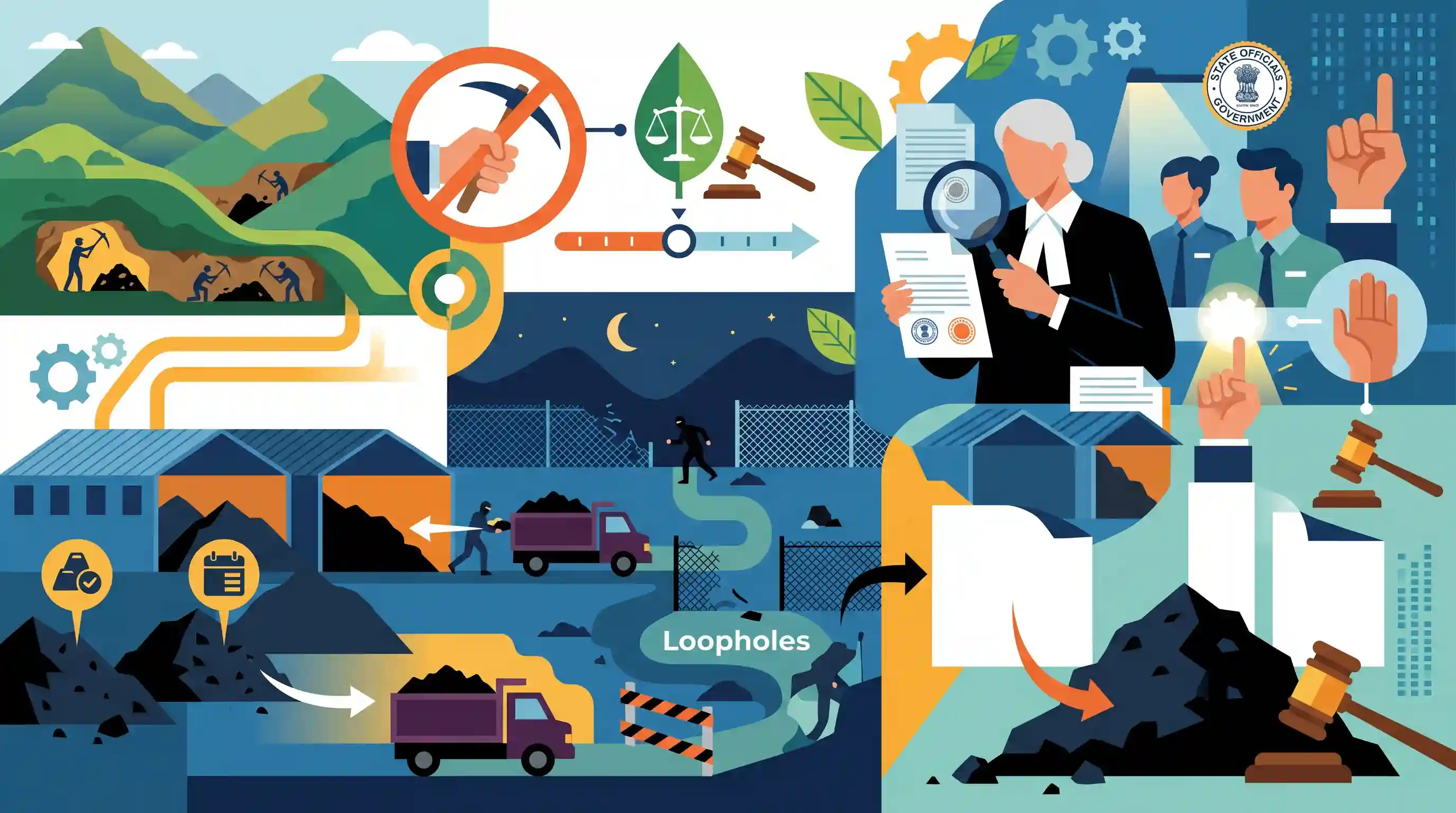
The Meghalaya government has initiated an inquiry into the disappearance of nearly 4,000 metric tonnes of coal from state-designated depots in Ri-Bhoi and West Khasi Hills districts. The discrepancy was reported by the High Court-appointed Justice B.P. Katakey committee. The National Green Tribunal (NGT) had banned unscientific rat-hole coal mining in the state in 2014, but illegal mining and transportation have reportedly continued by exploiting loopholes surrounding pre-ban inventoried coal stocks. State officials have assured strict action and transparency pending the investigation's outcome.
Key Points
- The Meghalaya government is investigating the disappearance of 3,960.95 metric tonnes of coal from two designated depots in the state.
- The missing coal was discovered by the Justice B.P. Katakey committee, which was appointed by the High Court of Meghalaya to monitor compliance with the state's mining regulations.
- The National Green Tribunal (NGT) had banned rat-hole coal mining in Meghalaya in April 2014 due to its environmental impact and unsafe labor conditions.
- The incident raises concerns about the persistent illegal extraction, transportation, and diversion of coal under the guise of previously inventoried stocks.
Important Terms
National Green Tribunal (NGT)

A specialized judicial body established under the NGT Act (2010) for the effective and expeditious disposal of cases relating to environmental protection and conservation of forests.
UPSC context
GS Paper 2 & 3: Statutory bodies; Environmental governance. Tests knowledge of judicial interventions in resource management.
Rat-hole Mining
A primitive, hazardous method of coal extraction involving narrow horizontal tunnels (3-4 feet high) dug into hillsides, primarily in Meghalaya, often using child labor.
UPSC context
GS Paper 3: Environment and Disaster Management. Important for discussing industrial safety, environmental degradation, and illegal mining challenges.
Justice B.P. Katakey Committee
A single-member committee appointed by the Meghalaya High Court to oversee the implementation of NGT and Supreme Court orders regarding the ban on illegal coal mining.
UPSC context
GS Paper 2: Judiciary. Demonstrates the role of court-appointed committees in monitoring executive compliance with environmental laws.
Sixth Schedule
Constitutional provisions (Articles 244(2) and 275(1)) granting administrative autonomy to tribal areas in Assam, Meghalaya, Tripura, and Mizoram through Autonomous District Councils (ADCs).
UPSC context
GS Paper 2: Indian Constitution. Crucial for understanding tribal rights, land ownership, and federal friction in mineral regulation.
Meghalaya Basin Development Authority (MBDA)
A specialized state agency in Meghalaya responsible for managing natural resources and implementing sustainable development projects, including the inventorying of coal stocks.
UPSC context
GS Paper 3: Environment. Relevant for discussing state-level institutional frameworks for resource mapping and environmental restoration.
Prelims Trap
"Tribal landowners in Sixth Schedule areas have absolute rights to mine coal without needing central regulatory clearances."
While the Supreme Court recognized tribal ownership of sub-soil minerals in Meghalaya, it clearly ruled that extraction operations must still comply with the central MMDR Act and obtain statutory environmental clearances.
Static Concepts Connected
What is 'Rat-hole mining' and why does it cause Acid Mine Drainage (AMD)?
- Rat-hole mining: Involves digging very small, unventilated tunnels (3-4 feet high) to extract thin coal seams. It is largely unregulated and hazardous.
- Sulphur content: Meghalaya's tertiary coal has high sulphur content. When exposed to air and water during mining, it forms sulphuric acid.
- River impact: AMD runoff has severely polluted local rivers like the Lukha and Kopili, turning them acidic and destroying aquatic ecosystems.
Who owns the sub-soil minerals in Meghalaya?
- Private ownership: Unlike most of India where the State owns minerals, in Meghalaya (Sixth Schedule), local tribals and clan networks own the land and sub-soil resources.
- Regulatory compliance: The Supreme Court (2019) ruled that despite ownership rights, any commercial mining extraction requires leases under the MMDR Act, 1957, and valid environmental clearances.
Cross-Topic Patterns
Customary rights vs Central environmental laws
The Meghalaya coal ban highlights the friction between customary tribal land/resource rights under the Sixth Schedule and statutory central environmental mandates like the EPA 1986 and MMDR Act.
Judicial oversight via specialized committees
The appointment of the Justice B.P. Katakey committee illustrates the judiciary's increasing reliance on specialized expert panels to monitor state compliance with NGT bans and audit resource inventories.

Prelims 2026 could feature a 3-statement question linking Acid Mine Drainage, sub-soil mineral ownership in Sixth Schedule areas, and the MMDR Act.
Linked PYQs · 4
Linked PYQs · 4
- 2013MainsGS3
What are the consequences of Illegal mining ? Discuss the Ministry of Environment and Forests' concept of GO AND NO GO zones for coal mining sector.
- 2017MainsGS1
In spite of adverse environmental impact, coal mining is still inevitable for development." Discuss.
- 2025MainsGS3
Mineral resources are fundamental to the country's economy and these are exploited by mining. Why is mining considered an environmental hazard? Explain the remedial measures required to reduce the environmental hazard due to mining.
- 2018PrelimsGS1
How is the National Green Tribunal (NGT) different from the Central Pollution Control Board (CPCB)? 1. The NGT has been established by an Act whereas the CPCB has been created by an executive order of the Government. 2. The NGT provides environmental justice and helps reduce the burden of litigation in the higher courts whereas the CPCB promotes cleanliness of streams and wells, and aims to improve the quality of air in the country. Which of the statements given above is/are correct?
