Meghalaya Orders Judicial Inquiry Following Illegal Coal Mine Blast
Source:The Hindu ↗
Why It Matters
This incident is a textbook case study for GS-3, intertwining environmental hazards (rat-hole mining despite NGT bans) with internal security and economic offenses (organized crime, money laundering). It also provides a practical context for GS-2 topics related to systemic governance failures and judicial interventions (High Court monitoring).
Summary
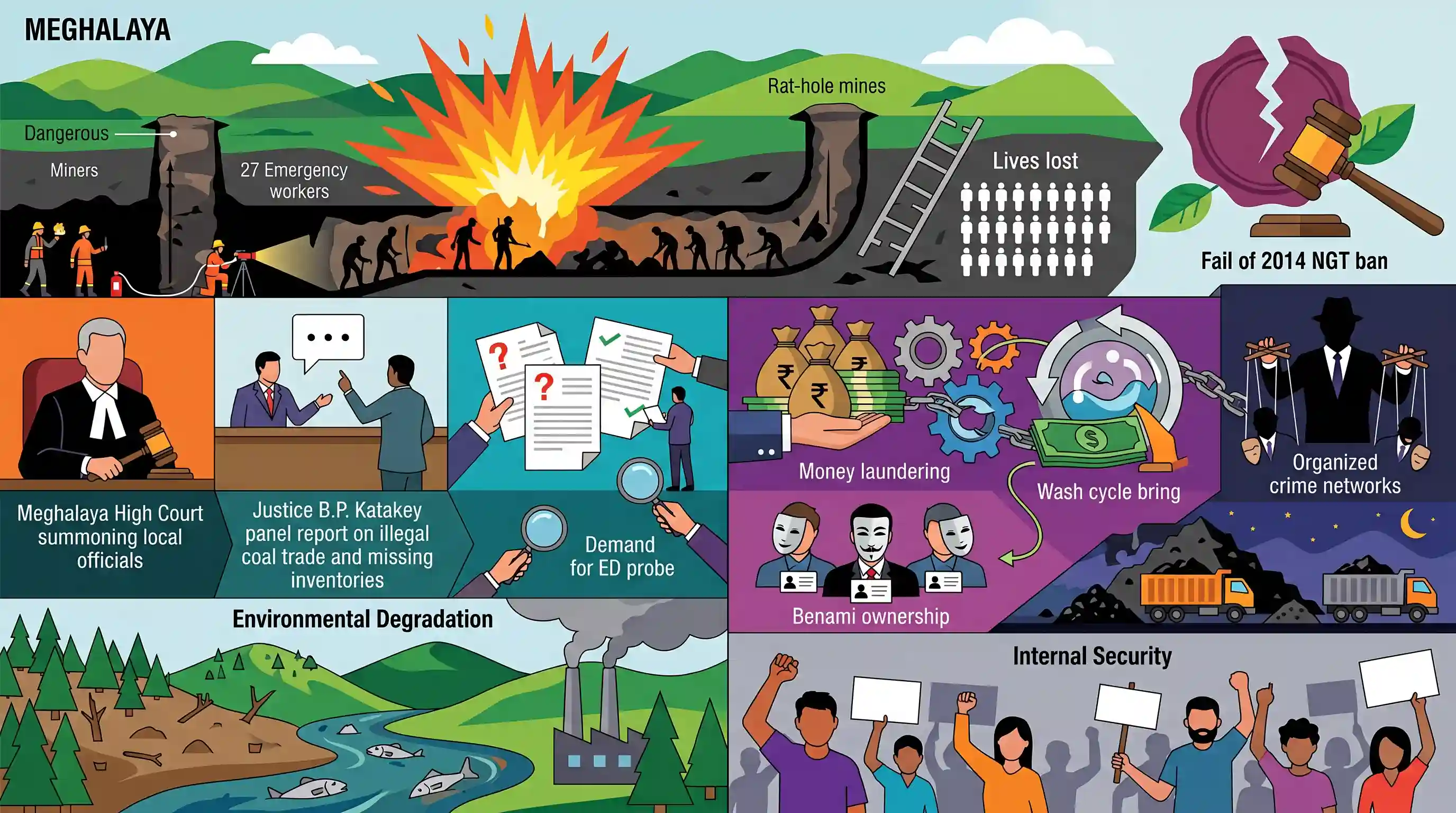
The Meghalaya government has ordered a judicial inquiry following a blast in an illegal rat-hole coal mine in East Jaintia Hills that claimed 27 lives. The tragic incident highlights the persistent failure to enforce the 2014 National Green Tribunal (NGT) ban on rat-hole mining. The Meghalaya High Court has summoned local officials, and earlier reports by the Justice B.P. Katakey panel highlighted large-scale illegal coal trade and missing inventories. Furthermore, social activists are demanding an Enforcement Directorate (ED) probe to uncover the money laundering, benami ownership, and organized crime networks that sustain this illegal economy.
Key Points
- The Meghalaya government has ordered a judicial inquiry into a blast at an illegal rat-hole coal mine in East Jaintia Hills that killed 27 people.
- Despite a 2014 ban by the National Green Tribunal (NGT), rat-hole mining continues rampant in the region, with over 22,000 mine openings identified.
- The Justice B.P. Katakey committee previously flagged a significant quantity of missing surveyed coal and warned about ongoing illegal mining operations.
- Activists are demanding an Enforcement Directorate (ED) investigation into the money laundering, benami ownership, and organized crime networks fueling the illegal coal trade.
Important Terms
Rat-hole Mining

A primitive and hazardous method of coal extraction involving narrow (3-4 feet high) tunnels dug manually. It is common in Meghalaya due to thin coal seams but was banned in 2014.
UPSC context
GS III (Environment/Disaster Management); tests knowledge of unscientific mining, ecological hazards, and tribal livelihood conflicts.
National Green Tribunal (NGT)
A specialized statutory body established in 2010 for the effective and expeditious disposal of cases relating to environmental protection and conservation of forests and other natural resources.
UPSC context
GS II (Statutory Bodies) and GS III (Environment); central to environmental governance and judicial activism in India.
Justice B.P. Katakey Committee
A judicial panel appointed by the Meghalaya High Court to monitor the ban on illegal mining, verify coal inventories, and oversee environmental restoration in the state.
UPSC context
GS II (Governance) and GS III (Environment); tests understanding of judicial oversight and executive accountability in resource management.
Enforcement Directorate (ED)
A financial investigation agency under the Ministry of Finance that enforces the Prevention of Money Laundering Act (PMLA) and Foreign Exchange Management Act (FEMA).
UPSC context
GS II (Governance) and GS III (Money Laundering); tests knowledge of specialized agencies tackling organized economic crime.
Money Laundering
The illegal process of making large amounts of money generated by criminal activity, such as illegal mining, appear to have come from a legitimate source.
UPSC context
GS III (Internal Security); a core topic regarding organized crime, financial integrity, and internal security threats.
Sixth Schedule
Constitutional provision (Articles 244(2) and 275(1)) granting administrative autonomy to tribal areas in NE India, often creating jurisdictional overlaps between customary rights and central mining laws.
UPSC context
GS II (Polity/Governance); tests understanding of tribal autonomy, federalism, and land/mineral rights in the Northeast.
Prelims Trap
Meghalaya's Sixth Schedule status exempts its tribal communities from the central MMDR Act for coal extraction.
The Supreme Court (2019) explicitly ruled that while indigenous people hold sub-soil rights, all mining must strictly comply with the central MMDR Act, 1957, and require proper environmental clearances.
Static Concepts Connected
What is Acid Mine Drainage (AMD) associated with coal mining?
- Chemical mechanism: Water and oxygen react with high-sulphur coal and adjacent rocks to form sulfuric acid.
- Ecological impact: Turns local rivers (e.g., Lukha and Kopili in Meghalaya) highly acidic, devastating aquatic biodiversity and rendering water unfit for use.
- Toxicity multiplier: The acidic water accelerates the leaching of toxic heavy metals like arsenic and lead from surrounding geological formations.
Who owns sub-soil minerals in Sixth Schedule areas like Meghalaya?
- Community ownership: Unlike most Indian states where the State owns minerals, land and sub-soil mineral rights in Meghalaya belong to indigenous tribes or private individuals.
- Regulatory bounds: Despite private ownership, the Supreme Court ruled that miners are not exempt from statutory frameworks like the MMDR Act, 1957, and NGT regulations.
Cross-Topic Patterns
Environmental Crimes & PMLA
Illegal mining generates massive 'proceeds of crime', bringing in the ED under the PMLA. This marks a shift where environmental degradation is investigated as a severe financial and organized crime.
Sixth Schedule vs Central Laws
Highlights the persistent administrative friction between customary indigenous land/mineral ownership under the Sixth Schedule and the stringent enforcement of central environmental mandates by the NGT and Supreme Court.

Expect a multi-statement Prelims question testing Sixth Schedule sub-soil rights, MMDR Act applicability, and Acid Mine Drainage.
Linked PYQs · 5
Linked PYQs · 5
- 2025MainsGS3
Mineral resources are fundamental to the country's economy and these are exploited by mining. Why is mining considered an environmental hazard? Explain the remedial measures required to reduce the environmental hazard due to mining.
- 2019MainsGS3
Coastal sand mining, whether legal or illegal, poses one of the biggest threats to our environment. Analyze the impact of sand mining along the Indian coasts, citing specific examples.
- 2021MainsGS3
Discuss how emerging technologies and globalisation contribute to money laundering. Elaborate measures to tackle the problem of money laundering both at national and international levels.
- 2022MainsGS3
Discuss the types of organised crimes. Describe the linkages between terrorists and organised crime that exist at the national and transnational levels.
- 2025PrelimsGS1
Consider the following statements : Statement I: In India, State Governments have no power for making rules for grant of concessions in respect of extraction of minor minerals even though such minerals are located in their territories. Statement II: In India, the Central Government has the power to notify minor minerals under the relevant law. Which one of the following is correct in respect of the above statements?
