Meghalaya Rat Hole Mine Blast Exposes Regulatory Enforcement Gaps
Source:The Hindu ↗
Why It Matters
The Meghalaya coal mine disaster serves as a critical case study of environmental governance failures and unregulated industrial hazards. It exposes the implementation gaps of the National Green Tribunal's 2014 ban on 'rat-hole' mining and highlights the challenges in disaster management within informal or illegal sectors of the economy. This is highly relevant for GS3 (Environment/Disaster Management) and GS2 (Governance/Statutory Bodies).
Summary
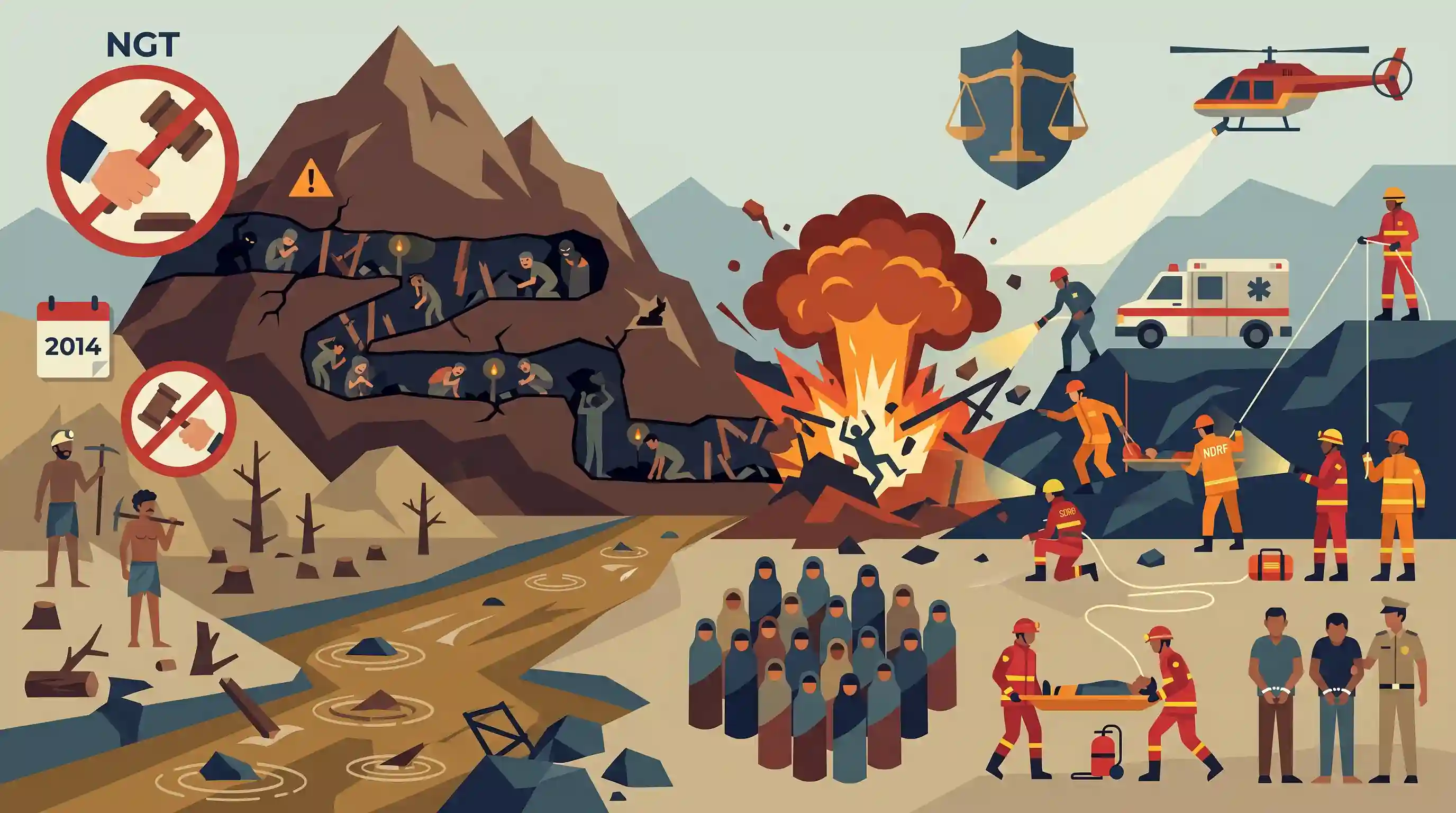
An explosion in an illegal rat-hole coal mine in Meghalaya's East Jaintia Hills has claimed 25 lives, emphasizing severe ongoing governance and safety failures. Despite a 2014 ban by the National Green Tribunal (NGT) on the highly hazardous "rat-hole" mining method, operations continue clandestinely. Joint rescue efforts led by the NDRF and SDRF are ongoing, and two mine owners have been arrested. The tragedy highlights the complex tension between local livelihoods, stringent environmental regulations, and disaster management regarding unregulated, illicit mining practices.
Key Points
- The death toll from an explosion in an illegal rat-hole coal mine in Meghalaya's East Jaintia Hills reached 25.
- Rescue operations are being coordinated by the National Disaster Response Force (NDRF), State Disaster Response Force (SDRF), and local agencies.
- The disaster underscores significant regulatory failures, as the hazardous "rat-hole" mining method was explicitly banned by the National Green Tribunal (NGT) in April 2014 due to extreme safety and environmental risks.
- Authorities arrested two coal mine owners, exposing the persistent illegal mining operations and the challenges of enforcing environmental regulations and occupational safety in the region.
Important Terms
Rat-hole Mining

A primitive coal extraction method where small horizontal tunnels (3-4 feet high) are manually dug into hillsides. It is extremely hazardous and was banned by the NGT in 2014.
UPSC context
GS Papers 1 & 3: Mineral distribution, environmental degradation, and safety hazards in unregulated sectors.
National Green Tribunal (NGT)
A specialized statutory body established under the NGT Act, 2010, for the effective and expeditious disposal of cases relating to environmental protection and forest conservation.
UPSC context
GS Papers 2 & 3: Statutory bodies and their role in environmental governance and judicial activism.
National Disaster Response Force (NDRF)
A specialized force constituted under the Disaster Management Act, 2005, for specialist response to threatening disaster situations, operating under the Ministry of Home Affairs.
UPSC context
GS Paper 3: India's institutional framework for emergency response and specialized rescue operations.
State Disaster Response Force (SDRF)
State-level specialized forces established under the DM Act, 2005, to provide immediate, localized response to disasters within their respective states.
UPSC context
GS Paper 3: Federal disaster response structure and localized crisis management.
Disaster Management Act, 2005
The 2005 central legislation that provides the legal and institutional framework for disaster management in India, including the creation of NDMA and NDRF.
UPSC context
GS Papers 2 & 3: Core act for disaster response, executive powers, and governance.
Mines and Minerals (Development and Regulation) Act (MMDR)
The primary central legislation regulating the mining sector in India, governing leases and the scientific development of mineral resources.
UPSC context
GS Papers 2 & 3: Legal framework for natural resource extraction and industrial regulation.
Prelims Trap
Sixth Schedule areas are exempt from the central MMDR Act due to Autonomous District Council oversight.
The Supreme Court ruled that tribal ownership of sub-surface minerals in Meghalaya does not grant exemption from central laws like the MMDR Act or NGT rulings.
Static Concepts Connected
Who owns and regulates sub-surface minerals in Meghalaya's Sixth Schedule areas?
- Tribal Ownership: The Supreme Court recognizes that local tribals, not the state, own both the surface land and sub-surface minerals.
- Central Law Supremacy: Extraction must still strictly comply with central statutory frameworks like the MMDR Act, Environment Protection Act, and NGT orders.
What is Acid Mine Drainage (AMD) and what is Phycoremediation?
- Acidic Outflow: Exposed sulfur-bearing coal minerals react with air and water to form sulfuric acid, severely acidifying local rivers like the Lukha and Myntdu.
- Phycoremediation: A bioremediation technique using cultivated microalgae to naturally absorb heavy metals and neutralize the acidic pH of polluted water bodies.
Cross-Topic Patterns
Tribal Autonomy vs. Environmental Governance
The crisis highlights the recurring friction between customary land rights under the Sixth Schedule and stringent national environmental mandates enforced by the NGT.
Geology dictates extraction economics
Meghalaya's exceptionally thin coal seams (under 2 meters) make standard open-cast mining economically unviable, sustaining the deadly reliance on manual, unreinforced tunnel extraction.

Expect a Prelims paired-match question on Phycoremediation/Acid Mine Drainage, or a Mains question on 6th Schedule vs Central mining laws.
Linked PYQs · 4
Linked PYQs · 4
- 2025MainsGS3
Mineral resources are fundamental to the country's economy and these are exploited by mining. Why is mining considered an environmental hazard? Explain the remedial measures required to reduce the environmental hazard due to mining.
- 2018PrelimsGS1
How is the National Green Tribunal (NGT) different from the Central Pollution Control Board (CPCB)? 1. The NGT has been established by an Act whereas the CPCB has been created by an executive order of the Government. 2. The NGT provides environmental justice and helps reduce the burden of litigation in the higher courts whereas the CPCB promotes cleanliness of streams and wells, and aims to improve the quality of air in the country. Which of the statements given above is/are correct?
- 2020MainsGS3
Discuss the recent measures initiated in disaster management by the Government of India departing from the earlier reactive approach.
- 2014MainsGS3
Environmental Impact Assessment studies are increasingly undertaken before a project is cleared by the Government. Discuss the environmental impacts of coal-fired thermal plants located at coal pitheads.
