Meghalaya Rat Hole Mining Ban Violations and Disaster Risks
Source:The Hindu ↗
Why It Matters
This incident exemplifies the challenges of environmental governance in India, illustrating the gap between judicial mandates (NGT/Supreme Court bans) and grassroots enforcement. It serves as a critical case study for UPSC aspirants on the socioeconomic and environmental consequences of illegal mining, the role of statutory bodies, and disaster response mechanisms.
Summary
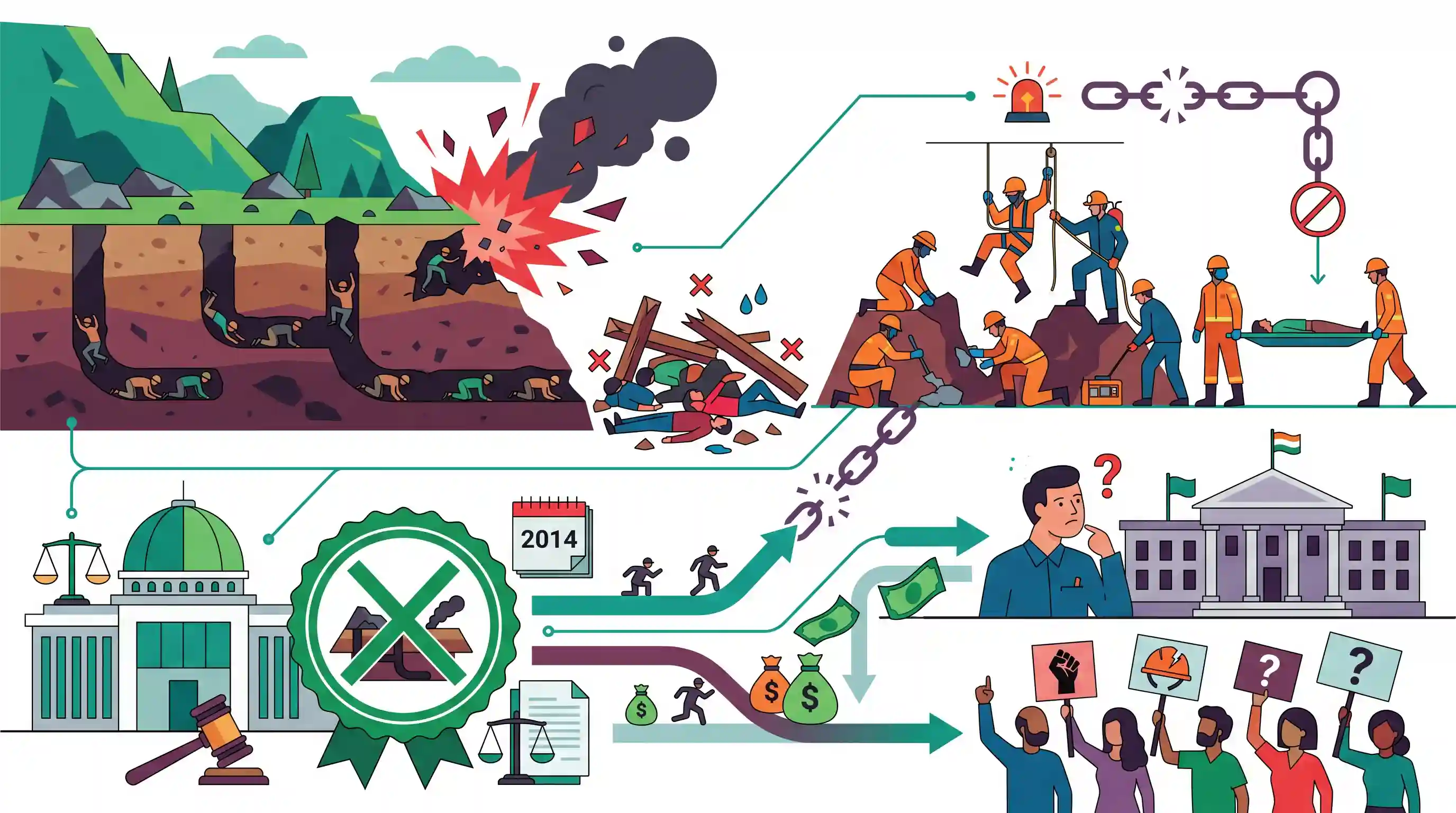
At least 27 people have died following a blast at an illegal 'rat-hole' coal mine in Meghalaya's East Jaintia Hills district. Rescue operations are currently being led by the NDRF and SDRF to recover bodies and search for survivors. The incident puts a spotlight on the controversial practice of rat-hole mining, which involves digging narrow tunnels to extract coal. Although the National Green Tribunal (NGT) banned the practice in 2014 and the Supreme Court upheld the ban, illegal operations have continued to thrive. The disaster has prompted civic groups to criticize the state government for failing to enforce environmental regulations and ensure the safety of vulnerable workers.
Key Points
- A blast at an illegal rat-hole coal mine in Meghalaya's East Jaintia Hills district has resulted in the deaths of at least 27 miners.
- Rescue and recovery operations are being conducted by the National Disaster Response Force (NDRF) and the State Disaster Response Force (SDRF).
- Rat-hole mining, a hazardous practice involving narrow, horizontal tunnels, was banned by the National Green Tribunal (NGT) in 2014, a decision later upheld by the Supreme Court.
- Despite the judicial bans, illegal mining operations have persisted in the region, leading civic organizations to demand strict accountability from the state government.
- The tragedy highlights severe governance failures in enforcing environmental and mining regulations, as well as the recurrent safety hazards of unregulated extraction.
Important Terms
Rat-hole mining

A manual, unscientific coal extraction method involving digging narrow 3-4 feet tunnels to reach thin coal seams. Prevalent in Meghalaya, it is notoriously hazardous and causes significant ecological damage, such as water acidification.
UPSC context
GS III: Environment & Disaster Management; tests knowledge of illegal mining impacts, labor safety, and environmental governance in ecologically sensitive zones.
National Green Tribunal (NGT)
A statutory judicial body established under the NGT Act (2010) for the effective and expeditious disposal of environmental cases. It banned rat-hole mining in 2014 citing severe environmental degradation and worker safety concerns.
UPSC context
GS II: Statutory Bodies & GS III: Environment; tests understanding of specialized adjudication mechanisms and their role in ecological preservation.
Supreme Court of India
India's highest judicial body. In this context, it upheld the NGT's authority but clarified that mining could resume if conducted legally under the Mines and Minerals (Development and Regulation) Act, 1957.
UPSC context
GS II: Judiciary; tests understanding of the court’s role in balancing tribal land rights with national environmental and industrial laws.
National Disaster Response Force (NDRF)
A specialized federal force established under the Disaster Management Act, 2005, for undertaking search, rescue, and relief operations during natural or man-made disasters. It plays a lead role in mining rescue operations.
UPSC context
GS III: Disaster Management; tests knowledge of the institutional framework for emergency response and the execution of the 2005 Act.
State Disaster Response Force (SDRF)
The state-level counterpart to the NDRF, constituted under the Disaster Management Act, 2005. It provides the first specialized response at the state level during notified disasters or emergencies.
UPSC context
GS III: Disaster Management; tests understanding of localized relief mechanisms and state-level coordination with central agencies during disasters.
Prelims Trap
Mining operations in Sixth Schedule areas are completely exempt from the Mines and Minerals (Development and Regulation) Act.
While tribal communities have mineral ownership rights in Sixth Schedule areas, the Supreme Court clarified they are not exempt from central regulatory oversight and must comply with the MMDR Act.
Static Concepts Connected
What is rat-hole mining and what are its primary hazards?
- Definition: A primitive manual extraction technique using extremely narrow tunnels (3-4 feet high), uniquely prevalent in Meghalaya due to exceptionally thin coal seams.
- Acid Mine Drainage: Exposed coal seams leach sulfuric acid into groundwater and rivers, a phenomenon known as acid mine drainage, which kills aquatic life and renders water toxic.
- Subsidence and Flooding: Unscientific digging leaves pillars weak, making these illegal mines highly susceptible to flooding and catastrophic cave-ins, trapping workers.
What is the statutory basis of the National Disaster Response Force (NDRF)?
- Statutory Origin: The NDRF was constituted under Section 44 of the Disaster Management Act, 2005, for specialized response to natural and man-made disasters.
- Apex Control: It functions under the overarching control, direction, and supervision of the National Disaster Management Authority (NDMA), which is chaired by the Prime Minister.
- Composition: The force is drawn on deputation from various Central Armed Police Forces (CAPFs) such as the CRPF, BSF, CISF, and ITBP.
Cross-Topic Patterns
Sixth Schedule rights vs. Central regulations
The Meghalaya crisis highlights the persistent tension between indigenous mineral ownership rights under the Sixth Schedule and the enforcement of central environmental regulations like the MMDR Act and EPA.
Acid mine drainage and river ecology
Unregulated coal extraction directly connects to riverine toxicity, notably causing acid mine drainage (sulfuric acid leaching) that devastates aquatic life in downstream transboundary rivers like the Kopili.

A 2026 Prelims question will likely merge NGT's rat-hole mining ban, MMDR Act applicability in Sixth Schedule areas & acid mine drainage.
Linked PYQs · 4
Linked PYQs · 4
- 2025MainsGS3
Mineral resources are fundamental to the country's economy and these are exploited by mining. Why is mining considered an environmental hazard? Explain the remedial measures required to reduce the environmental hazard due to mining.
- 2022MainsGS2
“The most significant achievement of modern law in India is the constitutionalization of environmental problems by the Supreme Court.” Discuss this statement with the help of relevant case laws.
- 2023PrelimsGS1
Consider the following statements regarding mercury pollution: 1. Gold mining activity is a source of mercury pollution in the world. 2. Coal-based thermal power plants cause mercury pollution. 3. There is no known safe level of exposure to mercury. How many of the above statements are correct?
- 2019MainsGS3
Coastal sand mining, whether legal or illegal, poses one of the biggest threats to our environment. Analyze the impact of sand mining along the Indian coasts, citing specific examples.
