Ladakh statehood demand and Sixth Schedule agitation
Source:Indian Express ↗
Why It Matters
Ladakh's demand for Sixth Schedule status and statehood is a prime case study for GS-II, illustrating the complex dynamics between strategic central control of border Union Territories and the constitutional aspirations of tribal populations seeking political and cultural self-governance.
Summary
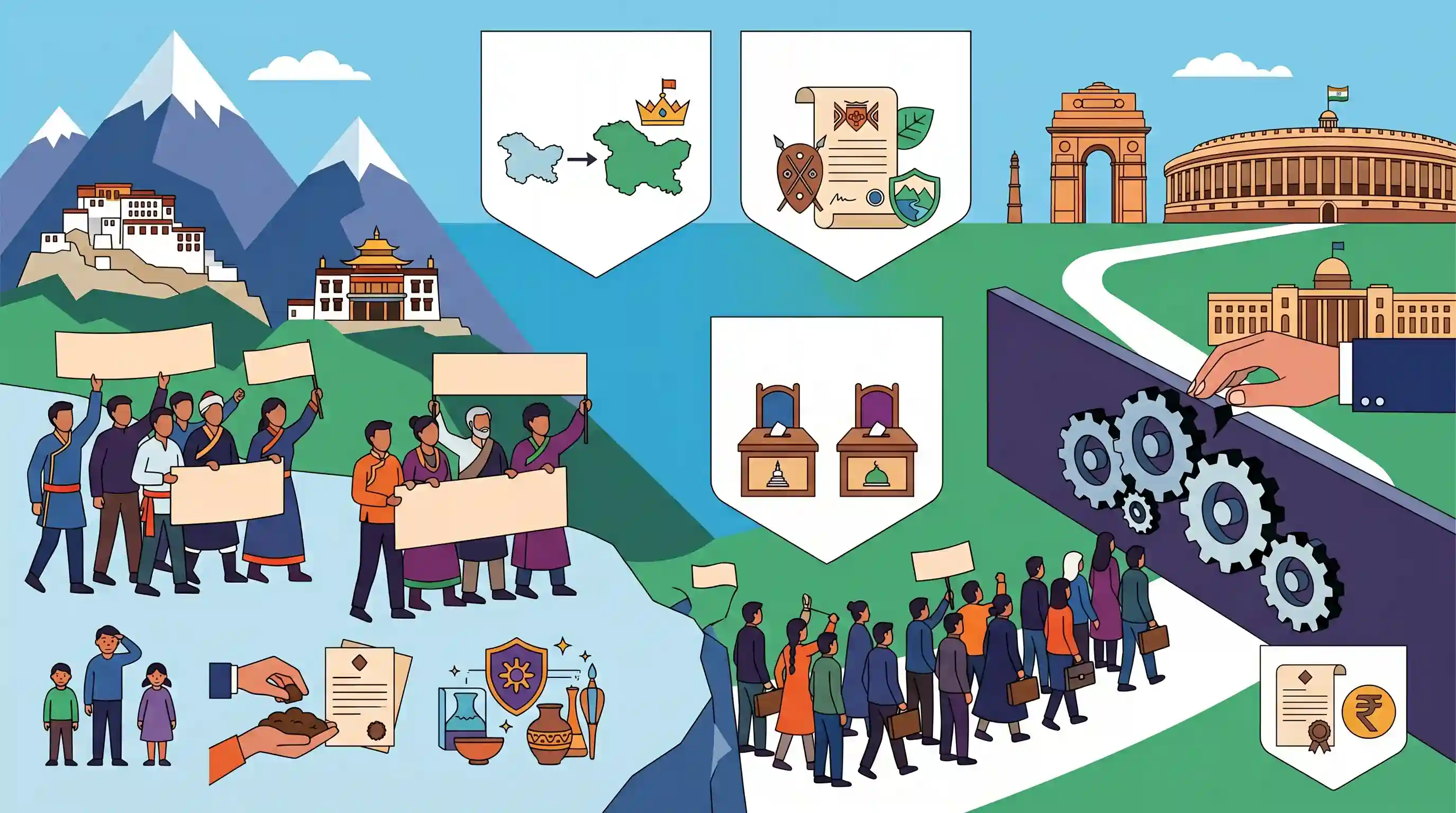
Socio-political groups in Ladakh, primarily the Leh Apex Body and the Kargil Democratic Alliance, are preparing to launch a protest in Delhi as talks with the Central government remain stalled. The groups have been advocating for a core four-point agenda: granting statehood to Ladakh, protecting the region under the Sixth Schedule of the Constitution, ensuring local job reservations, and providing separate Lok Sabha seats for the Leh and Kargil districts. The planned stir reflects deepening local anxieties over political marginalization, land rights, and cultural identity since Ladakh's transition to a Union Territory.
Key Points
- Socio-political organizations from Ladakh, including the Leh Apex Body (LAB) and Kargil Democratic Alliance (KDA), are planning a protest in Delhi.
- Their four-point agenda includes statehood for Ladakh, inclusion under the Sixth Schedule of the Constitution, job reservations for locals, and separate parliamentary seats for Leh and Kargil.
- The planned protest follows stalled and protracted negotiations with the Central government regarding these demands.
- The unrest highlights the ongoing tension over democratic representation, tribal autonomy, and land rights following Ladakh's reorganization into a Union Territory without a legislature in 2019.
Important Terms
Sixth Schedule of the Constitution

Constitutional provisions (Article 244) establishing Autonomous District Councils with legislative and executive powers to protect tribal culture, land, and customs in specific regions.
UPSC context
GS Paper II: Polity. Tests knowledge of tribal autonomy, asymmetrical federalism, and administrative frameworks for sensitive regions.
Leh Apex Body (LAB)
A socio-political coalition in Leh representing religious and social organizations, advocating for Ladakh's statehood and constitutional protections for land and jobs.
UPSC context
GS Paper II: Polity. Relevant to regional political movements and the evolution of governance in Union Territories.
Kargil Democratic Alliance (KDA)
A platform of political and social groups in Kargil district that coordinates with the Leh Apex Body to demand regional autonomy and statehood.
UPSC context
GS Paper II: Polity. Illustrates the dynamics of regional cooperation and democratic aspirations in post-2019 Ladakh.
Statehood
The status of a region as a primary unit of the Indian Union with its own elected legislature, possessing more autonomy than a Union Territory.
UPSC context
GS Paper II: Federalism. Important for understanding state reorganization and the constitutional criteria for regional self-governance.
Ministry of Home Affairs (MHA)
The nodal central ministry responsible for internal security and Union Territory administration, currently conducting the high-level dialogue process with Ladakh's leadership.
UPSC context
GS Paper II: Governance. Crucial for studying the executive's role in managing federal disputes and administrative oversight of UTs.
Prelims Trap
The President can extend the Sixth Schedule to the Union Territory of Ladakh by simply issuing a notification.
Extending the 6th Schedule beyond the four Northeastern states (AMTM) requires a Constitutional Amendment by Parliament under Article 368, not merely a Presidential notification.
Static Concepts Connected
How do the 5th and 6th Schedules differ in their administrative models?
- Fifth Schedule: Applies to scheduled areas outside the Northeast. It relies on Tribes Advisory Councils (TACs), which are largely advisory to the Governor.
- Sixth Schedule: Applies only to Assam, Meghalaya, Tripura, Mizoram. It creates Autonomous District Councils (ADCs) with actual legislative, judicial, and taxation powers.
- Degree of Autonomy: While 5th Schedule depends heavily on the Governor's executive direction, the 6th Schedule functions almost as a 'mini-state' within a state.
How is a Union Territory without a legislature administered?
- Article 239: Administered directly by the President, acting through an appointed Administrator (usually a Lieutenant Governor), rather than by an elected local government.
- Parliamentary Control: Parliament holds absolute power to make laws on any subject, including those in the State List, for such Union Territories.
Cross-Topic Patterns
Eco-fragility and Constitutional Shields
Ladakh's demands merge tribal identity with environmental anxiety. Securing Sixth Schedule land rights is increasingly viewed by locals as a constitutional shield against unchecked corporate infrastructure and mining in eco-fragile zones.
Border Security vs. Democratic Autonomy
The Centre's reluctance to grant statehood reflects a broader pattern of prioritizing direct federal control in highly sensitive border regions (China/Pakistan) over local democratic autonomy, mirroring post-370 J&K dynamics.

A multi-statement Prelims question in 2026 is highly likely to contrast 5th vs 6th Schedule powers and the criteria for their inclusion.
Linked PYQs · 3
Linked PYQs · 3
- 2015PrelimsGS1
The provisions in Fifth Schedule and Sixth Schedule in the Constitution of India are made in order to
- 2022PrelimsGS1
If a particular area is brought under the Fifth Schedule of the Constitution of India, which one of the following statements best reflects the consequence of it ?
- 2022MainsGS2
“While the national political parties in India favour centralisation, the regional parties are in favour of State autonomy.” Comment.
