Meerut Student Death Controversy and NHRC Notice to Police
Source:The Hindu ↗
Why It Matters
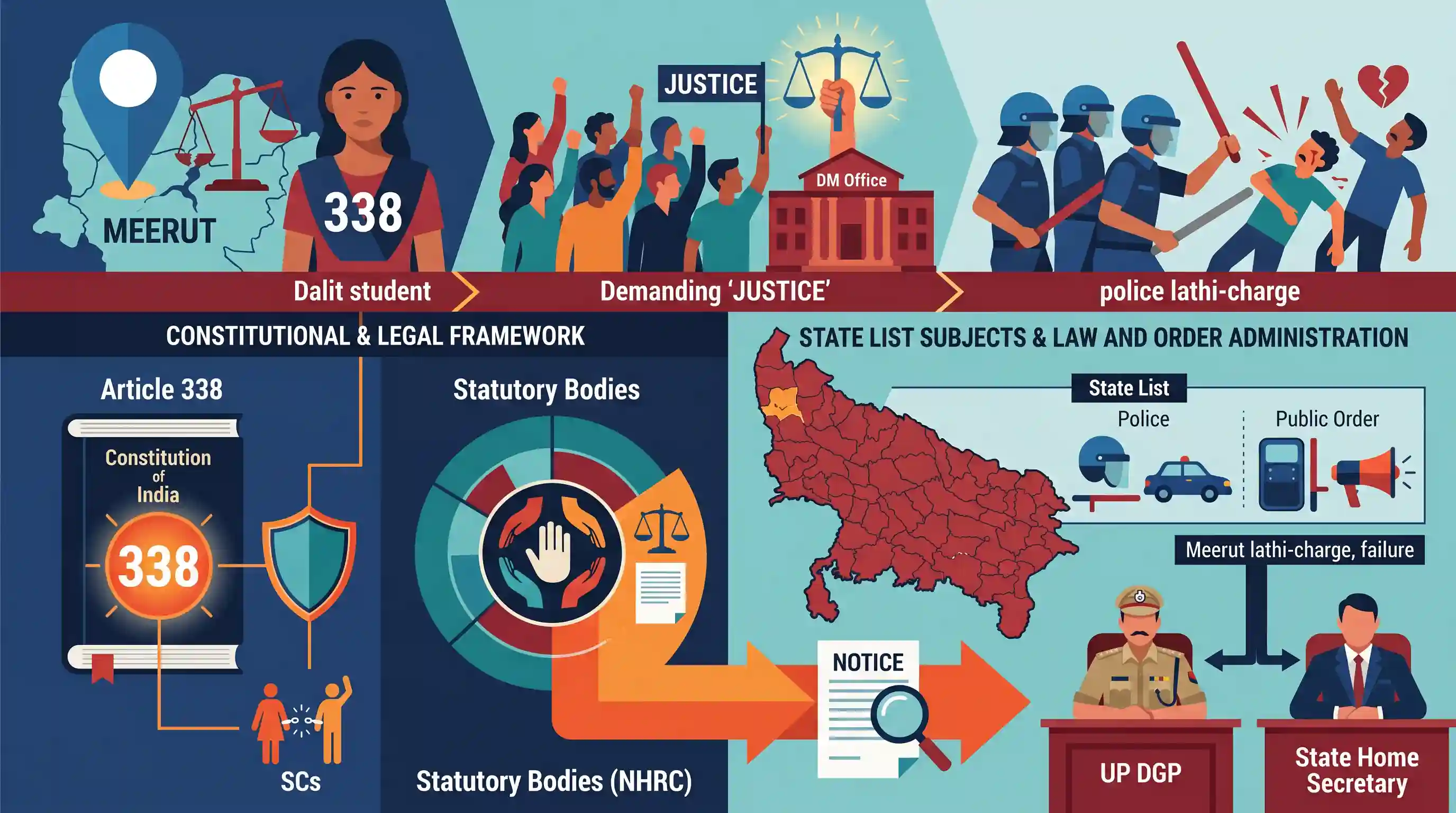
This article is highly relevant for UPPSC GS Paper-II (Polity & Governance). It touches upon the mandate and powers of the National Human Rights Commission (NHRC), constitutional safeguards for Scheduled Castes under Article 338 (NCSC), the division of legislative powers under the Seventh Schedule (Police as a State List subject), and district-level administrative dynamics in Uttar Pradesh.
Summary
The article reports on the political and human rights controversy in Meerut, Uttar Pradesh, following the death of a Dalit student, Lalita Gautam. Protests over her death led to a police lathi-charge near the DM's office, which MP Chandrashekhar Azad and other leaders termed excessive and brutal. In response to complaints, the National Human Rights Commission (NHRC) issued a notice to the UP DGP and State Home Secretary seeking a detailed investigation report.
Key Points
- A massive protest erupted in Meerut, Uttar Pradesh, following the alleged murder of a Dalit student, Lalita Gautam, who went missing on May 15 and was found dead on May 17.
- The protests turned violent as demonstrators attempted to enter the District Magistrate's (DM) office, prompting police to use force and initiate a lathi-charge.
- Nagina MP Chandrashekhar Azad (chief of the Azad Samaj Party-Kanshi Ram) condemned the police action, calling it 'unprovoked and brutal' and accusing the police of using excessive force against peaceful demonstrators.
- Following complaints regarding the police lathi-charge, the National Human Rights Commission (NHRC) issued a notice to the Uttar Pradesh DGP and State Home Secretary demanding a detailed report on the incident.
- BSP chief Mayawati also commented on the issue, cautioning against political exploitation of such tragic events while demanding justice for the victim's family.
Important Terms
National Human Rights Commission

A statutory watchdog established in 1993 under the Protection of Human Rights Act to protect and promote rights relating to life, liberty, equality, and dignity of individuals in India.
UPSC context
GS Paper II (Polity & Governance): Tests knowledge of statutory bodies, their composition, and their role in protecting citizens' rights.
Protection of Human Rights Act 1993
The central legislation that provides the statutory framework for establishing the National Human Rights Commission, State Human Rights Commissions, and Human Rights Courts to protect individual rights.
UPSC context
GS Paper II (Polity & Governance): Tests understanding of legislative enactments and institutional frameworks for rights protection.
Article 338 of the Constitution of India
The constitutional provision that establishes the National Commission for Scheduled Castes (NCSC) to safeguard, monitor, and investigate matters protecting the rights and welfare of Scheduled Castes.
UPSC context
GS Paper II (Polity & Governance): Tests knowledge of constitutional bodies and provisions safeguarding marginalized sections.
State List (Seventh Schedule)
The list of subjects under the Seventh Schedule of the Indian Constitution over which State Legislatures have exclusive power to legislate, notably including 'Police' and 'Public Order'.
UPSC context
GS Paper II (Polity & Governance): Tests understanding of federalism, division of legislative powers, and law and order administration.
Prelims Trap
The NHRC can take cognizance of any human rights violation in India, even if a State Human Rights Commission is actively investigating it.
Under Section 36(1) of the Protection of Human Rights Act, 1993, the NHRC is explicitly barred from inquiring into any matter that is already pending before a State Human Rights Commission.
Static Concepts Connected
What are the statutory jurisdiction limits and powers of the NHRC under the PHRA, 1993?
- Civil Court Powers: It possesses all the powers of a civil court to summon witnesses, requisition public records, and receive evidence on affidavits.
- One-Year Limitation: It cannot inquire into any matter after the expiry of one year from the date on which the act constituting human rights violation is alleged to have occurred.
- Recommendatory Character: Its recommendations are advisory and not binding; it cannot directly punish the guilty or award final compensation.
How does Article 338 govern the National Commission for Scheduled Castes (NCSC)?
- Constitutional Evolution: Originally a joint commission, the NCSC was established as a separate constitutional body under Article 338 via the 89th Constitutional Amendment Act, 2003.
- Judicial Powers: While investigating complaints of rights violations against SCs, the NCSC is vested with the powers of a civil court.
- Parliamentary Accountability: The President places NCSC reports before Parliament, alongside a memorandum explaining action taken or reasons for non-acceptance of recommendations.
Cross-Topic Patterns
Police Reforms + Human Rights Accountability
Balances the executive's duty to maintain public order (State List Entry 1 and 2) with the protection of fundamental rights under Article 21, monitored by statutory watchdogs like the NHRC.
NHRC-SHRC Jurisdictional Federalism
The statutory bar preventing NHRC from taking up cases pending before SHRCs highlights federal boundary lines designed to prevent overlapping jurisdictions.

NHRC's statutory limitations (1-year bar, SHRC override) versus NCSC's constitutional powers likely to be tested in GS-2 polity.
Linked PYQs · 2
Linked PYQs · 2
- 2023UPPSC_PRELIMSGS1
Match List-I with List-II and select the correct answer using the code given below the lists. List-I: (A) Article - 324 (B) Article - 315 (C) Article - 280 (D) Article - 338 List-II: 1. National Commission for Scheduled Castes 2. Finance Commission 3. Public Service Commission 4. Election Commission Code -
- 2024UPPSC_PRELIMSGS1
Which one of the following is correctly matched? Constitutional Body — Constitutional Article
