Meerut Metro Commences Operations with Shared RRTS Infrastructure
Source:Indian Express ↗
Why It Matters
The successful implementation of high-speed urban transit systems like the Meerut Metro and RRTS serves as a model for addressing transportation bottlenecks, urban sprawl, and environmental pollution in rapidly growing Indian megacities. It highlights the importance of multi-modal integration and efficient public transport in fostering sustainable economic development.
Summary
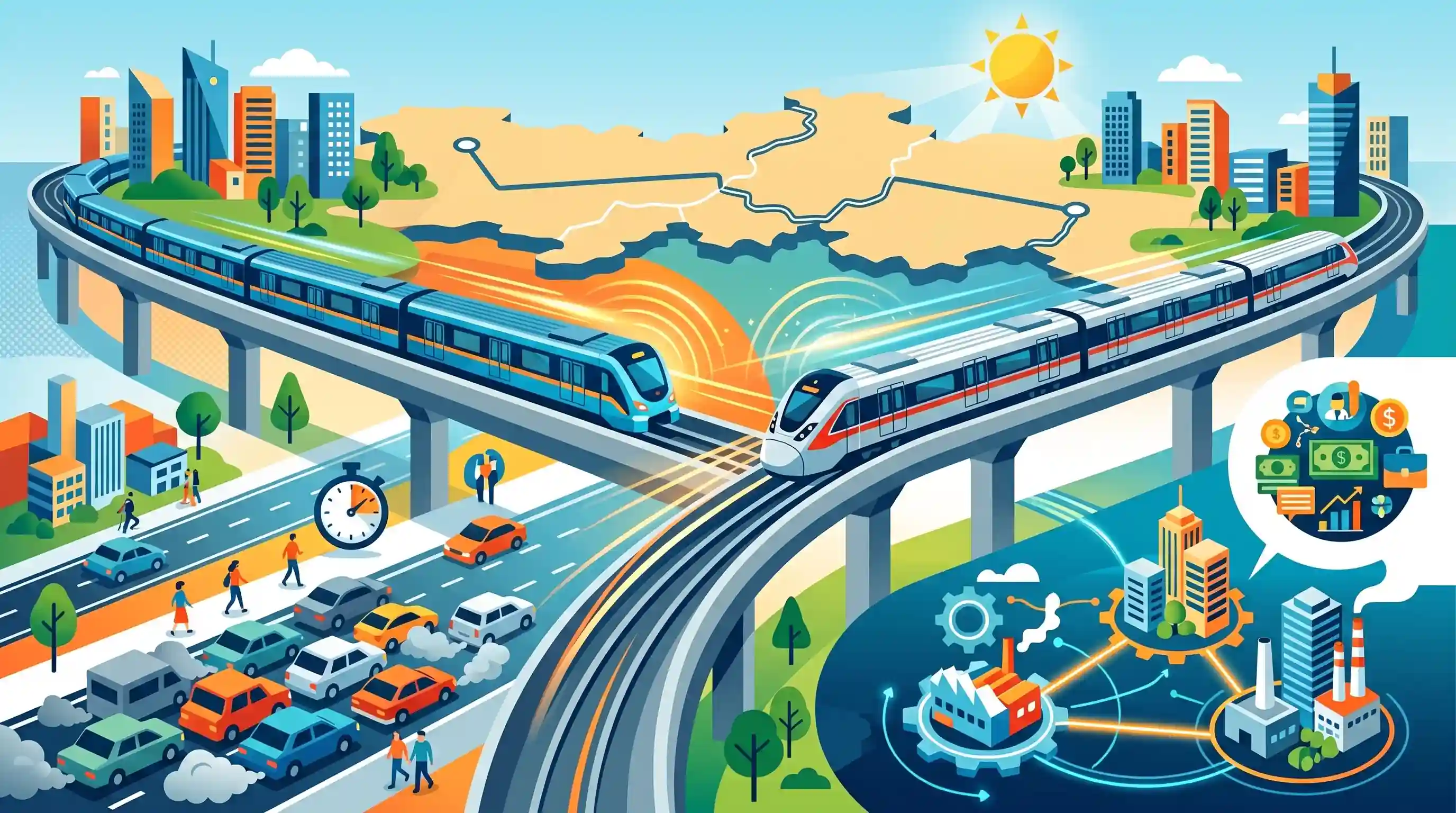
The commercial operation of India's fastest metro train has begun between Meerut South and Modipuram in Uttar Pradesh. Operated by the National Capital Region Transport Corporation (NCRTC), the Meerut Metro is designed to achieve speeds of 135 kmph with an operational speed of 120 kmph. A defining feature of this project is its shared track infrastructure with the Namo Bharat Regional Rapid Transit System (RRTS) trains. This development marks a significant advancement in India's urban mobility infrastructure, aimed at reducing travel time, lowering vehicular congestion in the National Capital Region (NCR), and fostering regional economic integration.
Key Points
- India's fastest metro train, the Meerut Metro, has commenced its commercial operations between Meerut South and Modipuram.
- It features a design speed of 135 kmph and an operating speed of 120 kmph, significantly reducing commute times.
- The Meerut Metro uniquely shares its track infrastructure with the Namo Bharat Regional Rapid Transit System (RRTS) trains.
- The project is spearheaded by the National Capital Region Transport Corporation (NCRTC) and is expected to decongest the National Capital Region (NCR) while promoting regional economic growth.
Important Terms
Regional Rapid Transit System (RRTS)

A semi-high-speed, high-capacity commuter rail network for regional connectivity. It connects urban nodes across the National Capital Region (NCR), operating significantly faster than conventional metro systems.
UPSC context
GS Paper 3 (Infrastructure). Tests knowledge of modern urban mobility, regional integration, and sustainable transit solutions.
Namo Bharat
The official name of India's first RRTS trains. Designed for speeds up to 180 kmph, they facilitate rapid intercity travel between Delhi and Meerut.
UPSC context
GS Paper 3 (Infrastructure). Highlights "Make in India" in high-speed rail and its impact on regional economic productivity.
Meerut Metro
India's fastest metro system, designed for 135 kmph. It is unique for sharing tracks and station infrastructure with the RRTS, a first-of-its-kind integration in India.
UPSC context
GS Paper 3 (Urbanization/Infrastructure). Demonstrates innovative multi-modal transport and cost-efficient urban planning models.
National Capital Region Transport Corporation (NCRTC)
A joint venture between the Union Government and state governments of Delhi, Haryana, Rajasthan, and Uttar Pradesh. It is the nodal agency implementing the RRTS.
UPSC context
GS Paper 2 (Governance/Federalism). Relevant for understanding institutional frameworks and cooperative federalism in mega-infrastructure projects.
Prelims Trap
NCRTC is a 100% Central Government-owned entity under the Ministry of Railways.
NCRTC is not wholly centrally owned. It is a Joint Venture company of the Government of India and four states (Delhi, Haryana, Rajasthan, and Uttar Pradesh).
Static Concepts Connected
How does the RRTS fundamentally differ from conventional Metro rail systems?
- Primary Purpose: RRTS connects regional, inter-city nodes over longer distances (100-250 km), whereas conventional metros serve high-frequency intra-city commuting.
- Operational Speed: RRTS is a semi-high-speed network (designed for up to 180 kmph), significantly faster than typical urban metros.
- Station Spacing: RRTS features fewer stops spaced much further apart, contrasting with metros designed for closely spaced halts.
What are the key pillars of the National Urban Transport Policy (NUTP)?
- Core Philosophy: Focuses explicitly on 'moving people instead of moving vehicles' to ensure equitable allocation of road space and alleviate urban congestion.
- Transit-Oriented Development: Promotes building dense, mixed-use urban spaces within short walking distance of high-capacity public transit nodes.
- Multi-modal Integration: Encourages multi-modal integration, allowing seamless commuter transition between railways, metros, buses, and non-motorized transport.
Cross-Topic Patterns
TOD + Regional Urbanization
RRTS enables Transit-Oriented Development, decongesting megacities by shifting demographic pressure and economic hubs to satellite towns—a key theme in GS1 Urbanization and GS3 Infrastructure.
Cooperative Federalism in Infra
NCRTC's Joint Venture model (GoI plus four state governments) provides a strong GS2 case study for cooperative federalism in executing complex, cross-border infrastructural megaprojects.

A 2026 Prelims question will likely contrast RRTS (Namo Bharat), standard metros, and Vande Bharat based on speed, purpose and ownership.
Linked PYQs · 4
Linked PYQs · 4
- 2014MainsGS3
National Urban Transport Policy emphasises on 'moving people' instead of 'moving vehicles'. Discuss critically the success of the various strategies of the Government in this regard.
- 2019MainsGS1
How is efficient and affordable urban mass transport key to the rapid economic development of India?
- 2023PrelimsGS1
Consider the following infrastructure sectors: 1. Affordable housing 2. Mass rapid transport 3. Health care 4. Renewable energy On how many of the above does UNOPS Sustainable Investments in Infrastructure and Innovation (S3i) initiative focus for its investments?
- 2022MainsGS3
Why is Public Private Partnership (PPP) required in infrastructural projects ? Examine the role of PPP model in the redevelopment of Railway Stations in India.
