Meerut Metro Launch and Uttar Pradesh Urban Transit Network Expansion
Source:Indian Express ↗
Why It Matters
Demonstrates the scale and pace of urban mass transit infrastructure development in India's most populous state, serving as a key example for answers on urbanization, MRTS, and sustainable urban mobility.
Summary
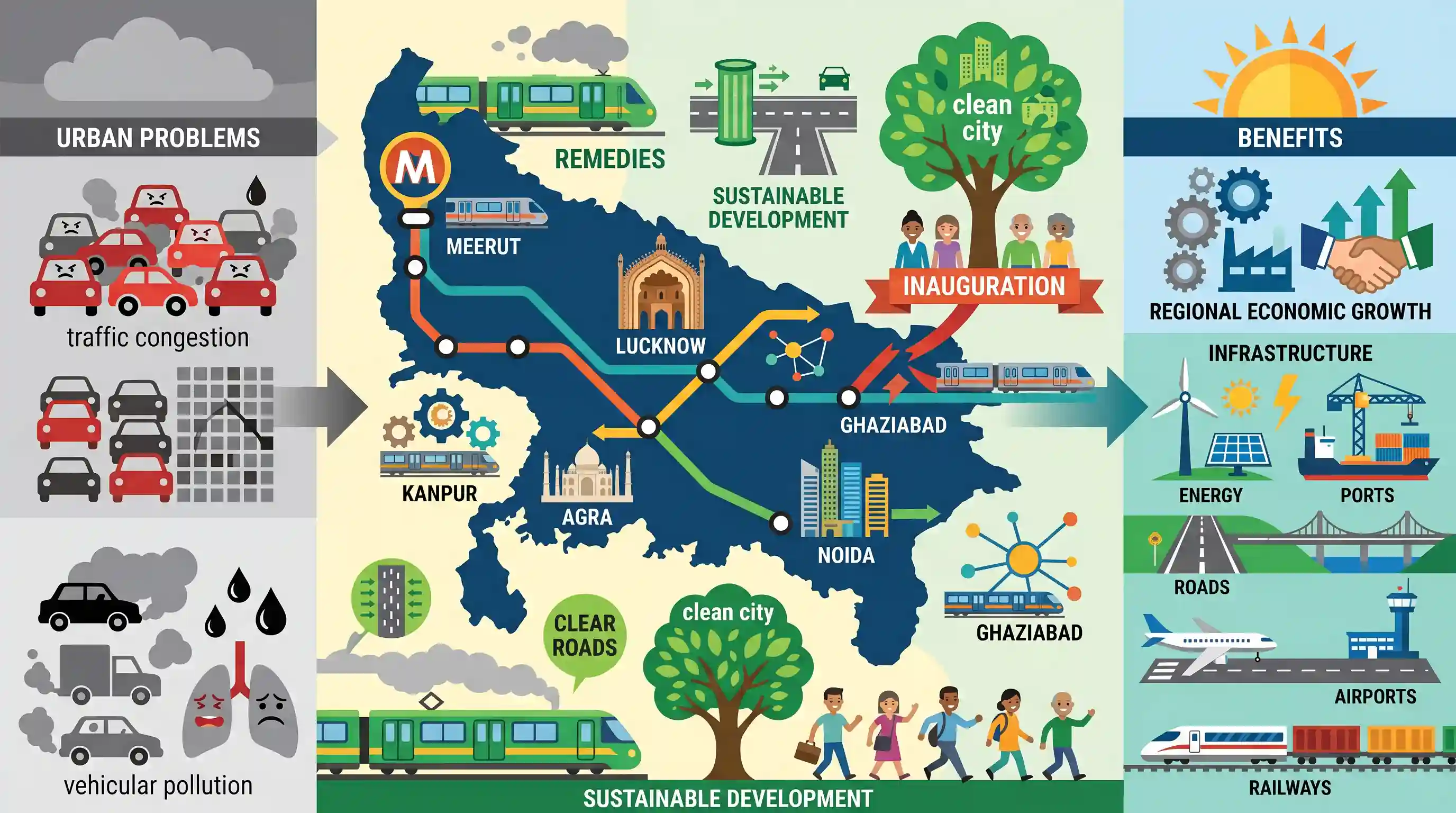
The inauguration of the Meerut Metro is a landmark event for Uttar Pradesh, pushing the state's total operational metro network past the 170 km mark. UP now features active metro transit systems in multiple key urban centers, including Lucknow, Kanpur, Agra, Noida, Ghaziabad, and Meerut. This rapid development of Mass Rapid Transit Systems (MRTS) illustrates a dedicated push towards modernizing urban mobility, reducing vehicular pollution, and alleviating traffic congestion. The expanded network is expected to foster regional economic growth while aligning with national policies that prioritize sustainable public transport and the efficient movement of citizens.
Key Points
- The inauguration of the Meerut Metro expands Uttar Pradesh's total operational metro network to over 170 km.
- UP now has operational metro rail services across multiple major cities, including Lucknow, Kanpur, Agra, Noida, Greater Noida, Ghaziabad, and Meerut.
- This infrastructure expansion aims to provide efficient, affordable, and sustainable urban mass transit to address traffic congestion and pollution.
- The growing metro footprint supports regional economic development and aligns with the national strategy of emphasizing the movement of people rather than vehicles.
Important Terms
Regional Rapid Transit System (RRTS)

A semi-high-speed, high-frequency rail system designed for inter-city travel between regional urban nodes. It operates at speeds up to 180 kmph, serving longer distances with fewer stops than conventional metro systems.
UPSC context
Relevant for GS Paper III (Infrastructure). It tests knowledge of modern multi-modal transport solutions and the "Namo Bharat" initiative for regional connectivity.
National Capital Region Transport Corporation (NCRTC)
A joint venture company of the Union Government and the states of Delhi, Haryana, Rajasthan, and Uttar Pradesh. It is the nodal agency implementing the RRTS project across the National Capital Region.
UPSC context
Relevant for GS Paper II (Statutory/Regulatory Bodies) and Paper III. Tests understanding of cooperative federalism in infrastructure development and special purpose vehicles.
National Urban Transport Policy (NUTP)
A 2006 policy framework by the Ministry of Housing and Urban Affairs that advocates for "people-centric" rather than "vehicle-centric" urban mobility, prioritizing sustainable public transport and non-motorized transit.
UPSC context
Key for GS Paper II (Government Policies) and Paper III. It is the foundational framework for urban transport and sustainable city planning in India.
Mass Rapid Transit System (MRTS)
High-capacity urban public transport systems, including Metros and RRTS, that operate on a dedicated right-of-way. They are designed to move large numbers of people quickly while reducing road congestion and pollution.
UPSC context
A central theme in GS Paper III (Infrastructure/Urbanization). Tests knowledge of sustainable urban development and the remedies for urban traffic and environmental issues.
Uttar Pradesh Metro Rail Corporation (UPMRC)
A 50:50 joint venture between the Government of India and the Government of Uttar Pradesh. It manages the development and operation of metro projects in Lucknow, Kanpur, and Agra.
UPSC context
Relevant for GS Paper III (Infrastructure). Highlights the state-level execution of mass transit systems and the "Metro Pradesh" vision of Uttar Pradesh.
Prelims Trap
Metro rail and semi-high-speed RRTS trains must operate on strictly separate track infrastructure.
Meerut Metro pioneers a unique shared-infrastructure model, running intra-city metro trains on the exact same physical tracks as the semi-high-speed Namo Bharat RRTS.
Static Concepts Connected
What are the mandatory mandates of the Metro Rail Policy 2017 for availing central funding?
- PPP Component: Makes private enterprise participation (PPP) a mandatory requisite for availing central financial assistance for new metro projects.
- Transit-Oriented Development: Requires states to integrate land use plans and commit to TOD around transit corridors to boost non-fare revenue.
- Last-mile Connectivity: Mandates the provision of non-motorized transport pathways and feeder services at metro stations to ensure end-to-end mobility.
What is the core paradigm shift introduced by the National Urban Transport Policy (NUTP) 2006?
- Moving People: Shifting the focus of urban planning and infrastructure design from 'moving vehicles' to 'moving people'.
- Equitable Space Allocation: Prioritizing equitable allocation of road space for public transit and non-motorized transport over personal motor vehicles.
Cross-Topic Patterns
Multi-nodal urban vs Primate city model
UP’s metro expansion across seven distinct cities deliberately contrasts with the "primate city" urbanization model, preventing the over-concentration of population and infrastructure seen in single megacities like Bengaluru.
Shared infra & ETCS Level 2 signaling
Running local metros and regional RRTS on the exact same tracks relies on advanced ETCS Level 2 signaling, optimizing capital expenditures and drastically reducing parallel land acquisition bottlenecks.

Expect a Prelims statement testing the Metro Rail Policy 2017's mandatory PPP/TOD clauses alongside RRTS-Metro track-sharing technology.
Linked PYQs · 3
Linked PYQs · 3
- 2014MainsGS3
National Urban Transport Policy emphasises on 'moving people' instead of 'moving vehicles'. Discuss critically the success of the various strategies of the Government in this regard.
- 2019MainsGS1
How is efficient and affordable urban mass transport key to the rapid economic development of India?
- 2021MainsGS3
“Investment in infrastructure is essential for more rapid and inclusive economic growth.” Discuss in the light of India's experience.
