Representation of People Act Provisions Govern Nomination Rejections
Source:Indian Express ↗
Why It Matters
It clarifies the procedural limitations on judicial intervention during the electoral process (Article 329) and details the specific grounds and remedies available under the RPA 1951 for election disputes, which are frequent subjects in GS-2 Mains questions.
Summary
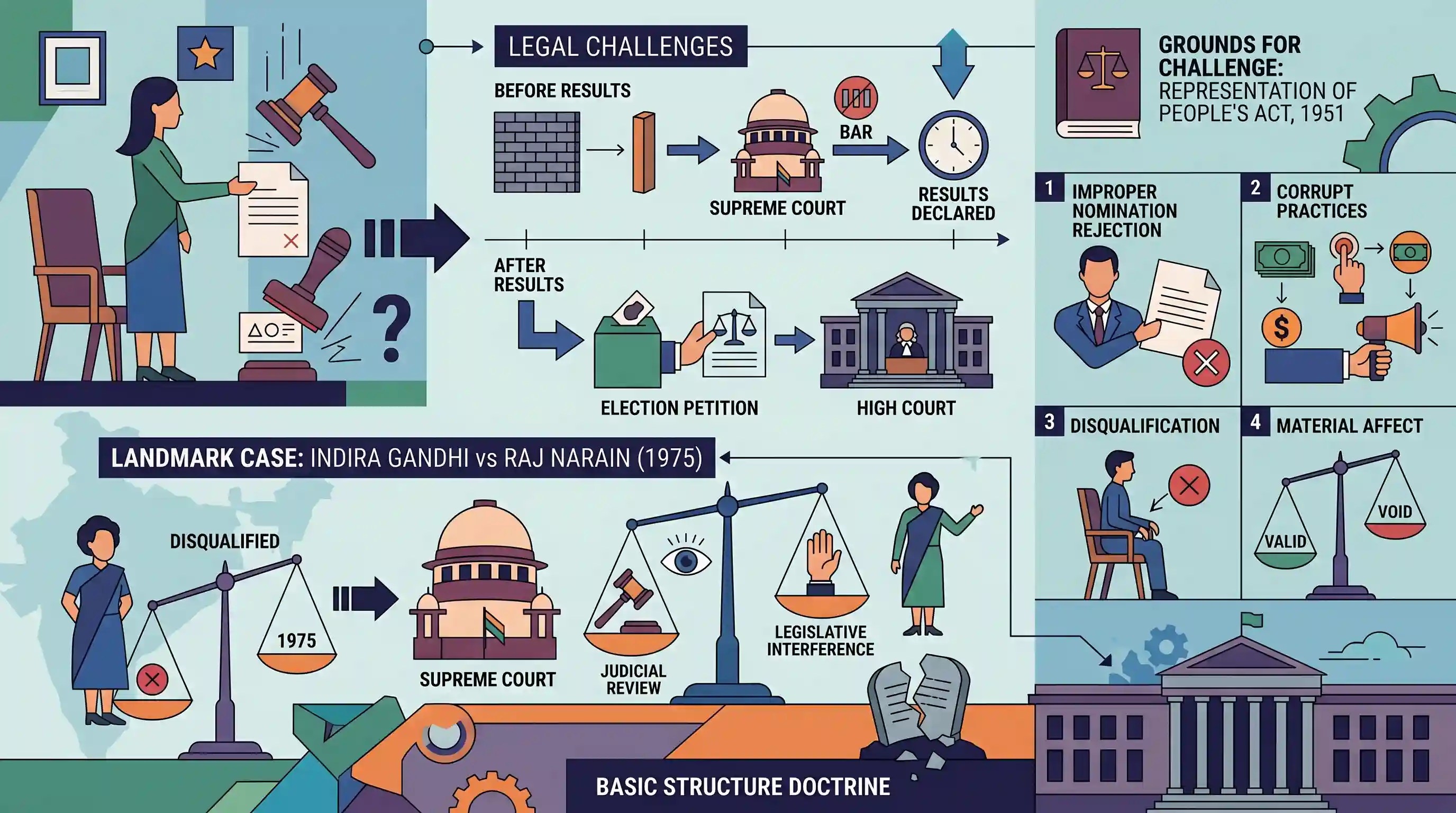
The article discusses the legal mechanisms for challenging an election in India, prompted by the rejection of Congress leader Meenakshi Natarajan's Rajya Sabha nomination due to incomplete disclosure of criminal antecedents. It details provisions under the Representation of the People Act (RPA), 1951, and the Constitution (Article 329), stipulating that elections can only be contested post-result via an election petition in a High Court. The piece highlights grounds for declaring elections void, such as improper nomination rejections or corrupt practices, and recalls the landmark 1975 Indira Gandhi vs Raj Narain verdict to underscore the judiciary's role in electoral disputes.
Key Points
- Congress leader Meenakshi Natarajan's nomination for the Rajya Sabha from Madhya Pradesh was rejected because she failed to disclose details of an FIR against her, violating Section 33A of the Representation of the People Act (RPA), 1951.
- Under Article 329(b) of the Constitution, once the election process begins, courts cannot intervene; the only recourse is an election petition filed in the relevant High Court within 45 days of the result declaration.
- Section 100 of the RPA, 1951 allows the High Court to declare an election void on grounds such as corrupt practices, improper rejection of a nomination, or the candidate being unqualified.
- Appeals against the High Court's decision on an election petition can be moved to the Supreme Court.
- The historic 1975 case of Indira Nehru Gandhi vs Raj Narain was cited, where the Allahabad High Court unseated the PM for corrupt electoral practices.
Important Terms
Representation of the People Act, 1951

A foundational law regulating the conduct of elections to Parliament and State Legislatures, including candidate qualifications, disqualifications, and the resolution of electoral disputes.
UPSC context
GS Paper II: Essential for topics on electoral reforms and the legal framework governing Indian democracy.
Article 329
A constitutional provision that bars courts from interfering in election processes, stipulating that election results can only be challenged via an election petition.
UPSC context
GS Paper II: Highlights the constitutional limits on judicial intervention in the timing and conduct of elections.
Election Petition
The exclusive legal mechanism to challenge the validity of a candidate's election; it must be filed in a High Court within 45 days of results.
UPSC context
GS Paper II: A key topic under the RPA 1951 regarding electoral dispute resolution and judicial oversight.
Corrupt Practices
Malpractices defined under Section 123 of the RPA 1951, such as bribery or undue influence, which serve as grounds for voiding an election result.
UPSC context
GS Paper II: Relates to criminalization of politics and maintaining the purity of the electoral process.
Indira Gandhi vs Raj Narain Case (1975)
A landmark 1975 Supreme Court ruling that established free and fair elections as part of the 'Basic Structure' of the Indian Constitution.
UPSC context
GS Paper II: Critical case study for judicial review, basic structure doctrine, and electoral integrity.
Prelims Trap
The Supreme Court has original jurisdiction to hear election petitions challenging the election of Members of Parliament.
The High Court has exclusive original jurisdiction over election petitions for MPs/MLAs under the RPA 1951. The Supreme Court only has appellate jurisdiction here, though it holds original jurisdiction for Presidential elections.
Static Concepts Connected
What is the judicial mechanism for handling MP and MLA election disputes?
- Original Jurisdiction: Under the Representation of the People Act, 1951, the relevant State High Court holds exclusive original jurisdiction to hear and decide election petitions.
- Post-Result Recourse: Once the election process begins, Article 329(b) bars judicial interference. A petition can only be filed within 45 days after the election results are declared.
- Appellate Mechanism: Appeals against the High Court's final order on an election petition lie directly with the Supreme Court under Section 116A of the RPA.
Under what specific grounds can a High Court declare an election void?
- Improper Nomination: If a candidate's nomination was improperly rejected or accepted, such as failing to disclose pending criminal cases under Section 33A of the RPA.
- Corrupt Practices: If the returned candidate, or their election agent, committed corrupt electoral practices as strictly defined in Section 123 of the RPA.
- Unqualified Candidate: If the candidate was not qualified, or was disqualified to be chosen to fill the seat on the date of their election.
Cross-Topic Patterns
Voter's Right to Know & RPA 1951
The mandate to disclose criminal antecedents (Section 33A) flows from the Supreme Court's ADR judgment (2002), directly linking the RPA 1951 to a voter's fundamental Right to Know under Article 19(1)(a).
Judicial Review vs Article 329(b) bar
While judicial review is a basic feature, Article 329(b) restricts courts from stalling ongoing elections, reflecting a constitutional balance between judicial oversight and the uninterrupted completion of democratic processes.

Expect a 2026 question contrasting dispute resolution for MP/MLA elections (High Court) vs Presidential elections (Supreme Court).
Linked PYQs · 5
Linked PYQs · 5
- 2022MainsGS2
Discuss the procedures to decide the disputes arising out of the election of a Member of the Parliament or State Legislature under The Representation of the People Act, 1951. What are the grounds on which the election of any returned candidate may be declared void ? What remedy is available to the aggrieved party against the decision ? Refer to the case laws.
- 2019MainsGS2
On what grounds a people's representative can be disqualified under the Representation of Peoples Act, 1951? Also mention the remedies available to such person against his disqualification.
- 2020MainsGS2
There is a need for simplification of procedure for disqualification of persons found guilty of corrupt practices under the Representation of Peoples Act". Comment.
- 2025MainsGS2
Discuss the 'corrupt practices' for the purpose of the Representation of the People Act, 1951. Analyze whether the increase in the assets of the legislators and/or their associates, disproportionate to their known sources of income, would constitute 'undue influence' and consequently a corrupt practice.
- 2020PrelimsGS1
Consider the following statements: 1. According to the Constitution of India, a person who is eligible to vote can be made a minister in a State for six months even if he/she is not a member of the Legislature of that State. 2. According to the Representation of People Act, 1951, a person convicted of a criminal offence and sentenced to imprisonment for five years is permanently disqualified from contesting an election even after his release from prison. Which of the statements given above is/are correct?
