Himachal Pradesh Doctors Strike and Public Healthcare Disruption
Source:Indian Express ↗
Why It Matters
This event exemplifies the critical vulnerability of public healthcare delivery systems in India when essential personnel strike. It is highly relevant for GS2 discussions on healthcare governance and GS4 debates on professional ethics and devotion to public service duty.
Summary
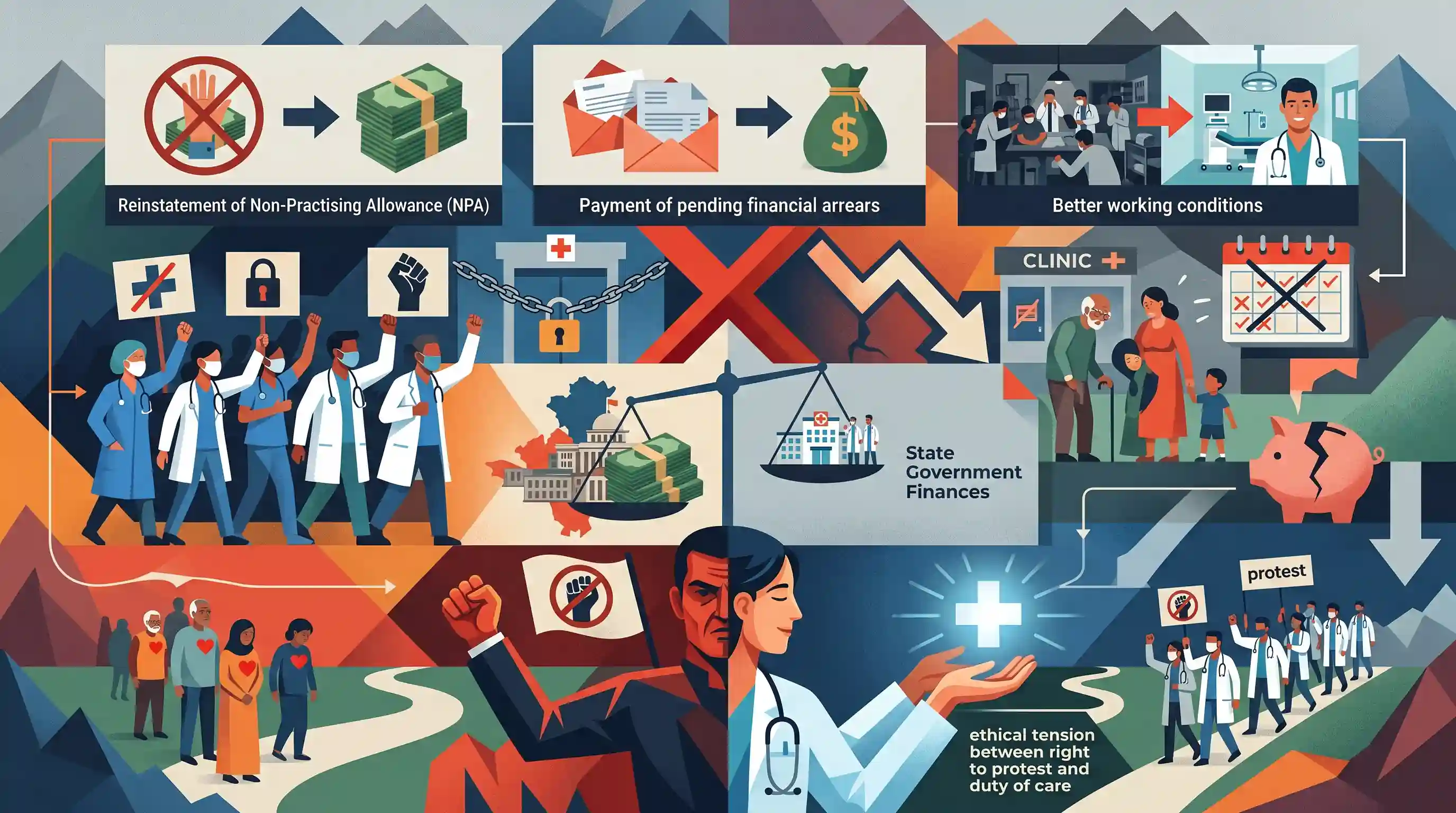
Medical services across Himachal Pradesh have been severely disrupted as doctors go on an indefinite strike. The medical practitioners are demanding the reinstatement of the Non-Practising Allowance (NPA), payment of pending financial arrears, and better working conditions. The suspension of routine services highlights severe systemic gaps in healthcare administration and state government finances. Crucially, it brings to the fore the ethical tension between medical professionals' right to protest for legitimate grievances and their overarching duty of care towards vulnerable patients.
Key Points
- Doctors in Himachal Pradesh initiated an indefinite strike, bringing routine medical services and OPDs to a halt across the state.
- The strike stems from unfulfilled demands, primarily the restoration of the Non-Practising Allowance (NPA) and the clearance of long-pending financial arrears.
- The disruption exposes systemic vulnerabilities in the public healthcare system and underscores the challenges faced by state governments in managing health sector human resources.
- The situation poses a classic ethical dilemma: balancing a medical professional's right to agitate for fair compensation against the fundamental duty of care and the Hippocratic Oath.
Important Terms
Non-Practising Allowance (NPA)

Financial compensation paid to government doctors to discourage private practice, ensuring their full-time availability for public service and preventing conflicts of interest.
UPSC context
GS-II (Health/Governance) & GS-III (Economy); relates to public service incentive structures and state fiscal management.
Essential Services Maintenance Act (ESMA)
A 1968 law (with state-level variants) empowering the government to prohibit strikes in sectors critical to public life, such as healthcare, transport, and communication.
UPSC context
GS-II (Governance/Polity); tests understanding of legal mechanisms to maintain public order during labor unrest.
Human Resources for Health (HRH)
The collective workforce engaged in enhancing health outcomes, identified as a core building block of the health system and essential for achieving Universal Health Coverage.
UPSC context
GS-II (Social Justice/Health); focuses on systemic workforce gaps, doctor-population ratios, and rural healthcare delivery.
Himachal Pradesh Medical Officers Association (HPMOA)
A professional union representing state-employed doctors in Himachal Pradesh, functioning as a pressure group to negotiate service conditions and administrative reforms with the state government.
UPSC context
GS-II (Pressure Groups); evaluates how professional associations influence state-level governance and public policy.
Duty of Care
The moral and legal obligation of healthcare professionals to provide reasonable care and avoid actions that might cause foreseeable harm to patients.
UPSC context
GS-IV (Ethics); analyzes the conflict between a professional's right to protest and their ethical responsibility to vulnerable populations.
Non-maleficence (Primum non nocere)
A fundamental ethical principle meaning 'first, do no harm,' requiring medical professionals to prioritize patient safety and minimize risk in all clinical decisions.
UPSC context
GS-IV (Medical Ethics); relevant for case studies involving healthcare strikes and the moral limits of professional industrial action.
Prelims Trap
"The right to strike for better working conditions is a fundamental right protected under Article 19."
While Article 19(1)(c) guarantees the right to form associations or unions, the Supreme Court has repeatedly clarified that the right to strike is only a statutory right, not a fundamental one.
Static Concepts Connected
What is the constitutional and legal status of the Right to Strike?
- Fundamental Rights: Article 19(1)(c) allows citizens to form associations, but this does not extend to a fundamental right to strike (TK Rangarajan vs Govt of Tamil Nadu).
- Statutory Right: It is a legal/statutory right under the Industrial Disputes Act, 1947, subject to heavy restrictions and procedural requirements.
- Government Servants: Under the Central Civil Services (Conduct) Rules and equivalent state rules, government servants are explicitly prohibited from going on strike.
How is public health administration divided under the Seventh Schedule?
- State List: 'Public health and sanitation; hospitals and dispensaries' falls under Entry 6 of the State List.
- State Responsibility: States have the primary administrative and financial responsibility to manage healthcare human resources, including salaries, NPA, and enforcing ESMA during strikes.
- Centre's Role: The Centre sets national standards, medical education regulations (Concurrent List), and provides funding via CSS like National Health Mission.
Cross-Topic Patterns
Polity + Ethics: Essential services strikes
GS4 often tests the ethical dilemma between a healthcare professional's right to demand fair wages and the overriding duty to not abandon vulnerable citizens (the principle of non-maleficence).
Fiscal Federalism vs Public Health
State governments frequently struggle to fund both health infrastructure and employee allowances (like NPA), reflecting structural fiscal constraints and dependency on Centre for State List subjects.

A GS4 case study on striking doctors balancing their right to fair compensation against the Hippocratic Oath and ESMA is highly likely.
Linked PYQs · 3
Linked PYQs · 3
- 2024MainsGS2
In a crucial domain like the public healthcare system the Indian State should play a vital role to contain the adverse impact of marketisation of the system. Suggest some measures through which the State can enhance the reach of public healthcare at the grassroots level.
- 2021MainsGS2
“Besides being a moral imperative of a Welfare State, primary health structure is a necessary precondition for sustainable development.” Analyze.
- 2022MainsGS4
Discuss the importance of 'Devotion to duty' in public service.
