Medical officers to monitor block level TB control in Tamil Nadu
Source:The Hindu ↗
Why It Matters
The article provides a concrete case study on decentralizing public health governance to tackle infectious diseases. It illustrates the practical integration of digital health tools (Ni-kshay, 99DOTS) and administrative monitoring at the grassroots (block-level), useful for Mains GS2 answers on public healthcare delivery and disease elimination targets.
Summary
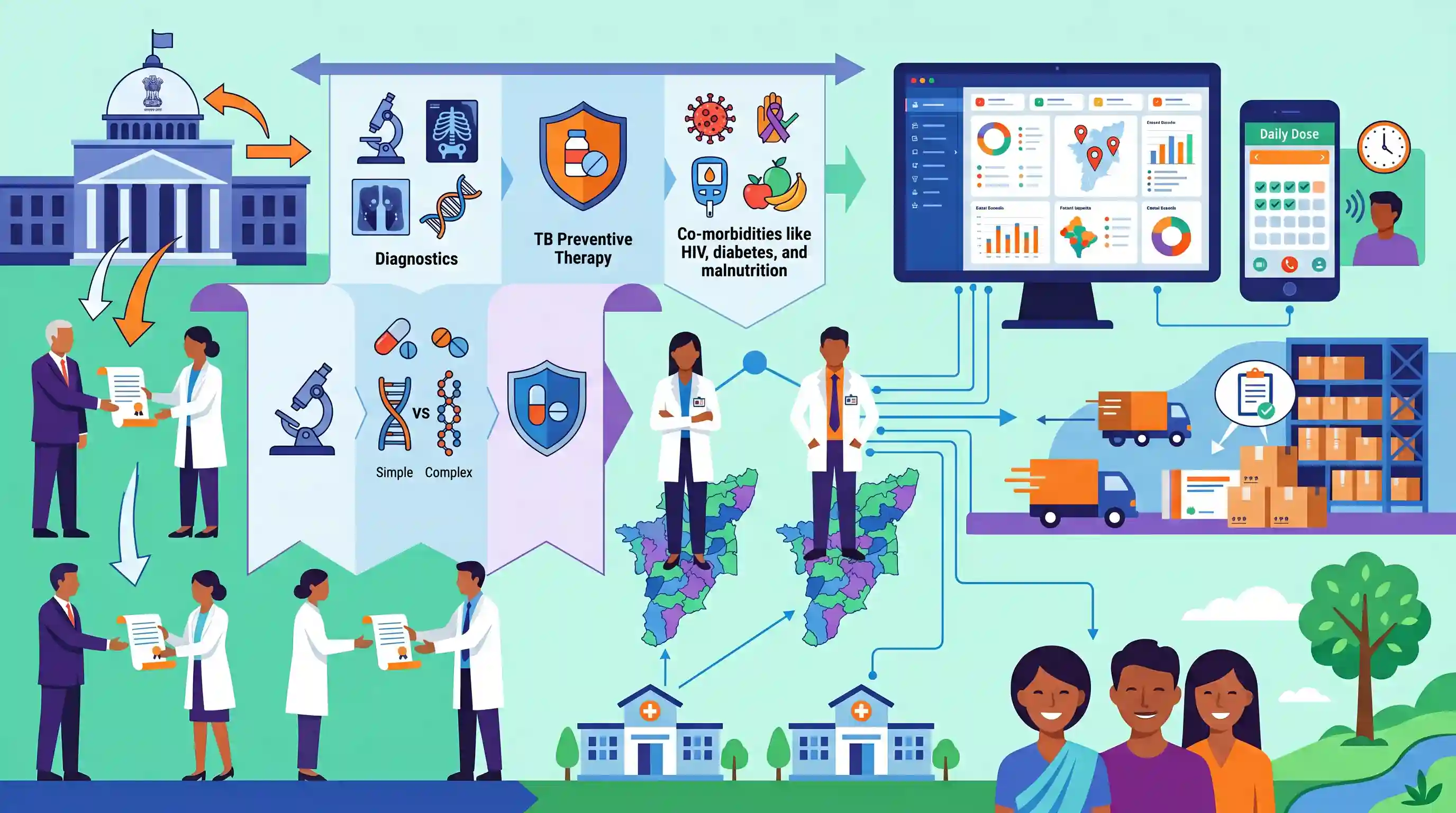
Tamil Nadu's health department is strengthening the National Tuberculosis Elimination Programme (NTEP) by authorizing Medical Officers-TB Control (MO-TC) to supervise and monitor block-level implementation. The initiative entails comprehensive training modules that cover diagnostic algorithms, drug-susceptible and drug-resistant TB, TB preventive therapy, and the management of major co-morbidities like HIV, diabetes, and malnutrition. The appointed officers will also be responsible for monitoring treatment adherence and drug supplies through digital platforms, including the Ni-kshay portal, '99DOTS Lite', and 'Nikshay Aushadhi', thereby reinforcing grassroots public healthcare administration.
Key Points
- Tamil Nadu is appointing Medical Officers-TB Control (MO-TC) to closely monitor block-level implementation of the National Tuberculosis Elimination Programme.
- MO-TCs undergo comprehensive training covering diagnostic algorithms, treatment regimens for both drug-susceptible and drug-resistant TB, and TB preventive therapy.
- The monitoring framework will concurrently focus on managing TB co-morbidities such as HIV, diabetes, and malnutrition at the primary healthcare level.
- Officers are tasked with overseeing the utilization of digital health platforms such as the Ni-kshay portal, 99DOTS Lite (for treatment adherence), and Nikshay Aushadhi (for drug supply chains).
Important Terms
National Tuberculosis Elimination Programme (NTEP)

The centrally-sponsored scheme (formerly RNTCP) aiming to eliminate TB in India by 2025, five years ahead of global Sustainable Development Goal targets.
UPSC context
GS Paper II (Health/Governance); GS Paper III (S&T). Tests knowledge of India's health missions and disease-specific targets.
Ni-kshay portal
A web-enabled patient management system for real-time TB surveillance, case notification, and tracking treatment outcomes, including Direct Benefit Transfers like Ni-kshay Poshan Yojana.
UPSC context
GS Paper II (E-governance/Health). Essential for understanding digital interventions in public health administration.
TB Preventive Therapy (TPT)
Treatment provided to individuals with latent TB infection or high-risk exposure to prevent progression to active TB disease, a key pillar of India's End TB strategy.
UPSC context
GS Paper III (S&T/Health). Tests scientific understanding of preventive healthcare and epidemiological interventions.
99DOTS Lite
A digital adherence technology (DAT) that monitors treatment compliance by having patients call a toll-free number to confirm daily medication intake, simplifying traditional envelope-based monitoring.
UPSC context
GS Paper II/III. Tests application of Information and Communication Technology (ICT) in improving healthcare delivery and patient outcomes.
Nikshay Aushadhi
The logistics and supply chain management component of the Ni-kshay ecosystem, ensuring uninterrupted availability of anti-TB drugs and diagnostics across health facilities.
UPSC context
GS Paper II (Governance/Health). Tests knowledge of public procurement and supply chain efficiency in government welfare schemes.
Medical Officer-TB Control (MO-TC)
The sub-district level official responsible for the National TB Elimination Programme's implementation, supervising TB Units, staff, and the "cough-to-cure" pathway.
UPSC context
GS Paper II (Governance/Decentralization). Tests understanding of administrative structures and grassroots health service delivery.
Prelims Trap
99DOTS is an advanced short-course medication regimen introduced for the treatment of Multi-Drug Resistant TB.
99DOTS is not a clinical drug regimen but a mobile-based digital medication adherence technology using hidden toll-free numbers on pill packaging.
Static Concepts Connected
What are the main categories of drug-resistant Tuberculosis?
- MDR-TB: Resistant to at least Isoniazid and Rifampicin, the two most potent first-line anti-TB medications.
- XDR-TB: Resistant to Isoniazid, Rifampicin, any fluoroquinolone, and at least one second-line injectable anti-TB drug.
How do major co-morbidities complicate Tuberculosis management?
- HIV interaction: HIV severely weakens cell-mediated immunity, increasing the likelihood of latent TB progressing to an active disease by up to 20 times.
- Diabetes impact: Poor glycemic control impairs the immune response, tripling the risk of developing active TB and increasing relapse rates post-treatment.
- Malnutrition cycle: Undernutrition weakens immunity, while active TB causes severe metabolic wasting, creating a mutually reinforcing downward cycle.
Cross-Topic Patterns
Digital Public Infrastructure in Health
Ni-kshay and 99DOTS reflect the broader integration of India's DPI ecosystem into disease surveillance, functioning similarly to CoWIN or the Ayushman Bharat Digital Mission.
Decentralized health governance
Shifting TB monitoring to block-level Medical Officers aligns with the National Health Mission's push for grassroots public health administration and strengthened Primary Health Centres (PHCs).

Expect a 2026 Prelims match-the-pairs question mapping digital health platforms (Ni-kshay, 99DOTS, Nikshay Aushadhi) to their functions.
Linked PYQs · 3
Linked PYQs · 3
- 2019PrelimsGS1
Which of the following are the reasons for the occurrence of multi-drug resistance in microbial pathogens in India? 1. Genetic predisposition of some people 2. Taking incorrect doses of antibiotics to cure diseases 3. Using antibiotics in livestock farming 4. Multiple chronic diseases in some people Select the correct answer using the code given below.
- 2024MainsGS2
In a crucial domain like the public healthcare system the Indian State should play a vital role to contain the adverse impact of marketisation of the system. Suggest some measures through which the State can enhance the reach of public healthcare at the grassroots level.
- 2022PrelimsGS1
Consider the following : 1. Aarogya Setu 2. CoWIN 3. DigiLocker 4. DIKSHA Which of the above are built on top of open-source digital platforms?
