Medical Negligence Surges in India with Focus on Hospital Lapses
Source:Indian Express ↗
Why It Matters
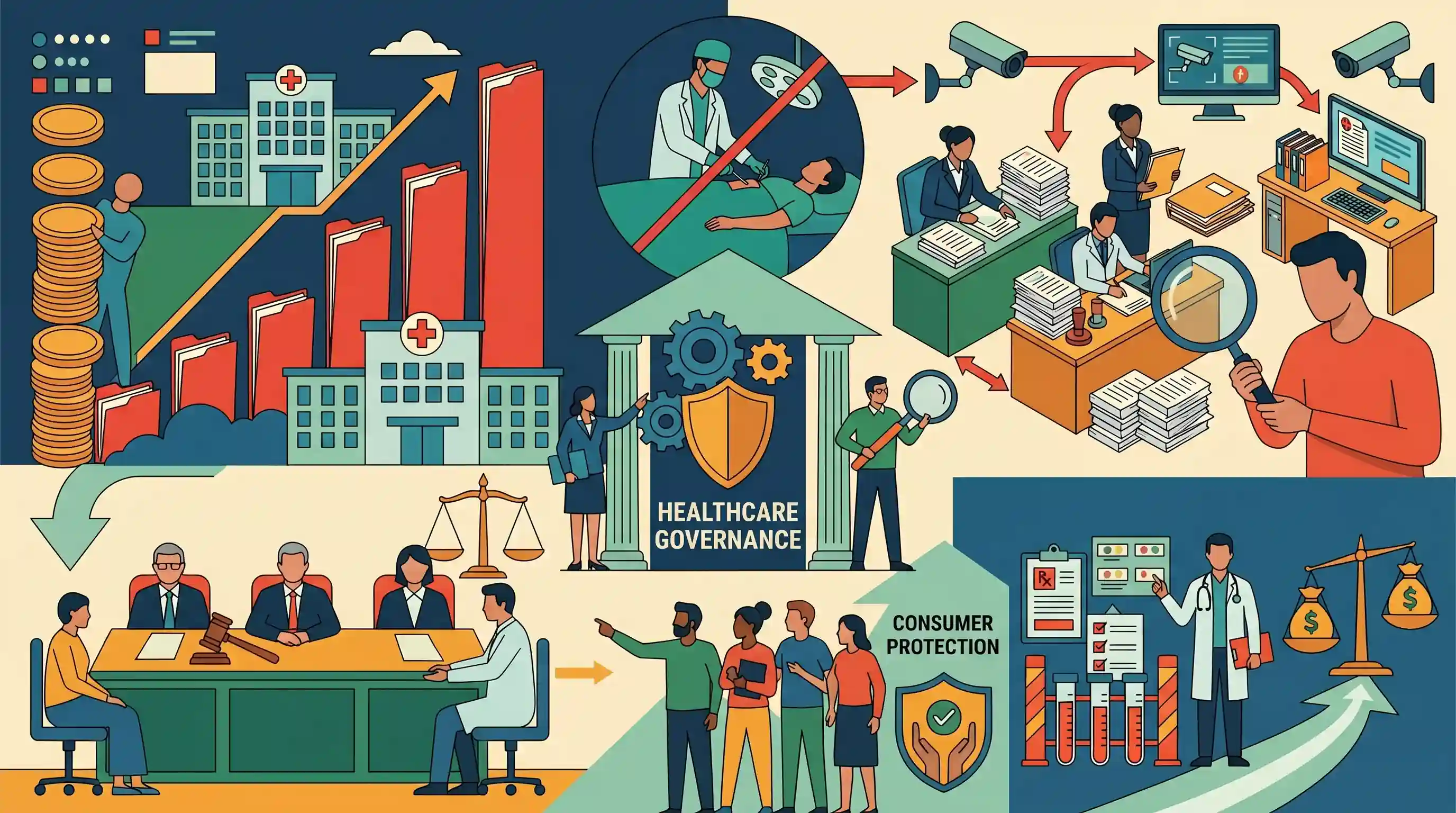
The surge in medical negligence litigation underscores the critical intersection of healthcare marketisation, consumer rights, and professional ethics. It highlights the evolving challenges in healthcare governance and the necessity for the State to ensure accountability and equitable service delivery in the health sector.
Summary
In 2025, medical negligence cases in India surged to a record 65,000, with legal focus shifting from clinical errors to administrative lapses. Patients are increasingly relying on hospital paperwork and digital evidence, such as CCTV footage, to hold healthcare institutions accountable under consumer protection laws. This highlights growing consumer awareness, the need for stringent healthcare governance, and the ethical implications of defensive medicine in a highly marketised healthcare system. The trend underscores the critical role of quasi-judicial bodies like the NCDRC in addressing healthcare grievances.
Key Points
- A record 65,000 medical negligence cases were reported in India in 2025, reflecting a significant rise in healthcare litigation.
- Legal strategies are shifting to target hospital paperwork, procedural lapses, and digital evidence such as CCTV footage, rather than solely focusing on surgical or clinical errors.
- The trend indicates growing patient awareness and the increasing use of consumer protection laws and bodies like the NCDRC to demand accountability from corporate hospitals.
- The surge in cases highlights the urgent need for systemic reforms in healthcare governance, addressing the ethical implications of defensive medicine and the rapid marketisation of the health sector.
Important Terms
Consumer Protection Act, 2019 (CPA 2019)

Legislation providing a three-tier mechanism (District, State, National) for grievance redressal against defective goods and deficient services, including healthcare. It replaced the 1986 Act to modernize consumer rights.
UPSC context
GS Paper 2 (Governance/Statutory Bodies) and GS Paper 4 (Ethics); tests knowledge of regulatory frameworks and consumer rights.
National Consumer Disputes Redressal Commission (NCDRC)
The apex quasi-judicial body in India’s consumer dispute redressal hierarchy, handling high-value claims (exceeding ₹2 crore) and appeals from State Commissions.
UPSC context
GS Paper 2 (Statutory, Regulatory and Quasi-judicial bodies); central to administrative justice and healthcare accountability.
Medical Negligence
A legal and ethical breach where a healthcare professional fails to exercise reasonable skill or care, resulting in unintended harm or death to a patient.
UPSC context
GS Paper 2 (Health) and GS Paper 4 (Ethics); tests understanding of professional liability and ethical standards in healthcare.
Defensive Medicine
Clinical actions, such as ordering excessive tests or avoiding high-risk procedures, performed primarily to protect the physician from litigation rather than for the patient's benefit.
UPSC context
GS Paper 4 (Ethics in Public Administration); examines the impact of litigation fear on professional integrity and healthcare costs.
Quasi-judicial Body
An entity with powers resembling a court, such as summoning witnesses and passing binding orders, but operating within a specialized administrative or regulatory domain.
UPSC context
GS Paper 2 (Polity/Governance); tests the distinction between formal judiciary and specialized adjudicatory forums in India.
Informed Consent
The legal and ethical requirement for healthcare providers to ensure patients understand the risks, benefits, and alternatives of a procedure before giving voluntary agreement.
UPSC context
GS Paper 4 (Ethics); vital for topics on patient autonomy, human rights (Article 21), and professional ethics.
Prelims Trap
All medical services, including completely free treatments provided at government hospitals, fall under the Consumer Protection Act.
Only paid medical services are covered. Completely free or charitable medical services are exempt from the CPA, as established by the landmark Supreme Court ruling in IMA vs. V.P. Shantha.
Static Concepts Connected
What is the structure and jurisdiction of the NCDRC?
- Statutory Body: Established under the Consumer Protection Act to provide inexpensive, speedy, and summary redressal of consumer disputes.
- Composition: Headed by a sitting or retired judge of the Supreme Court, or a Chief Justice of a High Court.
- Pecuniary Jurisdiction: Following recent CPA amendments, it entertains original complaints where the value of goods or services paid exceeds ₹2 crore.
- Supreme Court Appeal: Appeals against NCDRC orders can be filed directly in the Supreme Court within 30 days.
What is 'defensive medicine' in healthcare ethics?
- Definition: When doctors order excessive tests or avoid high-risk, beneficial treatments primarily to protect themselves against potential malpractice lawsuits.
- Ethical Conflict: It violates the core ethical principle of beneficence, shifting the priority from the patient's medical welfare to the physician's legal self-preservation.
- Socio-economic Impact: It leads to over-medicalization and significantly drives up Out-Of-Pocket Expenditure (OOPE) for patients, undermining equitable healthcare access.
Cross-Topic Patterns
Digital evidence in consumer disputes
The increasing reliance on CCTV and hospital logs in NCDRC aligns with the Bharatiya Sakshya Adhiniyam's push to elevate electronic records to primary evidence status in Indian courts.
Defensive medicine & healthcare OOPE
Defensive medicine inflates diagnostics costs, directly countering GS2 objectives of reducing Out-Of-Pocket Expenditure (OOPE) and achieving Universal Health Coverage under schemes like PM-JAY.

Expect a Prelims statement on NCDRC's pecuniary jurisdiction, or a GS4 question on 'defensive medicine' vs professional ethics in 2026.
Linked PYQs · 3
Linked PYQs · 3
- 2024MainsGS2
In a crucial domain like the public healthcare system the Indian State should play a vital role to contain the adverse impact of marketisation of the system. Suggest some measures through which the State can enhance the reach of public healthcare at the grassroots level.
- 2015MainsGS4
Differentiate between the following: Personal ethics and Professional ethics
- 2024MainsGS4
“Ethics encompasses several key dimensions that are crucial in guiding individuals and organizations towards morally responsible behaviour.” Explain the key dimensions of ethics that influence human actions. Discuss how these dimensions shape ethical decision-making in the professional context.
