SMS Hospital Administrative Lapses Leave Kidney Patients Waiting
Source:ndtv ↗
Why It Matters
This case study illustrates the intersection of public administration, administrative accountability, and health sector governance. Understanding institutional lapses at major state-run hospitals like SMS Hospital is vital for RPSC RAS topics concerning Public Service Delivery, Citizen's Charters, and healthcare policy implementation in Rajasthan.
Summary
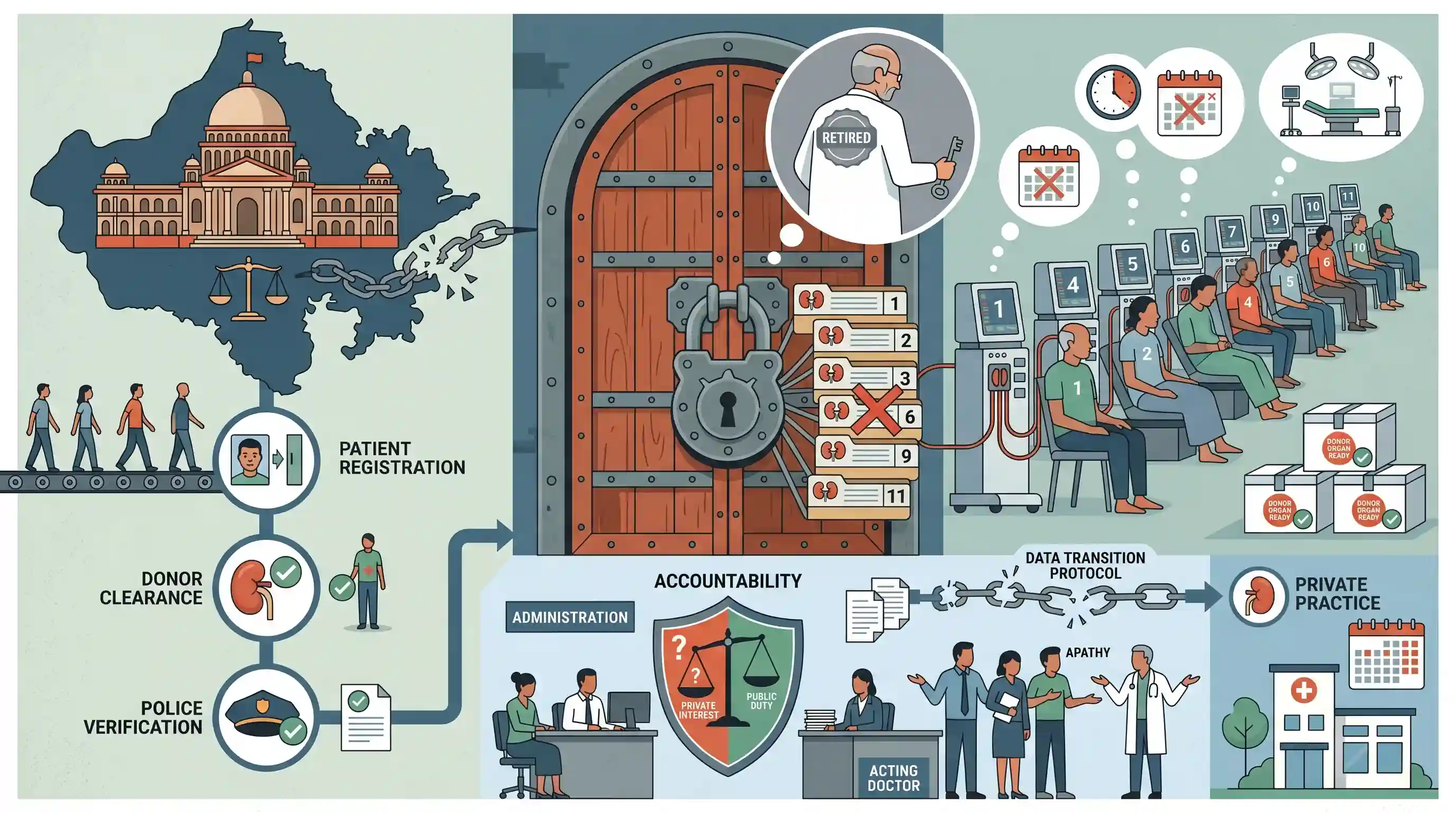
An incident of administrative apathy at Jaipur's SMS Hospital left 11 kidney transplant patients stranded after their medical files were locked inside a retired doctor's room. The case highlights crucial gaps in public health administration, data transition protocols, and institutional accountability in Rajasthan's primary state-run tertiary healthcare facility.
Key Points
- An administrative oversight at Sawai Man Singh (SMS) Hospital in Jaipur left 11 end-stage kidney patients stranded after their crucial medical and transplant files were locked inside the room of a retired senior doctor.
- The incident delayed necessary clearances and transplant surgeries, posing severe health risks to the patients waiting for life-saving organ transplants.
- The case highlights a failure in basic public administration, transition protocols, and accountability mechanisms within Rajasthan's largest state-run hospital.
- The incident underlines the practical challenges in implementing healthcare governance, patient-centric ethics, and the state's welfare commitments under its public health frameworks.
Important Terms
Right to Health Act

Landmark legislation enacted by Rajasthan in 2023, making it the first Indian state to guarantee its residents the right to free healthcare, emergency treatment, diagnostics, and medicines across public and designated private healthcare facilities.
UPSC context
GS Paper II: Social Sector & Health. Tests understanding of welfare-state obligations, healthcare rights, and legislative efforts to implement Directive Principles.
Transplantation of Human Organs and Tissues Act (THOTA)
A central Indian legislation enacted in 1994 (amended in 2011) that regulates the removal, storage, and transplantation of human organs and tissues for therapeutic purposes, while strictly prohibiting commercial dealings.
UPSC context
GS Paper II: Governance. Tests knowledge of regulatory frameworks governing bio-medical ethics, organ donation protocols, and institutional mechanisms like NOTTO.
Sawai Man Singh (SMS) Hospital
Located in Jaipur, it is Rajasthan's premier state-run tertiary referral government hospital and medical college, central to implementing state-level public health initiatives and specialized medical procedures like organ transplants.
UPSC context
GS Paper II: Health Infrastructure. Tests understanding of administrative challenges, accountability, and operational bottlenecks in public tertiary healthcare institutions.
Prelims Trap
National organ transplant rules mandate state domicile and restrict registrations to patients below 65 years of age.
Under the updated 'One Nation, One Policy' guidelines, the Central government abolished the state domicile requirement and the 65-year age limit for registering for deceased donor organs.
Static Concepts Connected
What is the constitutional and statutory framework for the Right to Health in India?
- Article 21 expansion: The Supreme Court interpreted the Right to Health as an integral part of the Right to Life under Article 21.
- Directive Principles: Article 47 (DPSP) directs the State to improve public health as one of its primary duties.
- State legislation: Rajasthan became the first Indian state to pass a dedicated Right to Health Act, making free healthcare a statutory right.
What is the institutional structure under the Transplantation of Human Organs and Tissues Act (THOTA)?
- NOTTO apex body: The National Organ and Tissue Transplant Organisation acts as the apex national registry and procurement coordinator.
- SOTTO network: State Organ and Tissue Transplant Organisations manage local lists and coordinate organ allocation within states.
- Authorisation Committees: Statutory hospital-level or state-level committees must approve all living donor transplants to prevent illegal commercialization.
Cross-Topic Patterns
Statutory rights vs executive capacity
Legislating rights (like the Right to Health) fails without structural administrative reforms, showcasing the deep mismatch between progressive statutes and grassroots executive capacity.
Health federalism and organ sharing
Organ donation rules involve central guidelines (NOTTO) executed via state bodies (SOTTO), illustrating how federal policy design depends entirely on local-level institutional integrity.

Mains 2026 may use public health bottlenecks to ask how procedural apathy compromises landmark welfare laws like the Right to Health.
Linked PYQs · 2
Linked PYQs · 2
- 2016RPSC_PRELIMSGS1
Which of the following Acts has Rajasthan been the first state to implement for resolving public grievances?
- 2024RPSC_PRELIMSGS1
The size of citizen's character is not –
