Patna High Court Warns Media Against Headline Trials
Source:lawchakra ↗
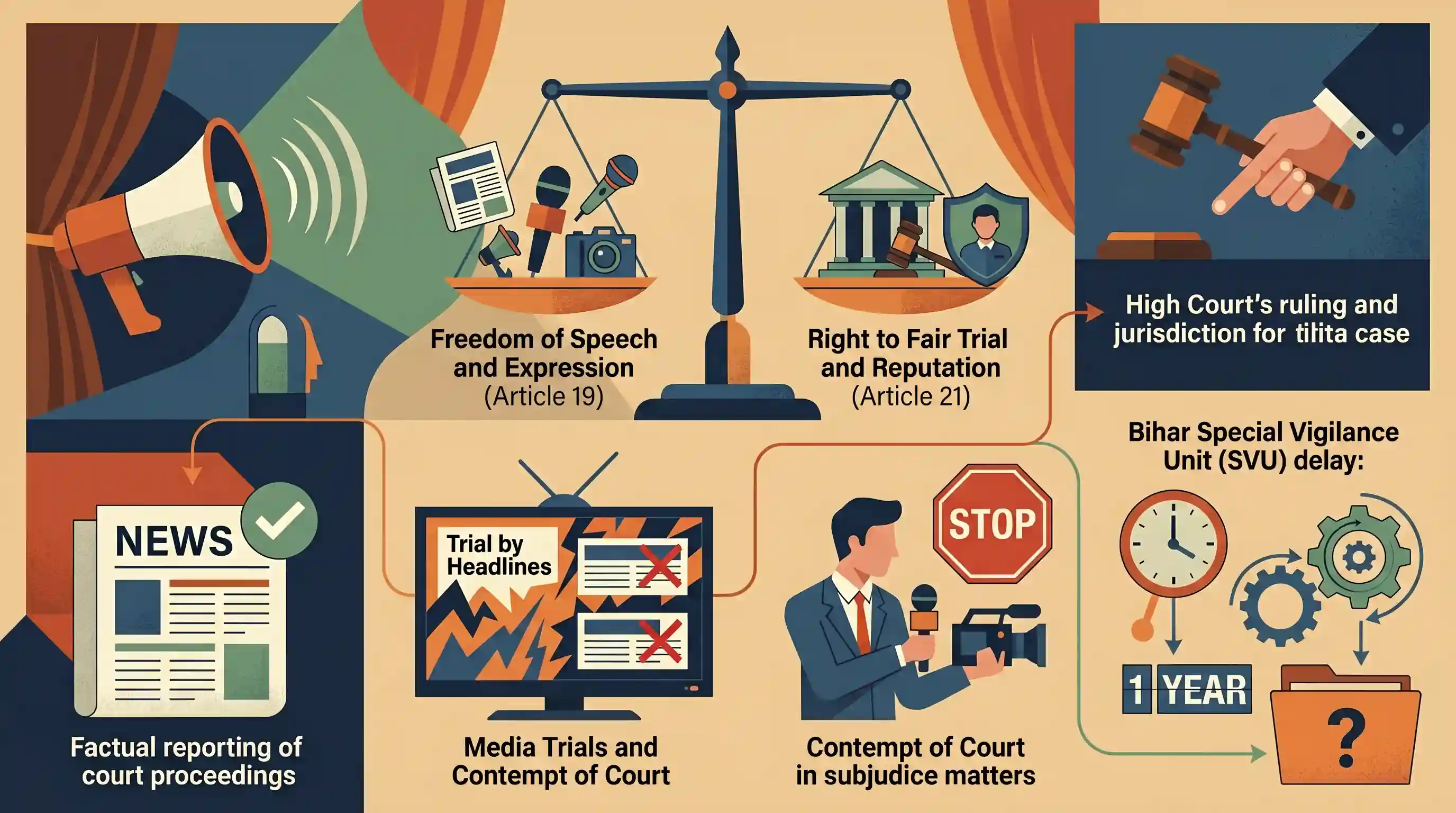
Why It Matters
This case represents a crucial judicial intervention in state governance and constitutional law, addressing the fine line between media freedom and individual rights. It holds high relevance for questions on constitutional rights, judicial guidelines on media trials, and the administrative accountability of Bihar's Special Vigilance Unit (SVU).
Summary
In the case of Rishu Shree v. State of Bihar, the Patna High Court ruled that the media can report on factual criminal proceedings but is strictly prohibited from conducting 'trials by headlines' or declaring an accused guilty. Justice Ansul emphasized that the press must avoid using prejudicial terms like 'mastermind' or 'kingpin' while reporting subjudice matters. The decision highlights the critical balance between Freedom of Speech (Article 19) and the Right to a Fair Trial and Reputation (Article 21), citing landmark Supreme Court precedents. The Court also questioned the Bihar Special Vigilance Unit (SVU) over a one-year investigation delay in the underlying tender scam.
Key Points
- The Patna High Court, led by Justice Ansul in the case of Rishu Shree v. State of Bihar, ruled that while the media has the constitutional right to report on criminal cases, it cannot conduct a 'trial by media' or declare an accused guilty before judicial verdict.
- The Court directed media organisations to refrain from using sensationalist and prejudicial labels such as 'mastermind', 'scamster', or 'kingpin' during the reporting of ongoing subjudice cases.
- The judgment balances the freedom of the press under Article 19(1)(a) with the accused's fundamental rights under Article 21, which includes the presumption of innocence, right to reputation, and right to a fair trial.
- The Court cited landmark Supreme Court judgments on media trials, including State of Maharashtra v. Rajendra Jawanmal Gandhi, MP Lohia v. State of West Bengal, and Sahara India Real Estate Corporation Ltd. v. SEBI.
- The court declined to order a blanket gag on the media, affirming that fair, accurate, and objective reporting of factual open court proceedings is completely permissible.
- The Patna High Court also questioned the Bihar Special Vigilance Unit (SVU) regarding a one-year delay between the registration of the FIR (April 30, 2025) and the subsequent search and arrest (May 27, 2026) in the alleged tender scam.
Important Terms
Constitution of India (Article 19(1)(a))

A fundamental constitutional provision guaranteeing all citizens freedom of speech and expression, which inherently includes freedom of the press and the right to disseminate information.
UPSC context
GS Paper II (Polity). Evaluates press freedom, media rights, and their balance with individual rights during sub-judice trials.
Constitution of India (Article 19(2))
Empowers the State to impose reasonable restrictions on the freedom of speech and expression under grounds like decency, morality, defamation, or contempt of court.
UPSC context
GS Paper II (Polity). Analyzes bounds of free speech and the judiciary's role in curbing trial by media.
Constitution of India (Article 21)
Guarantees the protection of life and personal liberty, interpreted by Indian courts to encompass the right to a fair trial, personal reputation, and dignity.
UPSC context
GS Paper II (Polity). Examines the expanding scope of fundamental rights and the right to a fair trial.
Constitution of India (Article 226)
Empowers state High Courts to issue directions, orders, and writs for enforcing fundamental rights and for any other legal purpose.
UPSC context
GS Paper II (Judiciary). Tests knowledge of High Court writ jurisdictions and remedies against fundamental rights violations.
Patna High Court
The highest judicial body in the state of Bihar, responsible for maintaining constitutional jurisprudence and enforcing legal and fundamental rights in its jurisdiction.
UPSC context
GS Paper II (Judiciary). Assesses the state-level higher judiciary’s power to enforce rights and supervise lower administration.
Bihar Special Vigilance Unit (SVU)
A specialized anti-corruption investigative agency under the Bihar government tasked with probing high-level corruption, bribery, disproportionate assets, and tender-rigging cases.
UPSC context
GS Paper II (Governance). Evaluates state institutional frameworks for maintaining administrative accountability and countering public corruption.
Prelims Trap
The Doctrine of Postponement allows courts to permanently ban media reporting on any subjudice criminal investigation to protect the accused's reputation.
It only permits temporary deferment, not a permanent or blanket ban on reporting, to prevent immediate prejudice to the administration of justice.
Static Concepts Connected
What is the "Doctrine of Postponement" in Indian media law?
- Origin: Established by the Supreme Court in the landmark Sahara India Real Estate Corp. Ltd. v. SEBI (2012) case.
- Objective: Allows courts to temporarily defer or postpone media reporting of ongoing trials if it poses a substantial risk of prejudice.
- Nature: Acts as a preventive measure balancing Article 19(1)(a) free speech with Article 21 fair trial rights.
How does "Contempt of Court" restrict media reporting under Article 19(2)?
- Constitutional Source: Article 19(2) lists 'Contempt of Court' as a valid ground to impose reasonable restrictions on free speech.
- Statutory Basis: The Contempt of Courts Act, 1971 classifies publishing material that prejudices or obstructs judicial proceedings as criminal contempt.
- Subjudice Rule: Prevents media from conducting parallel trials that can unconsciously influence judges or prejudice witness testimonies.
Cross-Topic Patterns
Media freedom vs Article 21 privacy
Connects the prohibition on 'trial by headlines' to the Right to be Forgotten and digital reputation under Article 21 post-Puttaswamy.
Police reforms & media briefings
Explores structural guidelines restricting investigative agencies from leaking sensitive case details to the press, protecting the presumption of innocence.

The balancing of Article 19(1)(a) against Article 21 via the 'Doctrine of Postponement' is primed for a multi-statement UPSC Prelims question.
Linked PYQs · 3
Linked PYQs · 3
- 2025BPSC_PRELIMSGS1
The constitution of India provides for reasonable restrictions on Fundamental Rights but reasonableness must keep in mind that: 1. The restrictions must be necessary for the protection of the rights of others. 2. The restrictions must be proportionate to the end sought. 3. The restrictions must be reasonable in the light of the circumstances. 4. The restrictions must be in the public interest.
- 2025BPSC_PRELIMSGS1
Which one of the following subjects fall within the jurisdiction of both High Court and Supreme Court?
- 2022BPSC_PRELIMSGS1
Judicial process in India is based on
