Shifting Poverty Measurement from Calorie Intake to Thali Index
Source:Indian Express ↗
Why It Matters
Poverty measurement methodology is a core UPSC topic. The transition from unidimensional calorie-based poverty lines to multidimensional and affordability-based metrics (like the Thali index) is crucial for analyzing policy efficacy, addressing malnutrition, and understanding contemporary governance reforms in India.
Summary
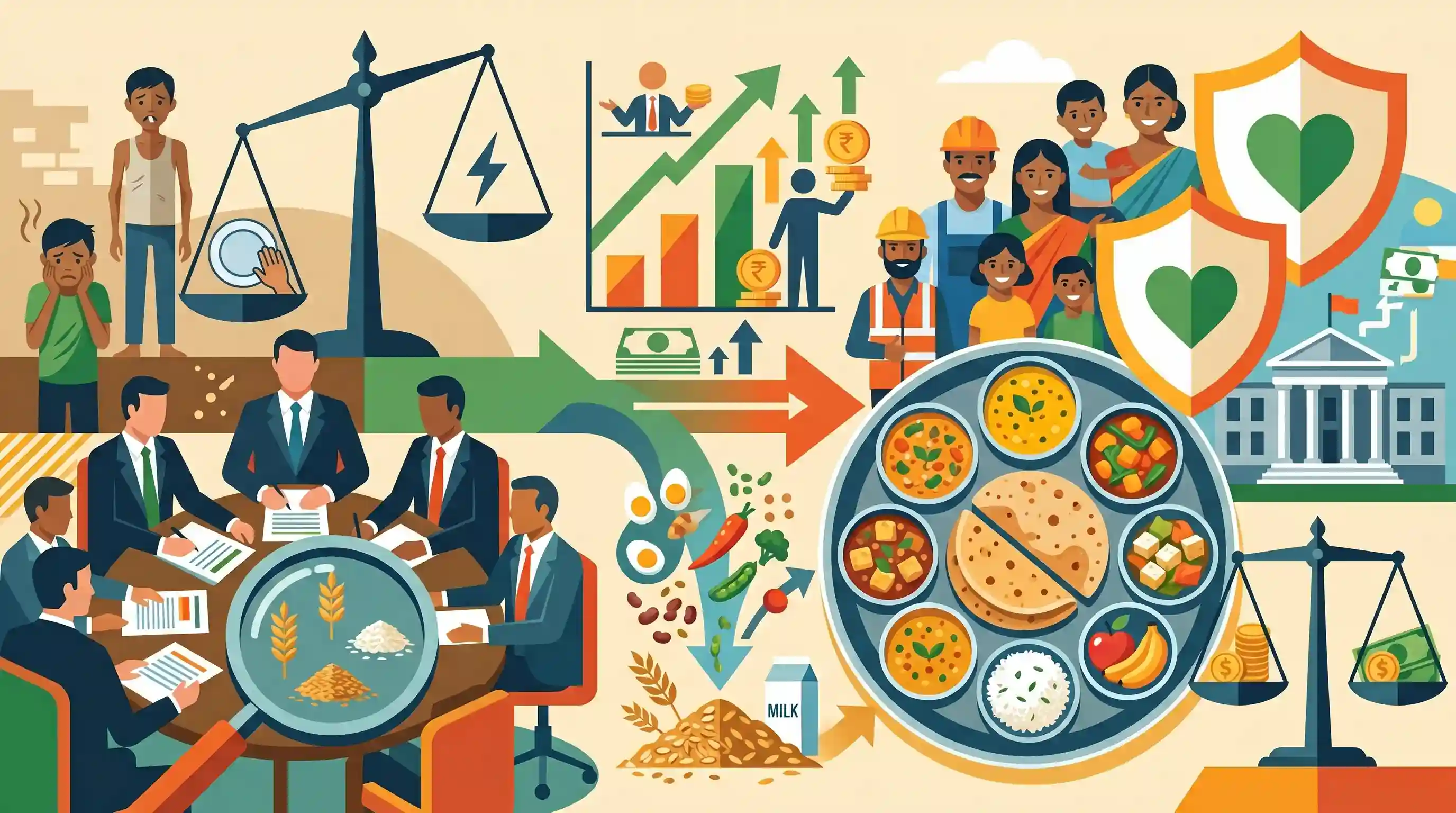
The article critiques the traditional reliance on calorie consumption as the primary metric for measuring poverty in India, a method historically formalized by various poverty estimation committees. It highlights that rising incomes have led to a diversification in diets away from cereals towards proteins and micronutrients, making calorie counting an outdated indicator of poverty. Instead, the author proposes the adoption of a "Thali index" — a concept inspired by 'Thalinomics' from the Economic Survey 2019-20. By evaluating the affordability of a balanced, nutritious meal rather than sheer caloric survival, a Thali index provides a more accurate, holistic measure of nutritional security, purchasing power, and standard of living for marginalized populations.
Key Points
- Historically, India's poverty line estimation (by Alagh, Lakdawala, Tendulkar, and Rangarajan committees) has relied heavily on minimum calorie intake benchmarks (2100 kcal urban / 2400 kcal rural).
- As incomes rise, dietary patterns shift from staple cereals toward proteins and micronutrients, meaning that lower calorie intake no longer strictly correlates with increased poverty.
- The article advocates replacing the calorie-based metric with a 'Thali Index' (a concept popularized as 'Thalinomics' in the 2019-20 Economic Survey).
- A Thali Index measures the affordability and cost of a nutritionally balanced meal across the country, serving as a better proxy for multidimensional well-being.
- This policy shift aligns with the transition from simply preventing starvation to ensuring holistic nutritional security and addressing malnutrition.
Important Terms
Thalinomics (Economic Survey 2019-20)

An initiative from the 2019-20 Economic Survey to quantify the cost and affordability of a standard meal ('thali') for the common person across India.
UPSC context
GS Paper 3: Indian Economy; relevant for discussing food affordability, welfare metrics, and retail inflation impact on households.
Poverty Line (Calorie-based)
The traditional threshold for identifying the poor in India, historically defined by the expenditure required to meet daily energy intakes (e.g., 2400 kcal rural, 2100 kcal urban).
UPSC context
GS Paper 3: Poverty and Hunger; tests knowledge of historical estimation methodologies (Alagh, Lakdawala Committees) and their critiques.
National Food Security Act (NFSA) 2013
A 2013 law providing subsidized food grains to 75% of rural and 50% of urban populations, transforming food security from welfare into a legal entitlement.
UPSC context
GS Paper 2: Social Justice; essential for topics on food security, hunger, and government welfare schemes.
NITI Aayog
India's premier policy think tank and the nodal agency for monitoring poverty; it releases the National Multidimensional Poverty Index (MPI) to track deprivation.
UPSC context
GS Paper 2: Governance; relevant for federal monitoring of Sustainable Development Goals (SDGs) and poverty reduction targets.
Multidimensional Poverty Index (MPI)
A metric that assesses deprivation across three equally weighted dimensions—Health, Education, and Living Standards—using 12 indicators like nutrition, schooling, and sanitation.
UPSC context
GS Paper 3: Inclusive Growth; crucial for analyzing holistic poverty reduction beyond simple income or calorie metrics.
Ministry of Statistics and Programme Implementation (MoSPI)
The central ministry responsible for official statistics; its National Statistical Office (NSO) conducts the Household Consumption Expenditure Surveys (HCES) vital for poverty data.
UPSC context
GS Paper 3: Indian Economy; tests understanding of the institutional framework for data collection and evidence-based policymaking.
Prelims Trap
The Tendulkar Committee established the 2100 and 2400 kcal/day benchmark for poverty.
The Y.K. Alagh Task Force (1979) established the 2100/2400 calorie norms. The Tendulkar Committee actually moved away from calorie anchoring to broader consumption indices.
Static Concepts Connected
How did post-1970 poverty estimation committees evolve their methodologies?
- Alagh & Lakdawala: Anchored poverty lines strictly to minimum daily calorie requirements of 2400 kcal (rural) and 2100 kcal (urban).
- Tendulkar (2009): Moved away from strict calorie anchors, incorporating private expenditure on health, education, and transport into the consumption basket.
- Rangarajan (2014): Reintroduced specific nutritional norms for calories, proteins, and fats, while continuing to account for non-food expenditures.
What is 'Thalinomics' as introduced in the Economic Survey?
- Origin: Introduced in the Economic Survey 2019-20 as an attempt to quantify what a common person pays for a meal across India.
- Methodology: It tracks the affordability of a nutritionally balanced "Thali" (both vegetarian and non-vegetarian) using CPI data and agricultural wages.
- Significance: It shifts the policy lens from mere caloric survival to measuring the true cost of holistic nutritional security and multidimensional well-being.
Cross-Topic Patterns
Dietary Shifts + CPI Base Revision
As incomes rise and diets diversify away from staples, demands intensify to revise the CPI base year and weightage to accurately reflect modern consumption patterns and true food inflation.
Nutritional Security + Biofortification
The transition from basic calorie security to nutritional security parallels India's agricultural shift toward biofortified crops to solve 'hidden hunger' and micronutrient deficiencies.

Expect a multi-statement question contrasting calorie-based benchmarks (Alagh) with modern Multidimensional Poverty and Thalinomics in 2026.
Linked PYQs · 4
Linked PYQs · 4
- 2020MainsGS2
The incedence and intensity of poverty are more important in determining poverty based on income alone". In this context analyse the latest United Nations Multidimensional Poverty Index Report.
- 2019MainsGS2
There is a growing divergence in the relationship between poverty and hunger in India. The shrinking of social expenditure by the government is forcing the poor to spend more on non-food essential items squeezing their food-budget. - Elucidate.
- 2024MainsGS2
Poverty and malnutrition create a vicious cycle, adversely affecting human capital formation. What steps can be taken to break the cycle ?
- 2012PrelimsGS1
The Multi-dimensional Poverty Index developed by Oxford Poverty and Human Development Initiative with UNDP support covers which of the following? 1. Deprivation of education, health, assets and services at household level 2. Purchasing power parity at national level 3. Extent of budget deficit and GDP growth rate at national level Select the correct answer using the codes given below:
