Methane emission metrics and global warming evaluation
Source:Indian Express ↗
Why It Matters
Redefining how we measure methane impact alters global climate negotiations and directly affects India's agricultural policies, given its massive livestock population and paddy cultivation, which are significant sources of methane.
Summary
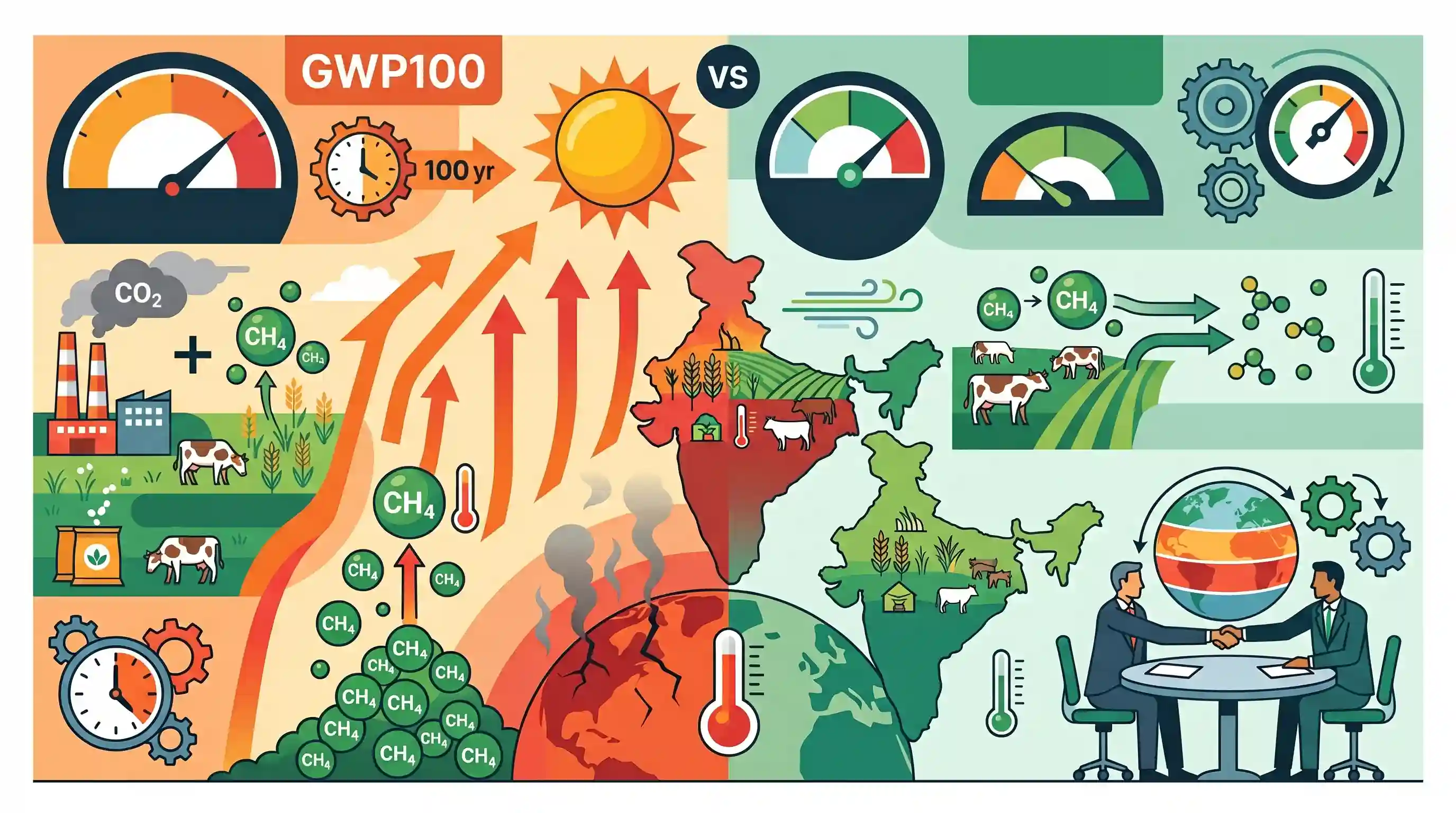
The article examines a recent study criticizing the traditional Global Warming Potential (GWP100) metric used to measure the impact of greenhouse gas emissions. GWP100 equates short-lived climate pollutants (SLCPs) like methane to carbon dioxide over a 100-year period. Since methane breaks down in the atmosphere within roughly 12 years, treating it cumulatively overestimates its long-term warming effect when emissions are stable, while underestimating its intense short-term heat-trapping capacity. The study advocates for GWP*, an alternative metric that measures changes in emission rates. This distinction holds significant diplomatic and economic implications for India—a top methane emitter due to its vast agricultural sector and livestock. Adopting GWP* could reshape climate negotiations, justifying India's stance on the Global Methane Pledge by showing that steady agricultural emissions do not cause new, additional warming.
Key Points
- Current climate accounting relies on the Global Warming Potential (GWP100) metric, which compares the warming impact of various greenhouse gases to carbon dioxide over a 100-year timeframe.
- A new study highlights that GWP100 inaccurately represents short-lived climate pollutants (SLCPs) like methane, which breaks down into CO2 and water in roughly 12 years, unlike CO2 which persists for centuries.
- GWP100 spreads methane's intense short-term warming effect over a century, underestimating its immediate impact while overestimating its long-term cumulative effect, as methane does not accumulate in the atmosphere if emission rates remain steady.
- An alternative metric called GWP* (GWP-star) evaluates the change in emission rates of short-lived gases over time rather than their absolute emissions, offering a more accurate reflection of their actual temperature impact.
- This metric debate is crucial for India, a major methane emitter due to agriculture (paddy fields) and livestock. Redefining methane metrics could support developing nations by showing that stable agricultural emissions do not contribute to additional warming.
Important Terms
GWP* (GWP-star)

A climate metric measuring changes in emission rates rather than cumulative mass. It more accurately reflects the actual warming impact of short-lived gases like methane over time.
UPSC context
GS-III Environment; tests understanding of scientific metrics in climate accounting and their policy implications for agricultural nations like India.
Global Warming Potential (GWP100)
The standard metric equating greenhouse gases to carbon dioxide over 100 years. It provides a common unit for carbon accounting but may misrepresent short-lived pollutants' warming effects.
UPSC context
GS-III Environment; crucial for understanding international emission standards, carbon footprints, and the technical limitations of current climate reporting.
Global Methane Pledge
A voluntary commitment launched at COP26 to reduce global methane emissions by 30% by 2030. India opted out, citing the 'survival emissions' nature of its vast agricultural sector.
UPSC context
GS-II/III Environment & IR; tests knowledge of sector-specific emissions and India's diplomatic stance on agricultural versus industrial pollution.
Short-Lived Climate Pollutants (SLCPs)
Gases and particles like methane, black carbon, and HFCs that stay in the atmosphere briefly but have a high capacity to trap heat in the short term.
UPSC context
GS-III Pollution & Climate Change; relevant for targeted mitigation strategies that yield immediate climate and health benefits.
IPCC (Intergovernmental Panel on Climate Change)
The UN's scientific body that assesses climate change. It provides the assessment reports (e.g., AR6) and metrics that form the technical basis for international climate negotiations.
UPSC context
GS-III Environment; fundamental for understanding the intersection of science and global policy in establishing climate targets.
Paris Agreement
The 2015 legally binding treaty aiming to limit warming to 1.5°C or 2°C. It uses GWP100 for countries to report their Nationally Determined Contributions (NDCs).
UPSC context
GS-III Environment; central to contemporary global climate action, net-zero pledges, and India’s long-term environmental commitments.
UNFCCC (United Nations Framework Convention on Climate Change)
The 1992 foundational treaty for international climate action. It provides the framework for annual COP meetings where global emission metrics and reduction targets are debated.
UPSC context
GS-II/III International Relations & Environment; the overarching institutional framework for all major global climate agreements and diplomacy.
Prelims Trap
Constant methane emissions from agriculture continuously add cumulative warming to the atmosphere over centuries.
Methane is a Short-Lived Climate Pollutant (~12-year lifespan). Under GWP*, steady agricultural emissions maintain existing atmospheric concentrations rather than causing new, compounding long-term warming like CO2.
Static Concepts Connected
What is Global Warming Potential (GWP) and how is it measured?
- Definition: It measures how much energy the emissions of 1 ton of a gas will absorb over a given period, relative to 1 ton of CO2.
- Determining Factors: The metric depends heavily on the gas's ability to absorb infrared radiation and its atmospheric lifetime.
- CO2 Baseline: CO2 is the baseline reference gas, meaning it always has a GWP of 1 regardless of the time horizon (e.g., 20 or 100 years).
What are the primary anthropogenic sources of methane in India?
- Enteric Fermentation: The digestive process in ruminant livestock (like cows and buffaloes) produces massive amounts of methane as a byproduct.
- Paddy Cultivation: Flooded rice fields create anaerobic (oxygen-free) conditions where methanogenic bacteria thrive, releasing methane during the growing season.
- Waste & Manure: The anaerobic decomposition of organic waste in landfills and the management of liquid animal manure also contribute significantly.
Cross-Topic Patterns
Agriculture Emissions & Climate Trade Barriers
Western pushes for carbon border adjustments could expand to agricultural emissions. Redefining methane metrics (GWP*) protects India's livestock economy from future non-tariff climate trade barriers.
Global Methane Pledge vs CBDR-RC
India opted out of the COP26 Global Methane Pledge, arguing that survival emissions from agriculture (livestock/rice) cannot be equated to luxury industrial emissions under the CBDR framework.

Expect a Prelims statement contrasting atmospheric lifespans of SLCPs (methane) vs CO2, specifically testing the new GWP* metric debate.
Linked PYQs · 4
Linked PYQs · 4
- 2022PrelimsGS1
Among the following crops, which one is the most important anthropogenic source of both methane and nitrous oxide?
- 2019PrelimsGS1
Which of the following statements are correct about the deposits of 'methane hydrate'? 1. Global warming might trigger the release of methane gas from these deposits. 2. Large deposits of 'methane hydrate' are found in Arctic Tundra and under the seafloor. 3. Methane in atmosphere oxidizes to carbon dioxide after a decade or two. Select the correct answer using the code given below.
- 2010PrelimsGS1
Due to their extensive rice cultivation, some regions may be contributing to global warming. To what possible reason/reasons is this attributable ? 1. The anaerobic conditions associated with rice cultivation cause the emission of methane. 2. When nitrogen based fertilizers are used, nitrous oxide is emitted from the cultivated soil. Which of the statements given above is/are correct ?
- 2022MainsGS3
Discuss global warming and mention its effects on the global climate. Explain the control measures to bring down the level of greenhouse gases which cause global warming, in the light of the Kyoto Protocol, 1997.
