MEA Clarifies India Energy Security Priority in Oil Import Policy
Source:The Hindu ↗
Why It Matters
This issue is central to India's foreign policy balancing act, illustrating the ongoing friction between strategic autonomy (pursuing national interest/energy security) and aligning with Western strategic partners (the US) amid global polarization over the Russia-Ukraine conflict.
Summary
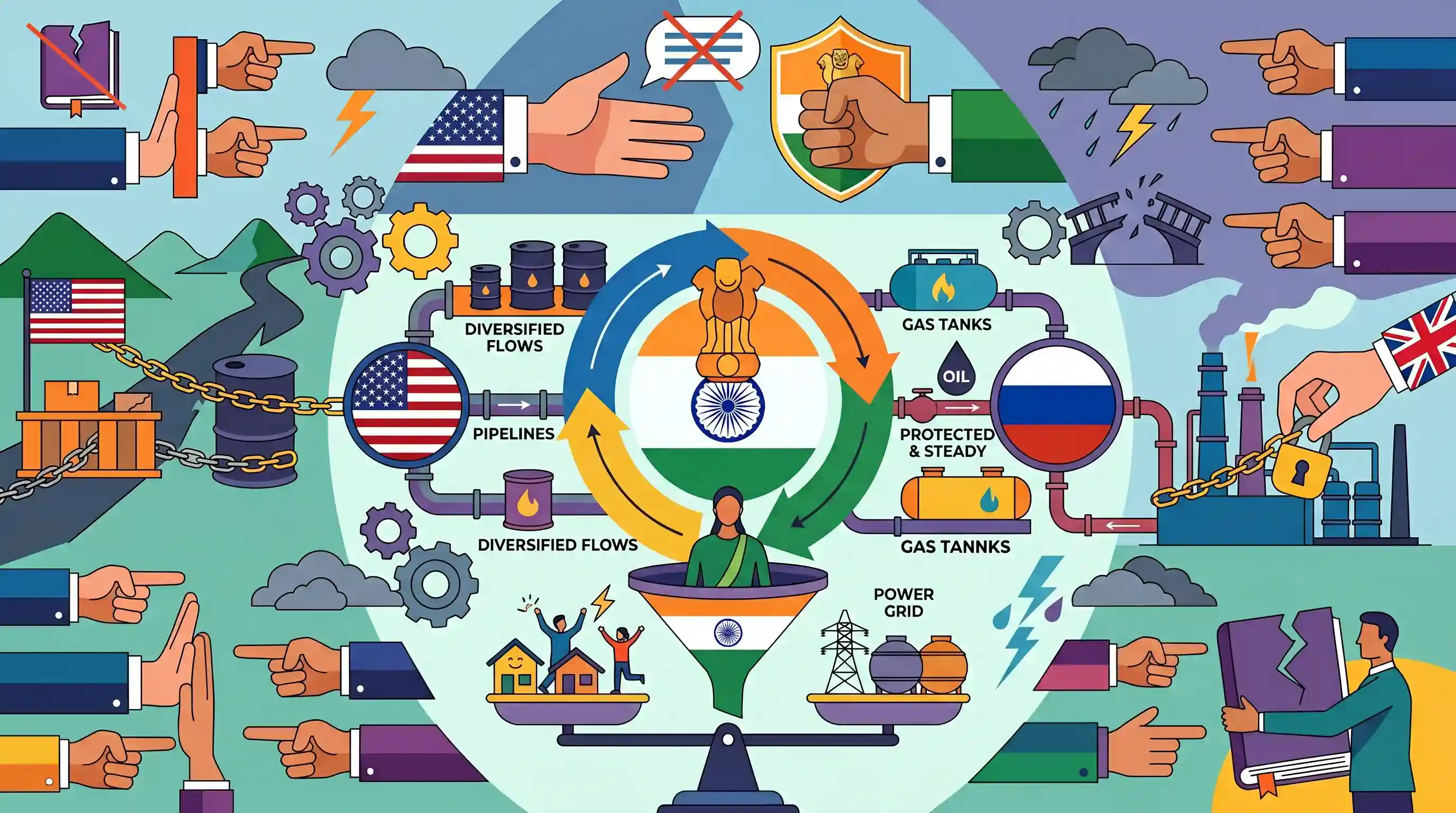
The Ministry of External Affairs (MEA) refuted US President Donald Trump's claim that Prime Minister Narendra Modi agreed to stop purchasing Russian oil, clarifying that no such discussion occurred. Reasserting India's strategic autonomy, the MEA emphasized that India prioritizes consumer interests and energy security by diversifying its oil and gas imports in a volatile global market. The dispute occurs against the backdrop of US penalty tariffs holding up trade talks, recent UK sanctions on an Indian refiner tied to a Russian firm, and India's continued stance against unilateral sanctions and double standards in global energy trade.
Key Points
- US President Donald Trump claimed PM Narendra Modi had agreed to stop buying Russian oil, but the MEA denied that any such conversation took place.
- The MEA stated India's policy is to broad-base and diversify its energy sources to ensure energy security and protect consumer interests amid market volatility.
- The US has imposed penalty tariffs on Indian goods, stalling bilateral trade talks over the issue.
- Despite a 45% drop in Russian oil imports by Indian PSUs between June and September, Russia remains India's largest oil supplier.
- The UK recently sanctioned Indian refiner Nayara Energy (owned by Russian firm Rosneft), to which India responded by opposing unilateral sanctions and double standards in energy trade.
Important Terms
Strategic Autonomy

A nation's ability to make independent foreign policy and defense decisions based on national interest, free from external pressure or binding military alliances.
UPSC context
GS Paper 2 (International Relations); tests India's 'multi-alignment' strategy and evolution from Non-Alignment.
Ministry of External Affairs (MEA)
The central government agency responsible for managing India's foreign relations, formulating diplomatic policies, and representing the nation in international forums.
UPSC context
GS Paper 2; fundamental for understanding the executive's role in foreign affairs and global engagement.
Energy Security
The uninterrupted availability of energy sources at an affordable price, ensuring that a nation's economic growth and basic needs remain resilient to global shocks.
UPSC context
GS Paper 3 (Economy/Infrastructure); critical for studying import dependence, diversification, and resource sovereignty.
Unilateral Sanctions
Economic or trade penalties imposed by a single country (rather than a multilateral body like the UN) to influence another state's policies.
UPSC context
GS Paper 2; examines international law, trade sovereignty, and bilateral frictions like CAATSA.
Nayara Energy
A major Indian private refiner, significantly owned by Russia’s Rosneft, that has faced Western sanctions due to its continued imports of Russian crude.
UPSC context
GS Paper 2/3; case study on energy diplomacy and the impact of geopolitics on corporate entities.
Rosneft
Russia's state-controlled oil giant and a key strategic partner for India, holding substantial stakes in Indian refineries and supplying discounted crude.
UPSC context
GS Paper 2; central to India-Russia strategic ties and navigating secondary sanctions.
Oil PSUs
State-owned enterprises (e.g., IOCL, ONGC) that manage India’s energy resources and implement government mandates for fuel security and pricing.
UPSC context
GS Paper 3 (Economy); relevant for studying the role of state enterprises in resource security.
Prelims Trap
India legally complies with secondary sanctions imposed by the US and UK to maintain strategic relations.
India consistently maintains that it only recognizes multilateral sanctions mandated by the UN Security Council, officially rejecting the extraterritorial application of unilateral sanctions.
Static Concepts Connected
What is India's official legal stance on international economic sanctions?
- UN Mandate: India only recognizes and enforces multilateral sanctions adopted by the UN Security Council under Chapter VII of the UN Charter.
- Unilateral Sanctions: India consistently rejects unilateral or secondary sanctions imposed by individual nations or blocs (like the US or EU).
- Extraterritoriality: India opposes the extraterritorial application of another nation's domestic laws on third parties as a violation of sovereign autonomy.
How does India conceptualize 'Energy Security' in its current foreign policy?
- Import Diversification: Mitigating supply shocks and market volatility by aggressively expanding the crude oil supplier base (recently from 27 to 40+ nations).
- Consumer Interest: Prioritizing affordable energy access for a massive domestic population to sustain economic growth, overriding external geopolitical pressures.
- Strategic Autonomy: Decoupling energy procurement decisions from military or strategic partnerships (e.g., remaining a Quad member while buying Russian crude).
Cross-Topic Patterns
Energy Security + Rupee-Ruble Trade
Unilateral sanctions on Russian entities accelerate India's push for local currency settlement mechanisms (Vostro accounts), linking energy procurement to the broader macroeconomic goal of internationalizing the Rupee.
Geopolitics + Supply Chain Resilience
Extraterritorial penalty tariffs by the US act as non-tariff barriers, showing how geopolitical energy disputes frequently spill over into broader WTO and bilateral free trade agreement negotiations.

Unilateral sanctions vs UN mandates and India's 'strategic autonomy' in energy procurement is a highly probable GS-2 Mains theme for 2026.
Linked PYQs · 4
Linked PYQs · 4
- 2025MainsGS2
"Energy security constitutes the dominant kingpin of India's foreign policy, and is linked with India's overarching influence in Middle Eastern countries.” How would you integrate energy security with India's foreign policy trajectories in the coming years?
- 2019MainsGS2
‘What introduces friction into the ties between India and the United States is that Washington is still unable to find for India a position in its global strategy, which would satisfy India's national self-esteem and ambitions.’ Explain with suitable examples.
- 2012MainsGS2
How have the US sanctions against Iran affected India's bilateral relations with Iran?
- 2020MainsGS2
What is the significance of Indo-US defence deals over Indo-Russian defence deals? Discuss with reference to stability in the Indo-Pacific region.
