MEA Rejection of Pakistan Allegations on Balochistan Attack
Source:Indian Express ↗
Why It Matters
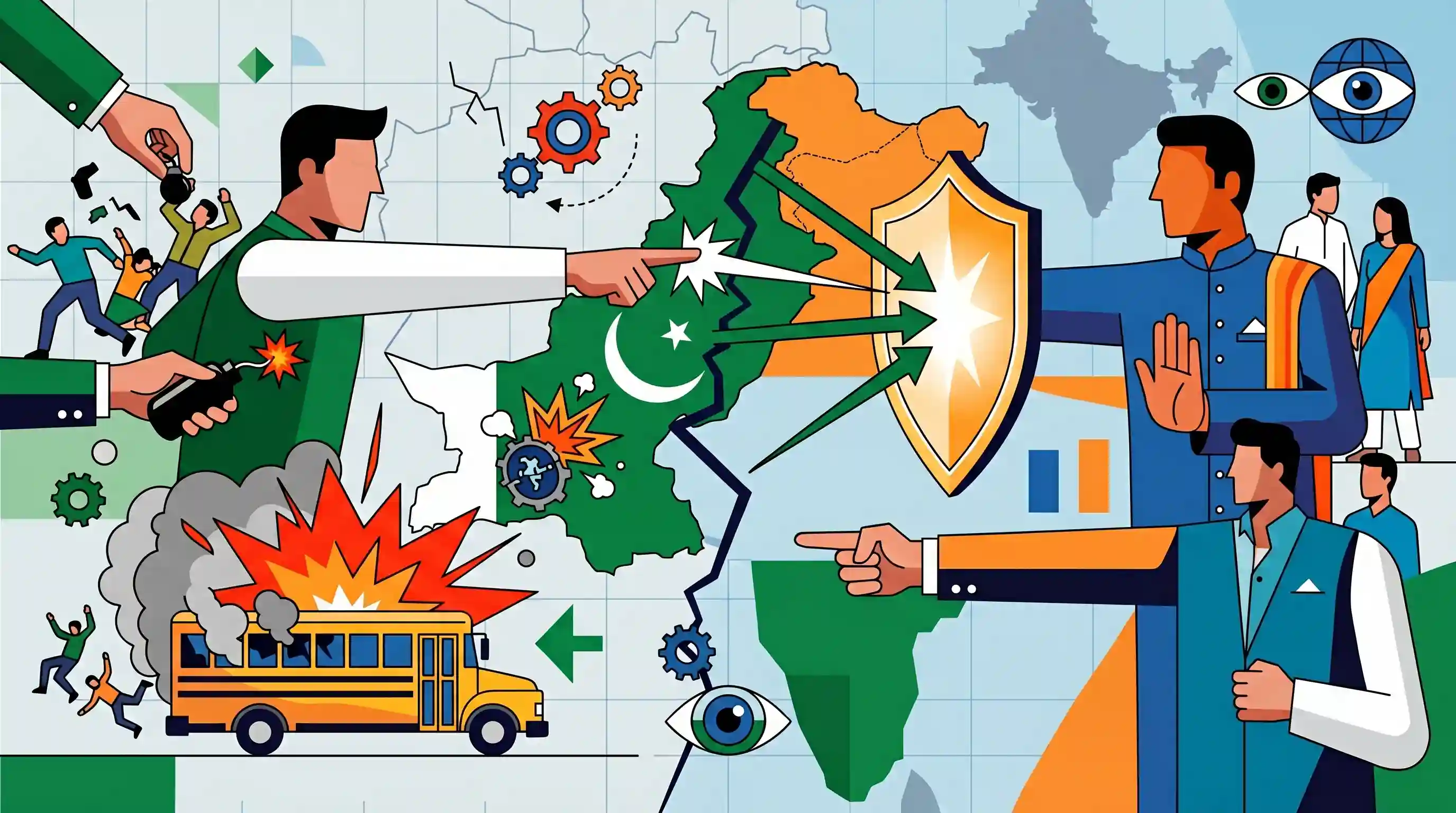
Highlights the persistent diplomatic friction between India and Pakistan, illustrating how internal security crises (like the Balochistan insurgency) are leveraged to shape bilateral narratives and deflect accountability for state-sponsored terrorism.
Summary
India’s Ministry of External Affairs (MEA) strongly rejected Pakistan's allegations of Indian involvement in a deadly suicide bombing targeting an army school bus in Khuzdar, Balochistan. Calling the claims entirely baseless, the MEA stated that Pakistan habitually blames India for its own internal security failures to deflect global attention from its long-standing reputation as a sponsor of terrorism. The exchange underscores the deep mutual distrust between the two nations, arriving shortly after a period of heightened military confrontation earlier in May.
Key Points
- A suicide bombing in Khuzdar, Balochistan, targeted an army school bus, resulting in the deaths of at least five people, including three children.
- Pakistan's military and Prime Minister Shehbaz Sharif accused India of involvement in the attack but provided no supporting evidence.
- India's MEA spokesperson Randhir Jaiswal dismissed the allegations as completely baseless, condemning the attack while expressing condolences for the lost lives.
- India asserted that Pakistan routinely blames New Delhi for its own internal security failures to deflect international attention from its status as the "global epicentre of terrorism."
- The diplomatic spat follows recent heightened military tensions between India and Pakistan in early May.
Important Terms
Ministry of External Affairs (MEA)

India's executive agency responsible for managing foreign relations, diplomatic missions, and formulating external policy to protect national interests.
UPSC context
GS Paper II: International Relations; crucial for understanding India's official stance and diplomatic responses to neighborhood conflicts.
Pakistan Military
The most powerful institution in Pakistan, exercising significant control over national security, foreign policy (especially toward India), and domestic political affairs.
UPSC context
GS Paper II & III: International Relations and Security; central to the 'security state' dynamic of India-Pakistan relations.
Balochistan Liberation Army (BLA)
An ethnonationalist militant group seeking independence for Pakistan's Balochistan province, designated as a terrorist organization by Pakistan, the US, and the UK.
UPSC context
GS Paper III: Internal Security; tests knowledge of regional insurgencies and non-state actors in South Asian geopolitics.
Cross-Border Terrorism
A persistent security challenge where militants from one country enter another to commit violence, a central friction point in Indo-Pak relations.
UPSC context
GS Paper III: Internal Security; a major theme in India's national security discourse and international counter-terrorism advocacy.
Balochistan
Pakistan's largest, resource-rich province, home to a long-running separatist movement and strategic infrastructure like the Chinese-backed Gwadar Port.
UPSC context
GS Paper II: Regional Geopolitics; impacts CPEC and remains a major flashpoint for India-Pakistan 'proxy war' allegations.
Proxy War
A conflict where major powers use third parties (proxies) as substitutes for fighting each other directly, often used to describe Indo-Pak regional competition.
UPSC context
GS Paper III: Security Challenges; focuses on how states use non-state actors to achieve geostrategic objectives.
Prelims Trap
Balochistan province of Pakistan shares international land borders with India, Afghanistan, and Iran.
Balochistan does NOT border India. It is located in southwestern Pakistan, bordering Iran and Afghanistan. Only Pakistan's Punjab, Sindh, and PoK share borders with India.
Static Concepts Connected
What is the strategic and geographical significance of Balochistan?
- Strategic Location: Situated in southwestern Pakistan, it borders Iran, Afghanistan, and the Arabian Sea, giving it command over the strategic Makran coastline.
- CPEC Epicenter: Hosts the Gwadar Port, serving as the critical maritime anchor for the China-Pakistan Economic Corridor (CPEC) and giving China direct access to the Arabian Sea.
- Resource Abundance: Despite severe economic marginalization, the province is highly resource-rich, housing massive natural gas, copper, and gold reserves (e.g., the Reko Diq mine).
What constitutes India's current official diplomatic policy toward Pakistan?
- Terror and Talks: A strict posture maintaining that formal bilateral dialogue cannot proceed until Pakistan verifiably dismantles anti-India cross-border terrorist networks operating from its soil.
- Diplomatic Isolation: Consistent diplomatic efforts to highlight Pakistan's status as a sponsor of terrorism at multilateral forums like the UN, SCO, and FATF to force behavioral change.
Cross-Topic Patterns
Balochistan unrest threatens CPEC viability
Ethno-nationalist insurgencies targeting Chinese infrastructure in Balochistan complicate the China-Pakistan strategic nexus, linking internal Pakistani security directly to global Belt and Road Initiative (BRI) progress.
Cross-border terror & FATF scrutiny
Pakistan's strategy of plausible deniability using non-state proxies repeatedly exposes it to FATF scrutiny, intertwining state-sponsored terror doctrines with international financial sanctions and economic distress.

Expect a 2026 GS-2 Mains question linking CPEC's security vulnerabilities in Balochistan to shifting China-Pakistan-India dynamics.
Linked PYQs · 3
Linked PYQs · 3
- 2016MainsGS2
Increasing cross-border terrorist attacks in India and growing interference in the internal affairs of several member-states by Pakistan are not conducive for the future of SAARC (South Asian Association for Regional Cooperation)." Explain with suitable examples.
- 2015MainsGS2
Terrorist activities and mutual distrust have clouded India-Pakistan relations. To what extent the use of soft power like sports and cultural exchanges could help generate goodwill between the two countries? Discuss with suitable examples.
- 2020MainsGS3
Analyze internal security threats and transborder crimes along Myanmar, Bangladesh and Pakistan borders including Line of Control (LoC). Also discuss the role played by various security forces in this regard.
