MEA Maintains Strategic Autonomy Stance on Russian Oil Imports
Source:The Hindu ↗
Why It Matters
Demonstrates the complex interplay between trade negotiations and geopolitical alignments, highlighting how India maneuvers to secure its energy needs while maintaining strategic partnerships with both the U.S. and Russia.
Summary
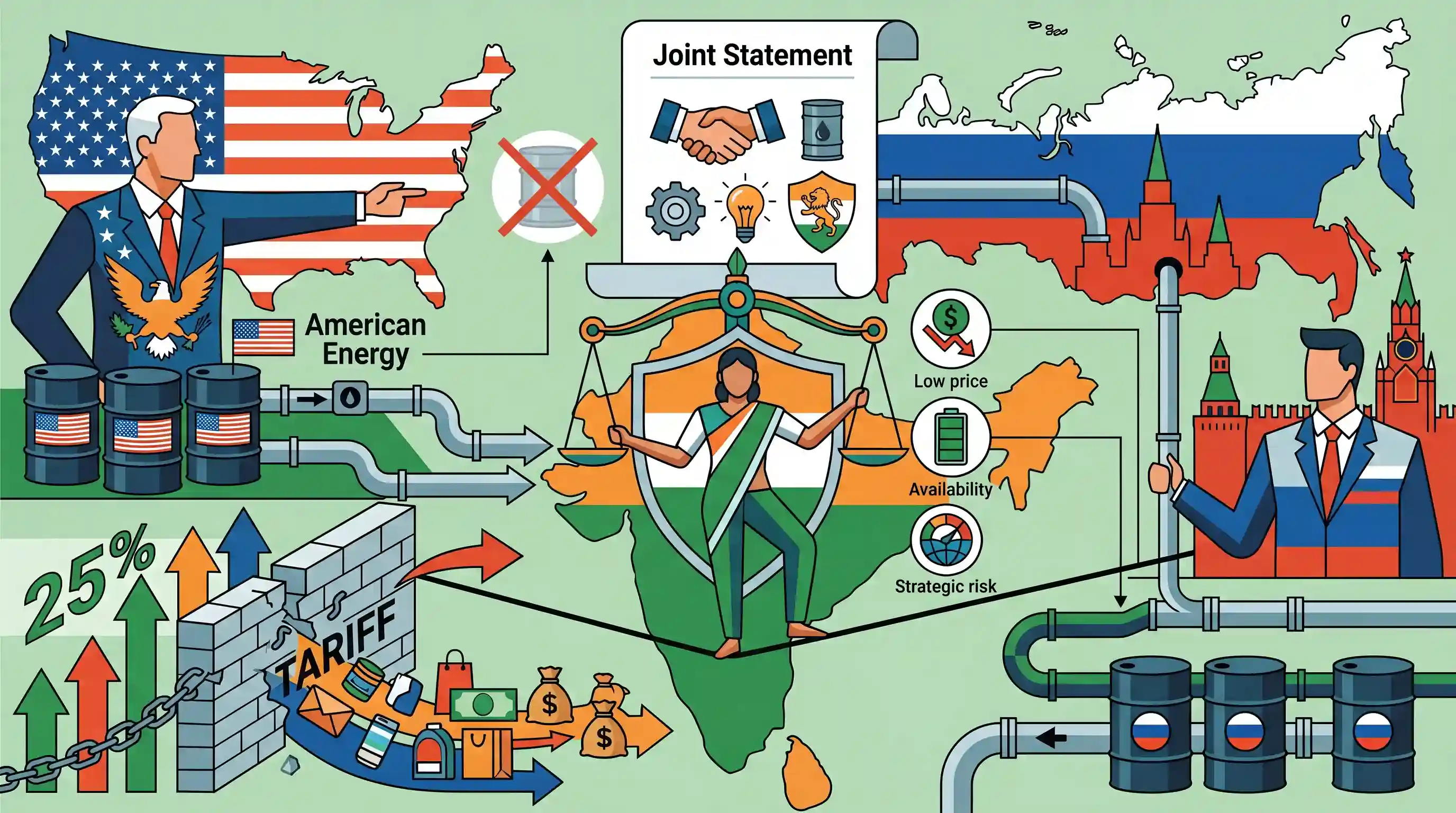
The Ministry of External Affairs (MEA) avoided directly denying assertions by U.S. officials that India agreed to halt Russian oil purchases in exchange for a trade deal that removed a 25% tariff on Indian imports. While U.S. officials, including Assistant Secretary of State S. Paul Kapur, insist India is actively replacing Russian oil with American energy, the MEA emphasized that the mutually agreed Joint Statement makes no mention of Russian oil. India officially maintains that its energy sourcing remains guided by pricing, availability, and strategic risks, reflecting its ongoing efforts to balance its strategic autonomy and energy security between the U.S. and Russia.
Key Points
- The MEA refrained from explicitly denying U.S. claims that India agreed to reduce Russian oil imports as part of a recent bilateral trade agreement.
- U.S. officials assert that India is increasing American energy purchases in exchange for the U.S. lifting a 25% tariff on Indian goods.
- A discrepancy exists between the India-U.S. Joint Statement, which omits Russian oil, and a White House fact sheet that explicitly states India committed to stop buying it.
- Indian officials reiterate that energy procurement decisions are strictly dictated by national interests, focusing on pricing, availability, and strategic risks.
Important Terms
India-U.S. Interim Trade Agreement

A 2026 bilateral framework aimed at reducing trade barriers and tariffs (lowering some from 50% to 18%) while realigning supply chains and energy ties between India and the United States.
UPSC context
GS Paper 2 (International Relations); tests understanding of bilateral trade dynamics and diplomatic negotiations under pressure.
Strategic Autonomy
India's foreign policy doctrine emphasizing sovereign, independent decision-making based on national interest, allowing for multi-alignment with diverse partners like the U.S. and Russia without joining rigid power blocs.
UPSC context
GS Paper 2 (IR); core pillar of Indian diplomacy tested in Mains regarding India’s role in a multipolar world.
Energy Security
The uninterrupted availability of energy sources at affordable prices to sustain India's population and economy, driving the diversification of crude oil imports from various global regions.
UPSC context
GS Paper 2 (Foreign Policy) & GS Paper 3 (Energy); critical for understanding India's sourcing from Russia versus the U.S.
Joint Statement
The official diplomatic document issued after high-level bilateral meetings that records the consensus, frameworks, and agreed-upon actions between two nations, serving as the basis for future implementation.
UPSC context
GS Paper 2 (IR); tests ability to analyze formal diplomatic records versus unofficial official claims.
Ministry of External Affairs (MEA)
India’s central government agency responsible for managing international relations, providing the official government stance on foreign policy, and protecting national interests through diplomacy.
UPSC context
GS Paper 2 (Governance/IR); the primary institutional actor in Indian foreign policy.
Prelims Trap
"India officially committed to halting Russian oil imports under the recent India-U.S. Joint Statement."
The MEA explicitly noted the Joint Statement omits Russian oil. The claim of a halt appears only in a unilateral White House fact sheet, highlighting a distinct diplomatic divergence.
Static Concepts Connected
What distinguishes UN sanctions from unilateral sanctions in international law?
- UN Sanctions: Sanctions passed under Chapter VII of the UN Charter are legally binding on all UN member states.
- Unilateral Sanctions: Imposed by individual countries (like the US or EU). India does not legally recognize unilateral sanctions, adhering only to UN mandates.
- Secondary Sanctions: When a country penalizes third-party nations (like India) for trading with a unilaterally sanctioned entity (like Russia), leveraging its economic dominance.
What are the core tenets of India's Strategic Autonomy?
- Multi-alignment: Transitioning from Cold War-era non-alignment to engaging with multiple, often rival, global powers based on specific issue-based interests.
- De-hyphenation: Maintaining independent bilateral relations with adversarial nations (e.g., US-Russia, Israel-Palestine) without letting one relationship dictate the other.
- Pragmatic National Interest: Prioritizing domestic economic stability, such as securing affordable crude oil, over external geopolitical pressures or bloc-politics.
Cross-Topic Patterns
Energy Security vs. Diplomatic Leverage
India substituting Russian crude with American energy imports ties directly to managing India's Current Account Deficit (CAD) while navigating geopolitical friction and secondary sanctions.
Constructive Ambiguity in Bilateral Pacts
The gap between mutually agreed joint statements and unilateral fact sheets is a classic tool to satisfy domestic constituencies without officially breaking bilateral trust.

A 2026 GS-II question will likely test India's use of 'constructive ambiguity' to balance US trade deals against Russian energy imports.
Linked PYQs · 2
Linked PYQs · 2
- 2025MainsGS2
"Energy security constitutes the dominant kingpin of India's foreign policy, and is linked with India's overarching influence in Middle Eastern countries.” How would you integrate energy security with India's foreign policy trajectories in the coming years?
- 2020MainsGS2
What is the significance of Indo-US defence deals over Indo-Russian defence deals? Discuss with reference to stability in the Indo-Pacific region.
