MEA Clarifies White House Factsheet Amendments on Trade Deal
Source:The Hindu ↗
Why It Matters
Understanding the nuances of bilateral trade negotiations—such as protecting sensitive domestic agricultural sectors and managing digital taxation policies—is crucial for GS2 International Relations and GS3 Economy. It illustrates the role of diplomacy in aligning public messaging post-negotiation.
Summary
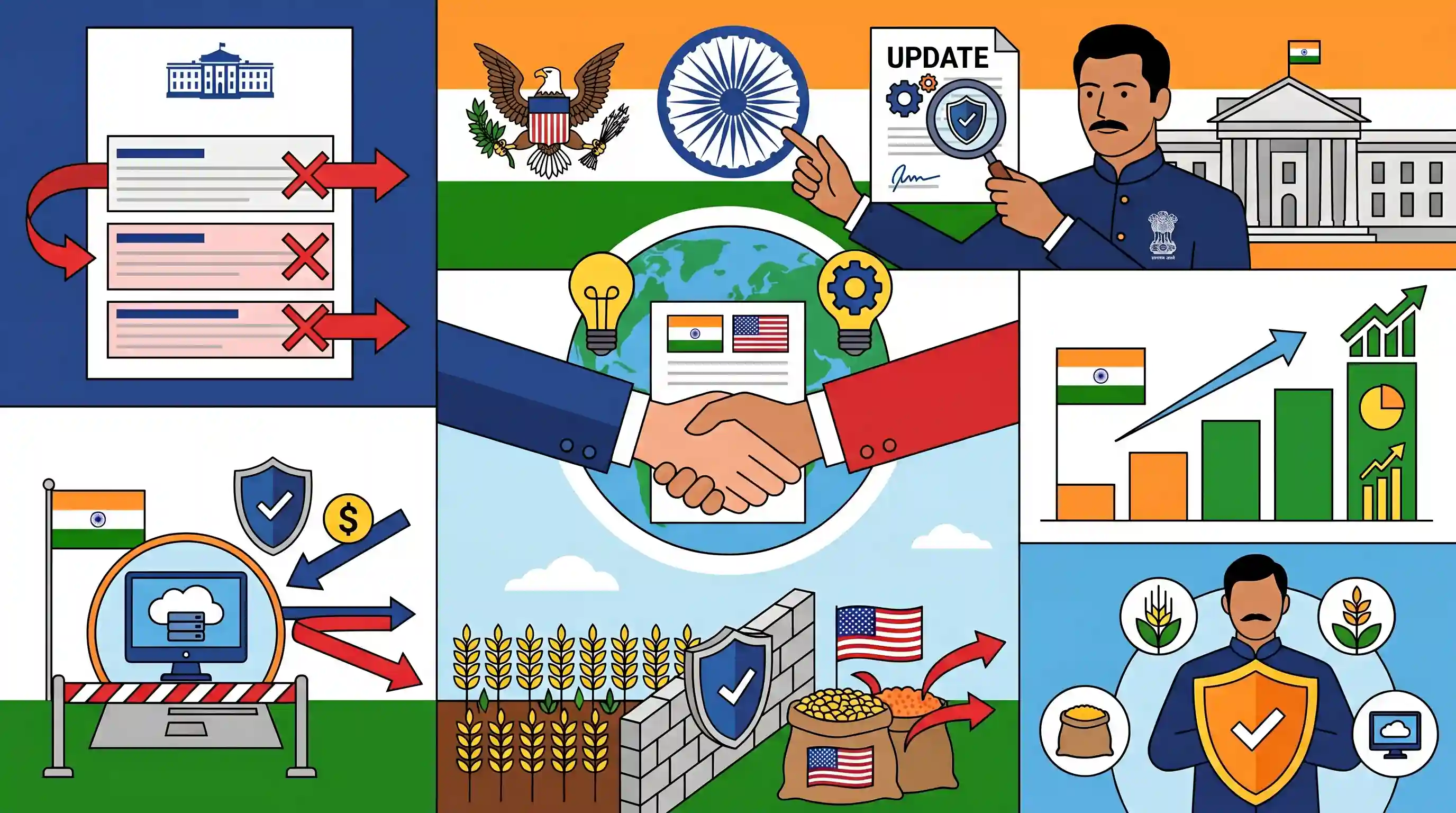
The Ministry of External Affairs (MEA) clarified that recent amendments by the U.S. to the White House factsheet regarding the India-U.S. interim trade deal accurately reflect the shared understandings from their joint statement. The U.S. retracted specific claims about India lifting its digital service tax and agreeing to import agricultural products like pulses. Additionally, language describing a $500 billion Indian investment in the U.S. was softened from a binding commitment to a future projection. The MEA underscored that India successfully protected its sensitive domestic sectors, particularly agriculture, during the trade negotiations.
Key Points
- The U.S. amended a White House factsheet on the India-U.S. interim trade deal to reflect mutual understandings reached in their joint statement.
- References to India dropping its digital service tax and agreeing to import American pulses were removed from the U.S. document.
- The MEA emphasized that India's sensitive agricultural sectors were explicitly protected during the negotiations.
- A stated $500 billion Indian investment in the U.S. was clarified as a future intent or projection, rather than a legally binding commitment.
Important Terms
India-U.S. Interim Trade Agreement

A 2026 framework for reciprocal tariff reductions (notably cutting U.S. duties from 50% to 18%) and improved market access, acting as a precursor to a full Bilateral Trade Agreement.
UPSC context
GS Paper 2: Bilateral Relations. Tests understanding of trade diplomacy, "mini-deals," and balancing reciprocal market access with domestic interests.
Digital Service Tax (Equalisation Levy)
India’s tax (initially 6% on ads, later 2% on e-commerce) on non-resident digital firms. It aims to tax value created in India by companies without a physical presence.
UPSC context
GS Paper 3: Indian Economy (Taxation). Tests knowledge of digital sovereignty, global tax friction, and the OECD’s Pillar 1/Pillar 2 framework.
Sensitive Sectors (Agriculture)
Domestic industries, specifically pulses and dairy, where India maintains high tariffs and resists liberalization to safeguard the livelihoods of millions of small-scale farmers from global competition.
UPSC context
GS Paper 3: Issues related to Direct and Indirect Farm Subsidies. Tests agricultural trade policy and the protection of rural economies in FTAs.
Section 301 (US Trade Act)
A provision of the U.S. Trade Act of 1974 allowing the president to investigate and retaliate against "unfair" trade practices, such as discriminatory taxes or intellectual property violations.
UPSC context
GS Paper 2: International Relations. Tests understanding of unilateral trade enforcement tools and their impact on global trade rules (WTO).
$500 Billion Trade Target
A long-term bilateral vision to increase annual goods and services trade between India and the U.S. to $500 billion, reframed as an "intention" rather than a binding commitment.
UPSC context
GS Paper 3: Effects of Liberalization. Tests ability to analyze economic diplomacy and the feasibility of high-growth bilateral trade projections.
Ministry of External Affairs (MEA)
The Indian government ministry responsible for foreign policy. It ensures trade deals align with "shared understandings" and provides diplomatic clarifications to protect national sovereignty.
UPSC context
GS Paper 2: Role of government institutions. Tests how ministries coordinate to safeguard strategic interests during international economic negotiations.
Prelims Trap
"India agreed to eliminate its Digital Service Tax under the new interim trade agreement with the U.S."
Aspirants often confuse early U.S. negotiation claims with finalized deals. The U.S. explicitly retracted this claim; India retains its sovereign right to tax digital entities.
Static Concepts Connected
What distinguishes an Early Harvest Scheme from a comprehensive FTA?
- Limited Scope: Targets tariff reduction on a limited, pre-identified set of goods and services rather than broad economic integration.
- Precursor Role: Acts as a confidence-building precursor to build trust before negotiating a comprehensive Free Trade Agreement (FTA).
- Strategic Exclusions: Typically shields highly sensitive domestic sectors (such as agriculture and dairy) to protect local stakeholders from sudden import surges.
How does India's Equalisation Levy (Digital Service Tax) function?
- Specific Target: Taxes non-resident e-commerce operators and digital platforms deriving significant revenue from Indian users.
- BEPS Countermeasure: Aims to prevent Base Erosion and Profit Shifting (BEPS) by taxing tech giants that lack a physical "Permanent Establishment" in India.
- Stop-gap Measure: Serves as a unilateral, transitional measure pending the full implementation of the OECD/G20 global tax framework.
Cross-Topic Patterns
Digital Tax & OECD Two-Pillar Framework
India's retention of the Equalisation Levy despite U.S. pressure links directly to delays in implementing the OECD's Pillar One consensus on taxing multinational digital enterprises.
Pulses Dependency & WTO Market Access
India's refusal to open its pulses market highlights the tension between its domestic demand-supply gap (importing 20%) and its defensive WTO strategy protecting farmer livelihoods.

Expect a Prelims question merging the Equalisation Levy, OECD's Pillar One tax framework, and US Section 301 retaliatory trade threats.
Linked PYQs · 3
Linked PYQs · 3
- 2023MainsGS3
What are the direct and indirect subsidies provided to farm sector in India? Discuss the issues raised by the World Trade Organization (WTO) in relation to agricultural subsidies.
- 2017PrelimsGS1
'Broad-based Trade and Investment Agreement (BTIA)' is sometimes seen in the news in the context of negotiations held between India and
- 2020MainsGS2
What is the significance of Indo-US defence deals over Indo-Russian defence deals? Discuss with reference to stability in the Indo-Pacific region.
