Supreme Court Examines Plea on Merchant Discount Rate for UPI
Source:The Hindu ↗
Why It Matters
It deals with the core economic architecture of India's digital payments ecosystem (UPI) and the contentious debate surrounding MDR, balancing financial inclusion with institutional sustainability.
Summary
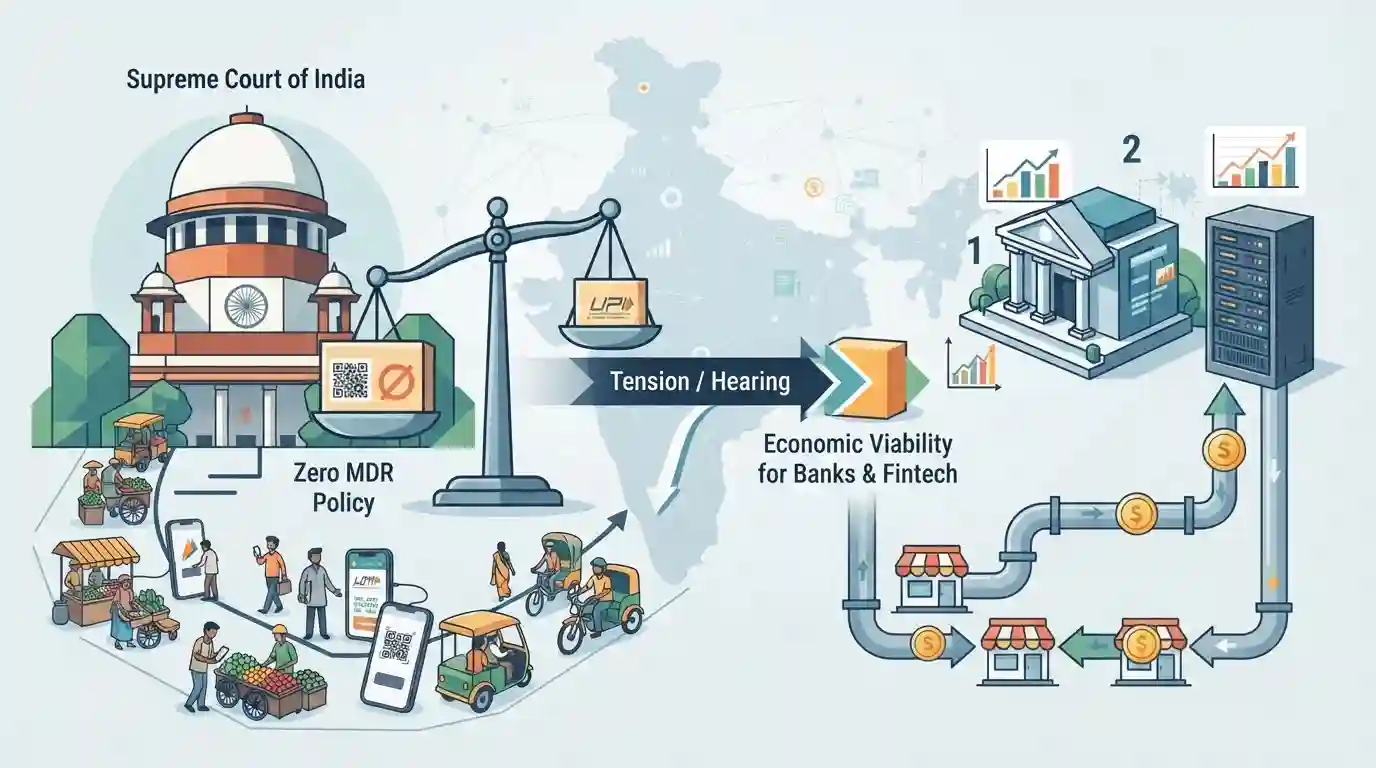
The Supreme Court of India is scheduled to hear a petition challenging the current framework or imposition of the Merchant Discount Rate (MDR) on Unified Payments Interface (UPI) transactions. The case highlights the ongoing tension between maintaining a zero-MDR policy to foster digital payments growth and ensuring the economic viability of banks and fintech players powering India's digital public infrastructure.
Key Points
- The Supreme Court is set to hear a plea challenging the imposition or framework surrounding the Merchant Discount Rate (MDR) on Unified Payments Interface (UPI) transactions.
- MDR is a fee charged to merchants for processing digital transactions, which has major implications for the financial viability of payment aggregators and banks supporting digital public infrastructure (DPI).
- A zero-MDR regime for UPI has heavily driven adoption and retail penetration in India but has sparked ongoing debates about long-term sustainability and compensation for service providers.
- The legal challenge brings to light regulatory governance, executive-judicial oversight over fiscal/monetary policies, and the balance between consumer/merchant welfare and payment ecosystem viability.
Important Terms
Merchant Discount Rate (MDR)

A fee charged to a merchant for accepting payments by digital methods, which compensates banks, fintechs, and payment networks for processing transactions and maintaining payment infrastructure.
UPSC context
GS Paper III (Economy - Digital Economy & Financial Inclusion); tests understanding of payment gateway economics, merchant costs, and financial sector viability.
Unified Payments Interface (UPI)
An instant real-time payment system developed by NPCI facilitating inter-bank transactions through mobile devices using virtual payment addresses without sharing bank details.
UPSC context
GS Paper III (Economy - Inclusive Growth & Digital Public Infrastructure); tests knowledge of India's retail payment systems and financial inclusion initiatives.
Reserve Bank of India (RBI)
India's central banking institution that controls the monetary policy of the Indian rupee, regulates the banking system, and oversees payment and settlement systems.
UPSC context
GS Paper III (Economy - Banking & Monetary Policy); tests familiarity with central bank functions, monetary oversight, and digital payment regulations.
National Payments Corporation of India (NPCI)
An umbrella organization for operating retail payments and settlement systems in India, created by RBI and Indian Banks' Association under the Payment and Settlement Systems Act, 2007.
UPSC context
GS Paper III (Economy - Financial Inclusion); tests knowledge of key institutional bodies governing India's digital payment architecture.
Supreme Court of India
The apex judicial body of India empowered under Article 143 to interpret the Constitution, adjudicate PILs, and review executive or legislative actions for fundamental rights compliance.
UPSC context
GS Paper II (Polity - Judiciary & Constitutional Bodies); tests awareness of judicial review, PIL mechanics, and executive policy challenges.
Prelims Trap
Zero-MDR is mandated across all digital payment instruments including credit cards and UPI in India.
Aspirants often assume zero-MDR applies to all digital payment modes in India, whereas credit cards and certain prepaid instruments routinely carry standard MDR charges.
Static Concepts Connected
What is the Merchant Discount Rate (MDR) and how does it function in India's digital payments ecosystem?
- Charge Mechanism: Fee definition charged to merchants by acquiring banks for processing customer digital payments.
- Revenue Split: Distributed among the issuing bank, payment network, and merchant acquiring bank.
- Policy Status: Currently zero for UPI and RuPay debit cards under government promotion policies, leading to compensation demands.
Cross-Topic Patterns
Zero-MDR Policy and Government Subsidy Burden
The debate over zero-MDR compensation intersects with fiscal deficit discussions, as government subsidies to reimburse banks for UPI processing costs directly impact the national exchequer.
Fintech Sustainability and Antitrust Regulation
Fintech viability issues under zero-MDR highlight the delicate regulatory balance required between antitrust laws and fostering indigenous digital public infrastructure champions.

MDR and UPI viability questions will likely feature as a statement-based question linking RBI regulations and digital infrastructure.
Linked PYQs · 5
Linked PYQs · 5
- 2018PrelimsGS1
Which one of the following best describes the term "Merchant Discount Rate" sometimes seen in news?
- 2026PrelimsGS1
Which one of the following statements about Unified Payments Interface (UPI) and Central Bank Digital Currency (Digital Rupee) is not correct ?
- 2025PrelimsGS1
Consider the following countries : I. United Arab Emirates II. France III. Germany IV. Singapore V. Bangladesh How many countries amongst the above are there other than India where international merchant payments are accepted under UPI?
- 2022MainsGS3
Is inclusive growth possible under market economy ? State the significance of financial inclusion in achieving economic growth in India.
- 2020MainsGS2
Judicial Legislation is antithetical to the doctrine of separation of powers as envisaged in the Indian Constitution. In this context justify the filing of large number of public interest petitions praying for issuing guidelines to executive authorities.
