Dehradun Municipal Corporation Launches Emergency Sanitation Teams
Source:pioneeredge ↗
Why It Matters
Underlines the direct execution of devolved municipal duties (Sanitation and Public Health) under the 74th Constitutional Amendment Act and illustrates local-level disaster mitigation and civic redressal frameworks within Uttarakhand.
Summary
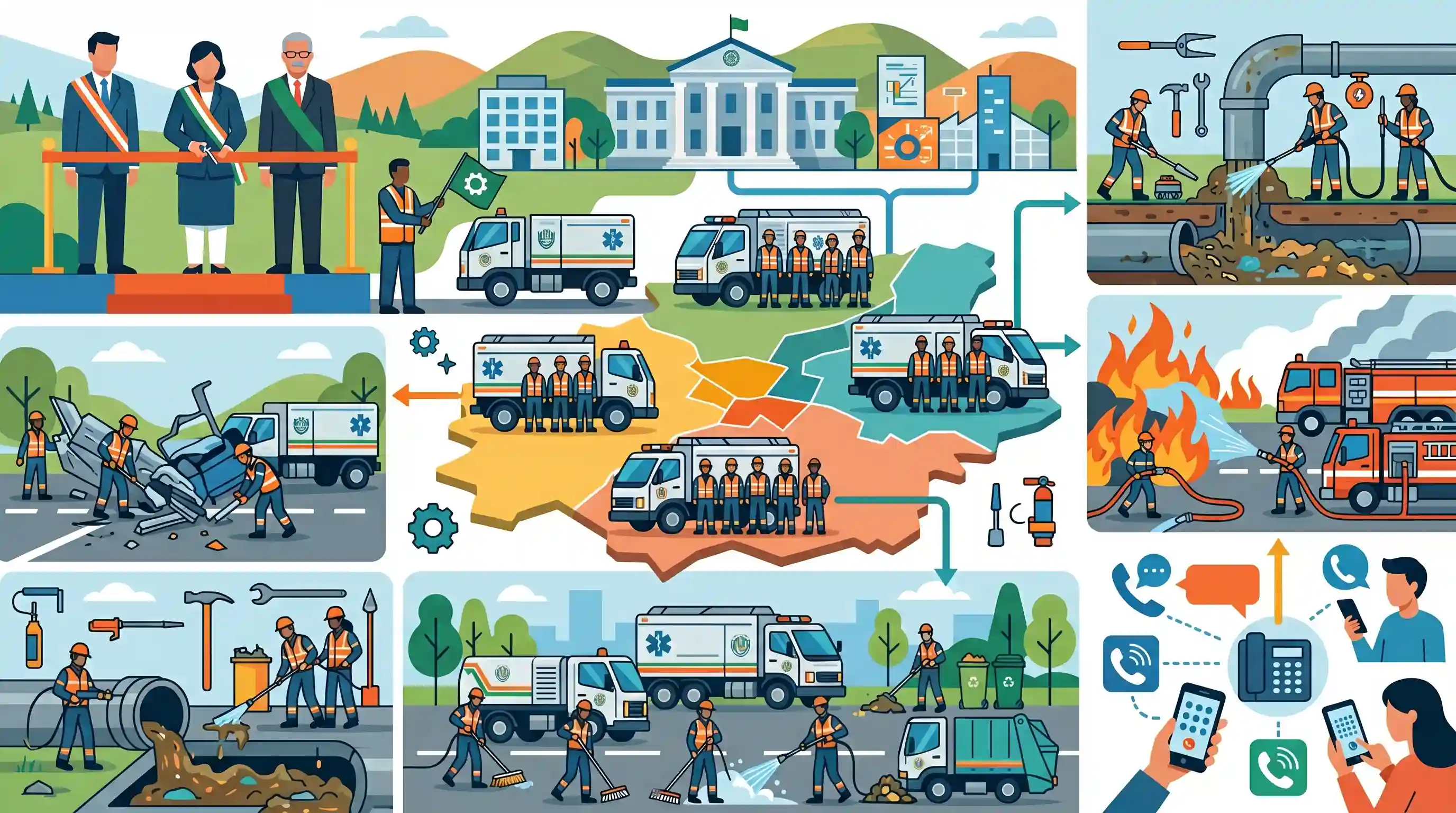
On July 3, 2026, the Municipal Corporation of Dehradun (MCD) launched its Quick Response Team (QRT) initiative to reinforce rapid-action emergency sanitation and localized disaster response. Flagged off by Uttarakhand Urban Development Minister Ram Singh Kaida, Mayor Saurabh Thapliyal, and Municipal Commissioner Alok Kumar Pandey, the fleet of five QRT vehicles is distributed across Dehradun's zones. Each vehicle is equipped with modern sanitation tools and staffed by six trained professionals who will handle emergency tasks like clearing accident debris, resolving drainage blockages, supporting fire safety, and running special cleanliness drives. Residents can access services using the toll-free helpline 1800-180-4571.
Key Points
- The Municipal Corporation of Dehradun (MCD) launched the Quick Response Team (QRT) initiative to provide rapid relief in sanitation emergencies and local disaster response.
- Five dedicated QRT vehicles have been deployed across various zones of the capital city, Dehradun.
- The initiative was flagged off by state Urban Development Minister Ram Singh Kaida, Dehradun Mayor Saurabh Thapliyal, and Municipal Commissioner Alok Kumar Pandey.
- Each QRT vehicle is staffed with six trained personnel and equipped with essential equipment including grass-cutting machines, shovels, pickaxes, crowbars, ropes, and safety gear.
- A dedicated toll-free helpline (1800-180-4571) has been set up to allow citizens to instantly report sanitation emergencies.
- Key responsibilities of the QRTs include clearing debris after road accidents and disasters, unclogging waterlogged drains, sanitation support in fire emergencies, and special cleanliness drives during major public events.
Important Terms
Quick Response Team (QRT)

A specialized, rapid-action municipal unit deployed during emergencies to address immediate urban hazards like severe waterlogging, disaster debris, drainage blocks, and localized safety issues.
UPSC context
GS Papers II & III: Decentralized disaster management and localized public service delivery mechanism during climate-induced urban crises.
Municipal Corporation of Dehradun (MCD)
The highest-tier Urban Local Body in Uttarakhand's capital, constitutionally mandated under the 74th Amendment Act to govern civic infrastructure, public health, and local sanitation.
UPSC context
GS Paper II: Decentralized governance, analyzing the executive and operational challenges of Tier-3 administrative units in India.
Urban Local Bodies (ULBs)
Democratic grassroots institutions established under the 74th Constitutional Amendment Act to administer, plan, and execute municipal development in urban areas.
UPSC context
GS Paper II: Local self-government; tests functional devolution, financial autonomy, and grassroots democratic administration under the Twelfth Schedule.
Local Self-Government
The constitutional decentralization of power to local bodies (Panchayats and Municipalities) to empower citizens and manage developmental and administrative affairs at the grassroots level.
UPSC context
GS Paper II: Indian Polity; tests democratic decentralization, participatory governance, and federal structure efficacy.
Prelims Trap
Local bodies possess constitutional jurisdiction to raise and manage specialized municipal forces for maintaining public order during disasters.
Public order is Entry 1 of the State List. Local bodies manage civic emergencies and sanitation, but cannot raise public order/law enforcement forces.
Static Concepts Connected
What functional items of the Twelfth Schedule relate to urban emergencies?
- Sanitation entry: Public health, sanitation, conservancy, and solid waste management are placed under local bodies to maintain civic hygiene.
- Fire services: This entry explicitly provides constitutional backing for municipal emergency fire and safety response.
- Urban infrastructure: Covers roads and bridges, which is essential for ensuring municipal teams can clear debris and restore transport routes.
Cross-Topic Patterns
Urban Flooding + Municipal Capacity
Localizing disaster response to municipal levels targets climate-induced urban flash floods, shifting reliance away from overstretched SDRF and NDRF units.
Fiscal Federalism + Local Disasters
Running resource-intensive emergency fleets (QRTs) exposes the structural issue of weak municipal revenue generation and dependency on state-discretionary funds.

UPSC may test the division of emergency powers between municipal bodies (12th Schedule) and state subjects like law and order.
Linked PYQs · 2
Linked PYQs · 2
- 2016UKPSC_PRELIMSGS1
Which one of the following functions is not the concern of Local Self Government?
- 2025UKPSC_PRELIMSGS1
Match the items given in Column-I and II : | Column-I | Column-II | |---|---| | A. Biomagnification | 1. Synthesis of ozone | | B. Electrostatic precipitation | 2. Solid waste | | C. Landfills | 3. Concentration build up at successive trophic levels | | D. Stratosphere | 4. Particulate matter | Codes : A B C D
