Mazagon Dock Colombo Dockyard Deal and Maritime Strategy
Source:The Hindu ↗
Why It Matters
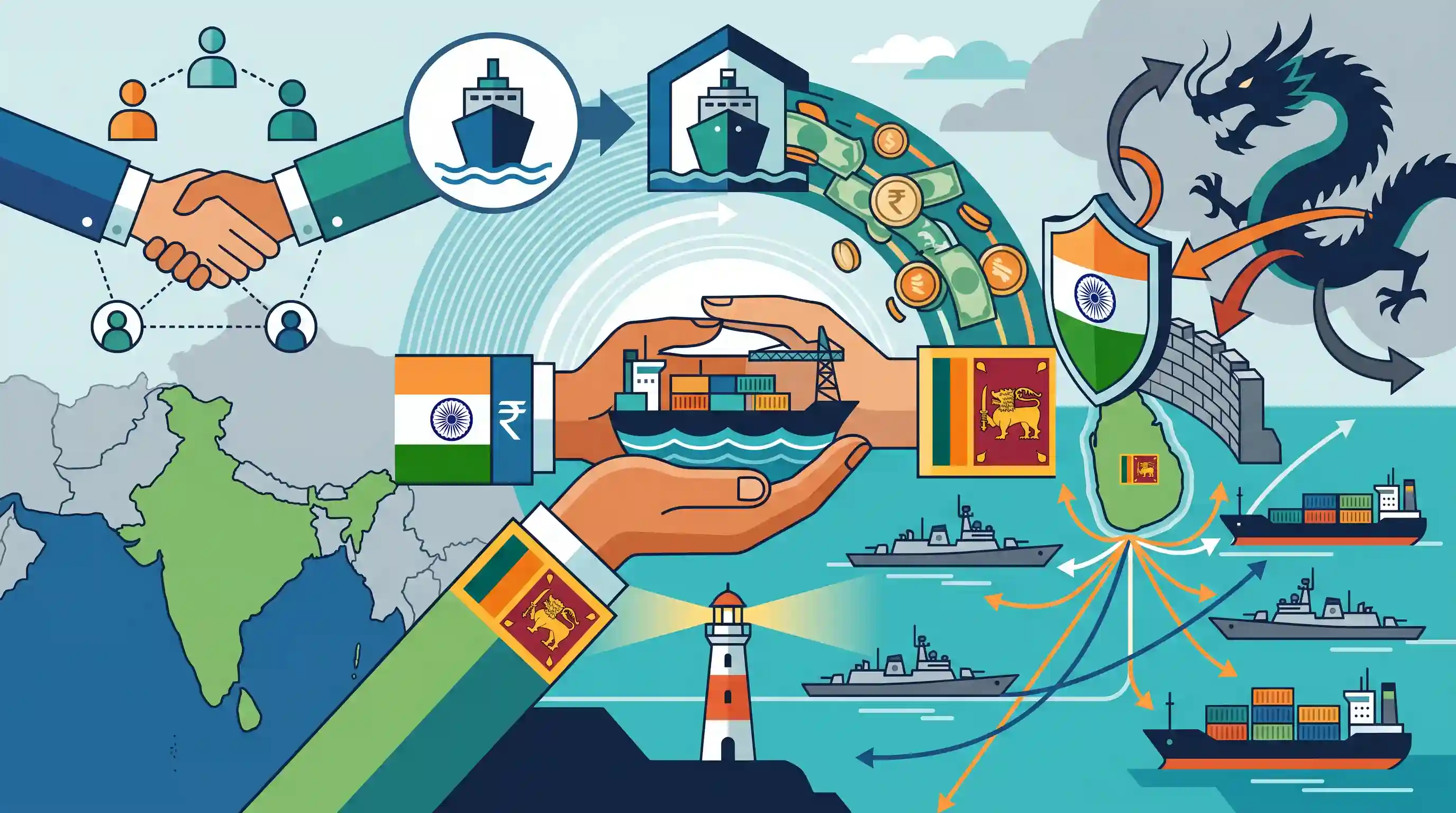
This deal represents a convergence of India's economic, defence, and foreign policy objectives. It highlights the strategic use of Defence PSUs in securing national interests abroad, directly addressing maritime security concerns in the Indian Ocean Region and countering the 'String of Pearls' strategy. It is highly relevant for GS Paper 2 (International Relations) and GS Paper 3 (Security/Economy).
Summary
India's Mazagon Dock Shipbuilders Limited (MDL) has struck a ₹452-crore deal involving Sri Lanka's Colombo Dockyard, signaling a major push in India's global shipbuilding and maritime strategy. The acquisition strengthens India's presence in the critical Indian Ocean Region (IOR) and bolsters bilateral ties under the 'Neighbourhood First' policy. Importantly, the investment serves as a strategic countermeasure against China's expanding footprint in Sri Lanka, reinforcing India's maritime security architecture and commercial shipping capabilities.
Key Points
- Indian defence PSU Mazagon Dock Shipbuilders Limited (MDL) has acquired a stake in Sri Lanka's Colombo Dockyard in a ₹452-crore strategic deal.
- The investment underscores India's ambitions to expand its global shipbuilding footprint and boost defence exports.
- The deal enhances India's strategic maritime presence in the Indian Ocean Region (IOR), offering access to crucial ship repair and building facilities.
- Strategically, this serves as a counter to China's growing influence and maritime infrastructure investments in Sri Lanka, such as the Hambantota port.
- The agreement strengthens bilateral ties, aligning with India's 'Neighbourhood First' policy and SAGAR vision.
Important Terms
Neighbourhood First Policy

India's diplomatic strategy prioritizing immediate neighbors for regional stability, connectivity, and prosperity. It emphasizes 'non-reciprocal' assistance and consultative engagement with countries like Sri Lanka, Nepal, and Maldives.
UPSC context
GS Paper II (International Relations). Tests understanding of regional diplomacy and counter-balancing external influences like China's BRI.
SAGAR (Security and Growth for All in the Region)
India's strategic doctrine for the Indian Ocean, focusing on cooperative maritime security, capacity building, and sustainable 'Blue Economy' growth for all littoral nations.
UPSC context
GS Paper II & III (Security/IR). Vital for topics on maritime domain awareness and India’s role as a net security provider.
Mazagon Dock Shipbuilders Limited (MDL)
A premier Indian Defense Public Sector Undertaking (PSU) and lead shipyard. It specializes in building warships and submarines (e.g., Kalvari-class) for the Indian Navy.
UPSC context
GS Paper III (Indigenization of Technology/Defense). Tests knowledge of self-reliance (Atmanirbharta) in naval manufacturing.
Maritime Amrit Kaal Vision 2047
A long-term strategic roadmap to transform India into a global maritime powerhouse by 2047, focusing on port-led development, shipbuilding, and international maritime clusters.
UPSC context
GS Paper III (Infrastructure/Economy). Relevant for long-term planning and India's ambition in global logistics.
Colombo Dockyard PLC (CDPLC)
Sri Lanka's largest shipyard located in the Port of Colombo. MDL's 51% acquisition marks India's first international shipyard deal, strengthening regional MRO (Maintenance, Repair, and Overhaul) capabilities.
UPSC context
GS Paper II (Bilateral Relations). Illustrates strategic investment as a tool to secure maritime interests in the IOR.
Prelims Trap
"The MDL-Colombo Dockyard agreement establishes a sovereign Indian naval base in Sri Lanka."
This is a commercial equity stake by a Navratna Defence PSU for shipbuilding and repair capabilities, not the establishment of a sovereign military base or defence pact.
Static Concepts Connected
What is the SAGAR (Security and Growth for All in the Region) doctrine?
- Origin: Introduced in 2015 to deepen economic and security cooperation with India's maritime neighbors.
- Core objective: Ensuring a secure Indian Ocean Region through capacity building, information exchange, and disaster management.
- Counter-strategy: Acts as India's diplomatic and strategic counterweight to China's expanding 'String of Pearls' footprint in the IOR.
What qualifies a Central Public Sector Enterprise (CPSE) for Navratna status?
- Base requirement: Must already hold Miniratna Category-I status and have at least four independent directors on its board.
- Performance score: Must achieve a composite score of 60/100 across six performance parameters, including net profit to net worth.
- Autonomy granted: Can invest up to ₹1,000 crore without explicit government approval, enabling agile overseas acquisitions like MDL's deal.
Cross-Topic Patterns
Defence PSUs as Geopolitical Tools
Links GS3 (Defence Indigenization) with GS2 (International Relations). India is moving beyond traditional diplomacy by using commercial equity acquisitions by Defence PSUs to secure strategic footholds and counter China's BRI.
Transshipment Hubs & Supply Chains
Connects GS1 (Economic Geography) to GS3 (Infrastructure). Over 60% of India's transshipment cargo passes through Colombo Port; securing dockyard infrastructure there directly protects India's commercial shipping lines.

Expect a 2026 Prelims question linking Defence PSU overseas acquisitions (like MDL) with the SAGAR doctrine and Indian Ocean transshipment.
Linked PYQs · 2
Linked PYQs · 2
- 2022MainsGS2
India is an age-old friend of Sri Lanka.’ Discuss India's role in the recent crisis in Sri Lanka in the light of the preceding statement.
- 2011MainsGS2
Critically examine the security and strategic implications of the so-called 'string of pearls' theory for India.
