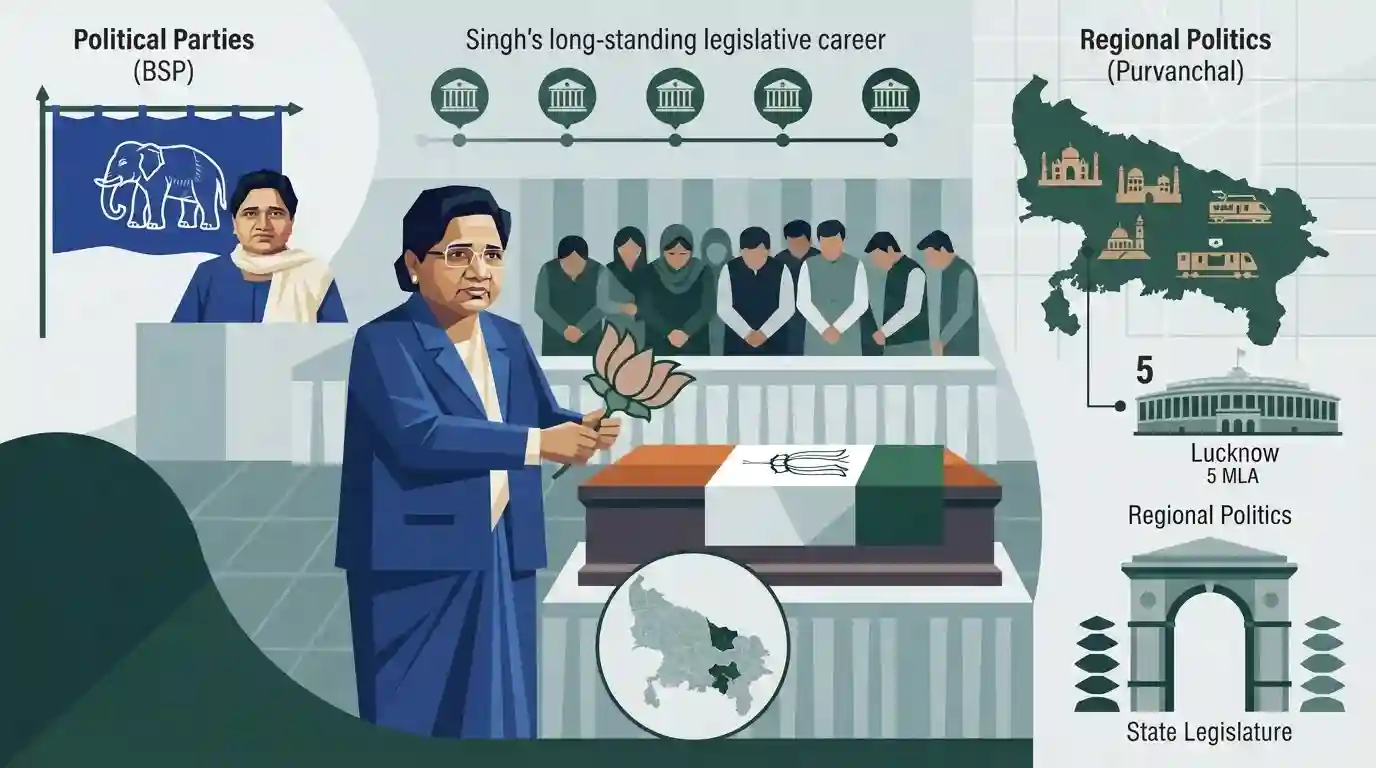
Mayawati pays last respects to veteran BSP MLA Uma Shankar Singh
Source:aninews ↗
Why It Matters
The passing of a veteran 5-time MLA is notable for state-level political current affairs. UPPSC PCS often asks questions regarding the chronological establishment of prominent state political parties (like the BSP) and the geography of the constituencies in Purvanchal.
Summary
BSP Chief Mayawati paid her last respects to five-time MLA Uma Shankar Singh, a prominent leader from the Purvanchal region who represented the Rasra constituency in Ballia district. Singh passed away at 63 in Delhi and is remembered for his long-standing legislative career in Uttar Pradesh.
Key Points
- Bahujan Samaj Party (BSP) chief Mayawati paid her last respects to veteran party leader Uma Shankar Singh at her residence in Lucknow.
- Uma Shankar Singh passed away at the age of 63 while undergoing treatment at a hospital in Delhi.
- He was a prominent leader of the Purvanchal region and served as an MLA for five consecutive terms from the Rasra assembly constituency in Ballia district.
- His final rites are scheduled to be performed in his home district of Ballia.
Important Terms
Bahujan Samaj Party (BSP)

A national political party in India founded by Kanshi Ram in 1984. Rooted in Ambedkarism, it aims to politically mobilize and represent historically marginalized communities, including Scheduled Castes, Scheduled Tribes, Other Backward Classes, and religious minorities.
UPSC context
Relevant for GS Paper 2 (Indian Polity). Tests knowledge on political parties, national party status, and the political mobilization of marginalized communities.
Purvanchal Region
The eastern extension of the Himalayan mountain system in northeastern India. Comprising ranges like the Patkai, Naga, and Mizo hills, the region features dense forests, rich biodiversity, and forms a natural boundary between India and Myanmar.
UPSC context
Important for GS Paper 1 (Geography) and GS Paper 3 (Biodiversity). Tests knowledge of India's physical geography, border security, and ecological hotspots.
State Legislature
The law-making body of an Indian state, governed by Articles 168-212. It consists of the Governor and the Legislative Assembly (Vidhan Sabha), with some states also having a Legislative Council (Vidhan Parishad) in a bicameral setup.
UPSC context
Crucial for GS Paper 2 (Polity and Governance). Tests understanding of constitutional provisions, state-level legislative structures, and the federal distribution of powers.
Prelims Trap
By-elections for a vacant State Assembly seat must unconditionally be held within six months of the vacancy.
Section 151A of RPA 1951 exempts by-elections if the remaining term is less than one year, or if the EC certifies that holding polls is difficult.
Static Concepts Connected
What are the statutory rules for filling vacancies in a State Legislature?
- Time limit: Under Section 151A of the RPA 1951, the Election Commission must hold a by-election within six months from the date of the vacancy.
- Term remainder exception: A by-election is not required if the remainder of the departing member's term is less than one year.
- EC certification exception: Exempted if the EC, in consultation with the Central Government, certifies that it is difficult to hold elections within the stipulated timeframe.
How does the Constitution facilitate the creation of new states or alteration of boundaries?
- Parliamentary Power: Under Article 3, Parliament holds exclusive authority to form new states or alter boundaries of existing states by a simple majority.
- Presidential Assent: A bill for this purpose can only be introduced in Parliament with the prior recommendation of the President.
- Consultative Role: The President must refer the bill to the concerned state legislature for its views within a specified period, but these views are not binding on Parliament.
Cross-Topic Patterns
Purvanchal demand & regionalism
The sustained demand for a separate Purvanchal state highlights how perceived developmental deficits and skewed resource allocation fuel regionalism in demographically large states like Uttar Pradesh.
National Party status criteria
The BSP's shifting electoral fortunes often trigger debates on the Election Commission's criteria for National Party status, testing aspirants on the specific vote share and Lok Sabha seat thresholds required.

Expect a Prelims statement on RPA 1951 by-election exceptions or a GS-1 question on how administrative size fuels regional demands.
Linked PYQs · 2
Linked PYQs · 2
- 2022UPPSC_PRELIMSGS1
Consider the following Political Parties and arrange them in the chronological order of their establishment. I. Bahujan Samaj Party II. Samajwadi Party III. Telugu Desham Party IV. All India Trinamool Congress Select the correct answer from the code given below.
- 2021UPPSC_PRELIMSGS1
The functions of the State Public Service Commission of Uttar Pradesh can be extended by
