Centre State Friction on Delimitation and Education Policy
Source:Indian Express ↗
Why It Matters
The recurring friction between the Centre and states over delimitation and language highlights structural challenges to India's federalism. The demographic success of Southern states contrasting with their potential political marginalization is a major upcoming constitutional and governance debate.
Summary
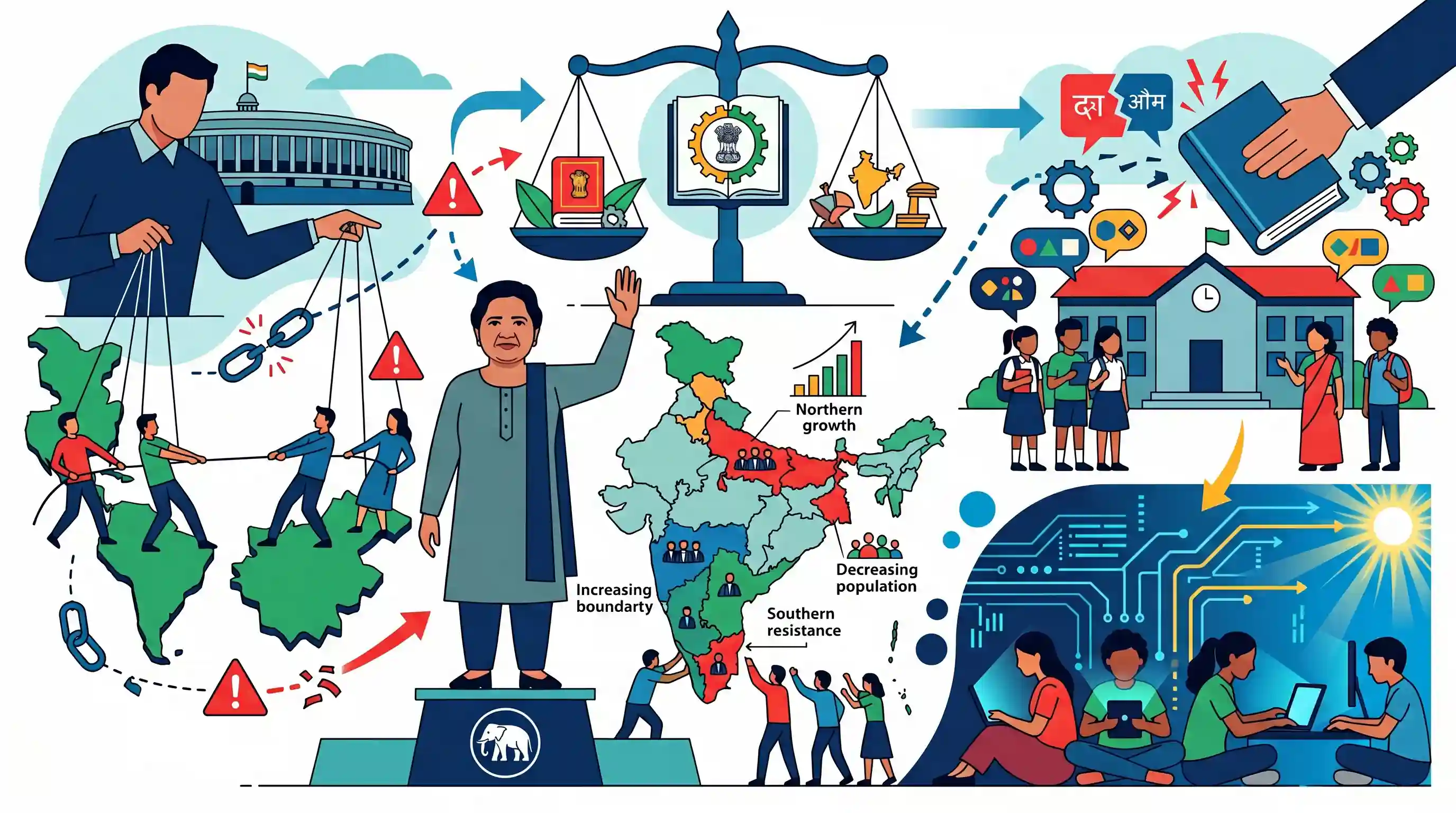
BSP chief Mayawati raised concerns over ongoing political disputes between the Centre and state governments regarding the delimitation exercise, the National Education Policy (NEP), and language imposition, warning that such friction undermines the national interest. The remarks come amidst growing federal tensions, particularly with Southern states protesting the potential reallocation of Lok Sabha seats based on population size. Additionally, states like Tamil Nadu and Maharashtra are engaged in debates over the imposition of Hindi as a mandatory language in schools under the NEP. Mayawati urged the government to focus on constitutional governance and prioritize practical skill development in IT for marginalized students rather than engaging in linguistic disputes.
Key Points
- BSP chief Mayawati criticized the growing political disputes between the Centre and states over the upcoming census, delimitation of Lok Sabha constituencies, and the National Education Policy (NEP).
- Southern states have expressed deep concerns that the impending delimitation exercise will reduce their political representation in Parliament, effectively penalizing them for successful population control.
- The implementation of the NEP has reignited debates around 'Hindi imposition', highlighted by resistance in Tamil Nadu and Maharashtra's recent move to make Hindi a mandatory third language for Classes 1 to 5.
- Mayawati emphasized that instead of politicizing language, the government should prioritize accessible IT and skill-based education for students from marginalized and oppressed communities.
Important Terms
Delimitation Commission

The process of redrawing electoral constituency boundaries to reflect population changes. It ensures the democratic principle of 'one person, one vote, one value' and is currently frozen until post-2026.
UPSC context
GS-II: Elections and Parliament. Tests knowledge of Article 82 and federal impacts of population-based seat reallocation.
National Education Policy (NEP) 2020
A 2020 framework replacing the 1986 policy, introducing a 5+3+3+4 school structure and emphasizing vocational training, mother-tongue instruction, and holistic learning across school and higher education.
UPSC context
GS-II: Social Justice/Education. Tests understanding of educational reforms, federal implementation, and linguistic inclusivity.
Federalism (Centre-State Relations)
A constitutional system dividing powers between Union and States. India’s 'quasi-federal' model features a unitary tilt, frequently leading to jurisdictional friction over regional representation and autonomy.
UPSC context
GS-II: Indian Constitution. Tests understanding of the 'Union of States' model and challenges like centralization versus regional interests.
Concurrent List
A Seventh Schedule list containing subjects (e.g., Education) where both Parliament and State Legislatures can legislate, with Central laws prevailing in cases of direct conflict.
UPSC context
GS-II: Seventh Schedule. Tests knowledge of legislative distribution and friction points in areas like education and environment.
Eighth Schedule
A constitutional schedule listing 22 official languages of India. It serves as a guide for language development and is central to debates regarding Hindi imposition and regional identity.
UPSC context
GS-I: Society/GS-II: Governance. Tests knowledge of linguistic diversity and the 'Three-Language Formula' in federalism.
Lok Sabha
The lower house of India’s Parliament, representing the people. Its total seat count and state-wise distribution are the primary subjects of the upcoming 2026 delimitation exercise.
UPSC context
GS-II: Parliament. Tests knowledge of legislative structure and the link between demographics and political representation.
Prelims Trap
The total number of Lok Sabha seats allocated to each state is currently based on the 2001 Census.
The allocation of Lok Sabha seats among states is still frozen based on the 1971 Census. Only territorial boundaries within states were redrawn using 2001 Census data (87th Amendment).
Static Concepts Connected
How does the Constitution govern the Delimitation exercise?
- Article 82: Mandates Parliament to enact a Delimitation Act after every census to readjust seat allocation and constituency boundaries.
- 84th Amendment (2001): Froze the state-wise allocation of Lok Sabha seats based on the 1971 census until the first census post-2026 to encourage population control measures.
- Judicial Immunity: Orders of the Delimitation Commission have the absolute force of law and cannot be challenged or modified in any court.
What are the key constitutional directives regarding language policy?
- Article 343: Declares Hindi in the Devanagari script as the Official Language of the Union, alongside the continued use of English. It does not declare a "National Language".
- Article 351: Directs the Union government to actively promote the spread and development of the Hindi language as an expression of India's composite culture.
- Article 350A: Directs states and local authorities to provide adequate facilities for instruction in the mother-tongue at the primary education stage for linguistic minority groups.
Cross-Topic Patterns
Demographic Transition vs. Political Representation
The Southern states' advanced demographic transition (TFR below replacement) directly threatens their political representation, linking human geography and population control policies directly to constitutional federalism.
Fiscal Devolution parallels Delimitation
Just as the 15th Finance Commission faced backlash for using 2011 census data for tax devolution, the impending post-2026 delimitation sparks identical federal friction over "penalizing" states for successful population control.

A 2026 Mains question will likely integrate the sunset clause of the 84th Amendment, demographic disparities, and Centre-State federalism.
Linked PYQs · 4
Linked PYQs · 4
- 2024MainsGS2
What changes has the Union Government recently introduced in the domain of Centre-State relations ? Suggest measures to be adopted to build the trust between the Centre and the States and for strengthening federalism.
- 2025MainsGS2
Examine the evolving pattern of Centre-State financial relations in the context of planned development in India. How far have the recent reforms impacted the fiscal federalism in India?
- 2020MainsGS2
National Education Policy 2020 is in conformity with the Sustainable Development Goal-4 (2030). It intends to restructure and reorient education system in India. Critically examine the statement.
- 2016MainsGS1
Has the formation of linguistic States strengthened the cause of Indian Unity?
