Rajasthan High Court Suo Motu PIL on Building Dome Safety
Source:bar-and-bench ↗
Why It Matters
The incident highlights the proactive use of suo motu PIL powers by High Courts under Article 226 while drawing attention to critical lapses in the quality of public infrastructure projects executed by state agencies.
Summary
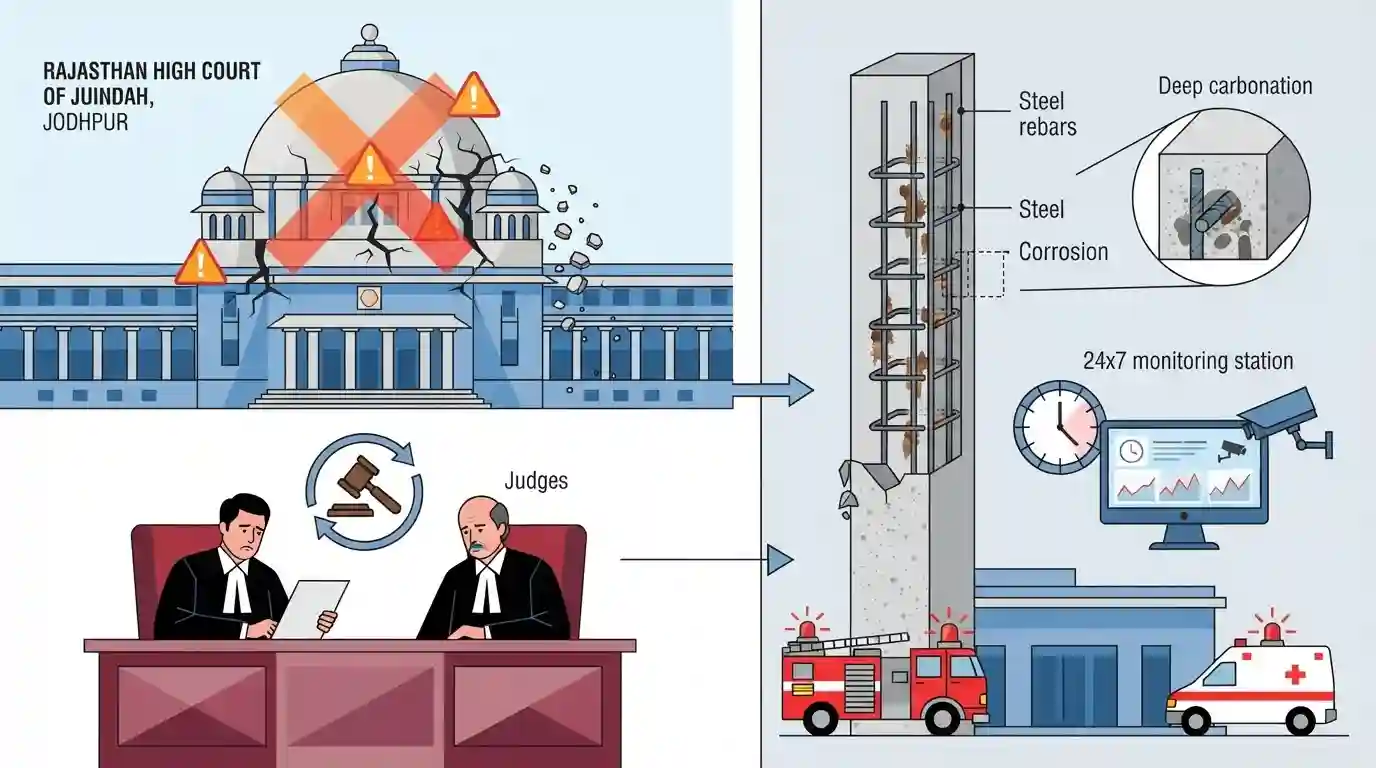
The Rajasthan High Court has initiated a suo motu Public Interest Litigation (PIL) after a structural audit by IIT Bombay revealed that the High Court's building in Jodhpur is at imminent risk of a partial collapse. The structure, which was inaugurated in 2019, exhibits severe defects like deep carbonation and rebars corrosion, particularly threatening the 21-metre-high central dome. A Division Bench comprising Justices Pushpendra Singh Bhati and Praveer Bhatnagar has ordered emergency protocols, including 24x7 structural monitoring, to prevent potential loss of life and property.
Key Points
- The Rajasthan High Court took suo motu cognizance of the severely compromised structural safety of its own building in Jodhpur, inaugurated in 2019.
- A structural assessment by IIT Bombay warned that the 21-metre-high central dome is at risk of imminent collapse.
- Severe structural deficiencies include deep carbonation, significant corrosion of rebars, and concrete spalling.
- The Court issued notices to State and Central authorities and mandated a 24x7 control room to monitor the building's stability and devise a time-bound repair strategy.
Important Terms
Rajasthan High Court

The principal court of Rajasthan, located in Jodhpur. In 2026, it took suo motu cognizance of the imminent collapse of its own central dome due to severe structural defects.
UPSC context
Highlights the role of the judiciary in initiating suo motu PILs (GS2) and underscores issues of infrastructure safety and public accountability.
Indian Institute of Technology (IIT) Bombay
A premier engineering institute whose expert structural audit revealed severe carbonation and rebar corrosion in the Rajasthan High Court building, warning of its imminent collapse.
UPSC context
Relevant to GS3 (Infrastructure) and GS2 (Governance), showing the importance of expert technical audits in public administration and disaster prevention.
Indian Institute of Technology (IIT) Jodhpur
A leading technical institute whose 2023 expert committee report initially highlighted severe steel corrosion and spalling concrete in the Rajasthan High Court building prior to IIT Bombay's audit.
UPSC context
Demonstrates the role of technical institutions in disaster prevention frameworks and early warning safety audits (GS3: Disaster Management & Infrastructure).
Public Works Department (PWD)
A state government department responsible for public infrastructure. It oversaw the boundary construction and initial phases of the structurally flawed Rajasthan High Court complex.
UPSC context
Connects to GS2 & GS3, focusing on public sector accountability, administrative negligence, and poor quality in government construction projects.
Rajasthan State Road Development & Construction Corporation Ltd. (RSRDC)
A state agency involved in infrastructure development. It executed a Memorandum of Understanding for constructing the structurally compromised Rajasthan High Court main building inaugurated in 2019.
UPSC context
Crucial for GS2/3 topics regarding the legal and ethical accountability of state-run corporations for substandard, life-threatening public construction.
Prelims Trap
"Suo motu Public Interest Litigation (PIL) can only be initiated by the Supreme Court."
Both the Supreme Court (Article 32) and High Courts (Article 226) possess expansive powers to initiate suo motu PILs, relaxing the traditional rule of locus standi.
Static Concepts Connected
What is the constitutional and jurisprudential basis of Public Interest Litigation (PIL)?
- Constitutional basis: Derived from the power of judicial review under Articles 32 (SC) and 226 (HCs), focusing on enforcing fundamental rights for marginalized or unrepresented groups.
- Locus Standi relaxation: PILs fundamentally depart from traditional adversarial jurisprudence by relaxing the strict rule of "locus standi," allowing public-spirited individuals or courts (suo motu) to intervene.
How does 'carbonation' cause structural failure in reinforced concrete infrastructure?
- Chemical degradation: Atmospheric CO2 reacts with calcium hydroxide in concrete, lowering its pH. This neutralizes the alkaline passivation layer that normally protects embedded steel rebars.
- Corrosion and Spalling: Loss of the passivation layer leads to severe rebar corrosion. The expanding rust creates tensile stress, causing 'spalling' or the violent flaking away of surface concrete.
Cross-Topic Patterns
Infrastructure Failures & Governance Deficits
The deterioration of a newly built (2019) High Court building underscores a recurrent GS2/GS4 theme: corruption, poor project execution, and lack of accountability in state public works departments.
Executive Control over Judicial Infrastructure
Highlighting a GS2 polity debate, state governments control funding and execution of court buildings, which can indirectly impact judicial autonomy and delay critical infrastructure upgrades.

Expect a GS-3 Mains question in 2026 linking recurring public infrastructure failures (bridges, airports, buildings) to governance deficits.
Linked PYQs · 3
Linked PYQs · 3
- 2013RPSC_PRELIMSGS1
List-1 is matched with List-2 and the correct answer is selected using the codes given below - List-1 – List-2 Constitutional Article – Provision A. 215 1. Transfer of a judge from one High Court to another High Court B. 222 2. Power of superintendence over all courts C. 226 3. Power of the High Court to issue certain writs D. 227 4. The High Court as a court of record Code:
- 2023RPSC_PRELIMSGS1
According to Article 217 (1) of the Constitution, the President shall make the appointment of a judge of the Rajasthan High Court (other than the Chief Justice) after consultation with whom?
- 2023RPSC_PRELIMSGS1
In April 2023, the state government approved the establishment of a bench of the Rajasthan State Information Commission in which city?
