Historical Evolution of India US Strategic and Tech Ties
Source:Indian Express ↗
Why It Matters
The 1985 India-US technology transfer MoU laid the early groundwork for contemporary strategic and technological partnerships, such as the iCET. Understanding the historical context of the Iran-Iraq conflict and the Sri Lankan Tamil refugee crisis provides a critical backdrop for current geopolitical and humanitarian issues. The cyclone evacuation efforts underscore the enduring challenges and evolution of coastal disaster management in India.
Summary
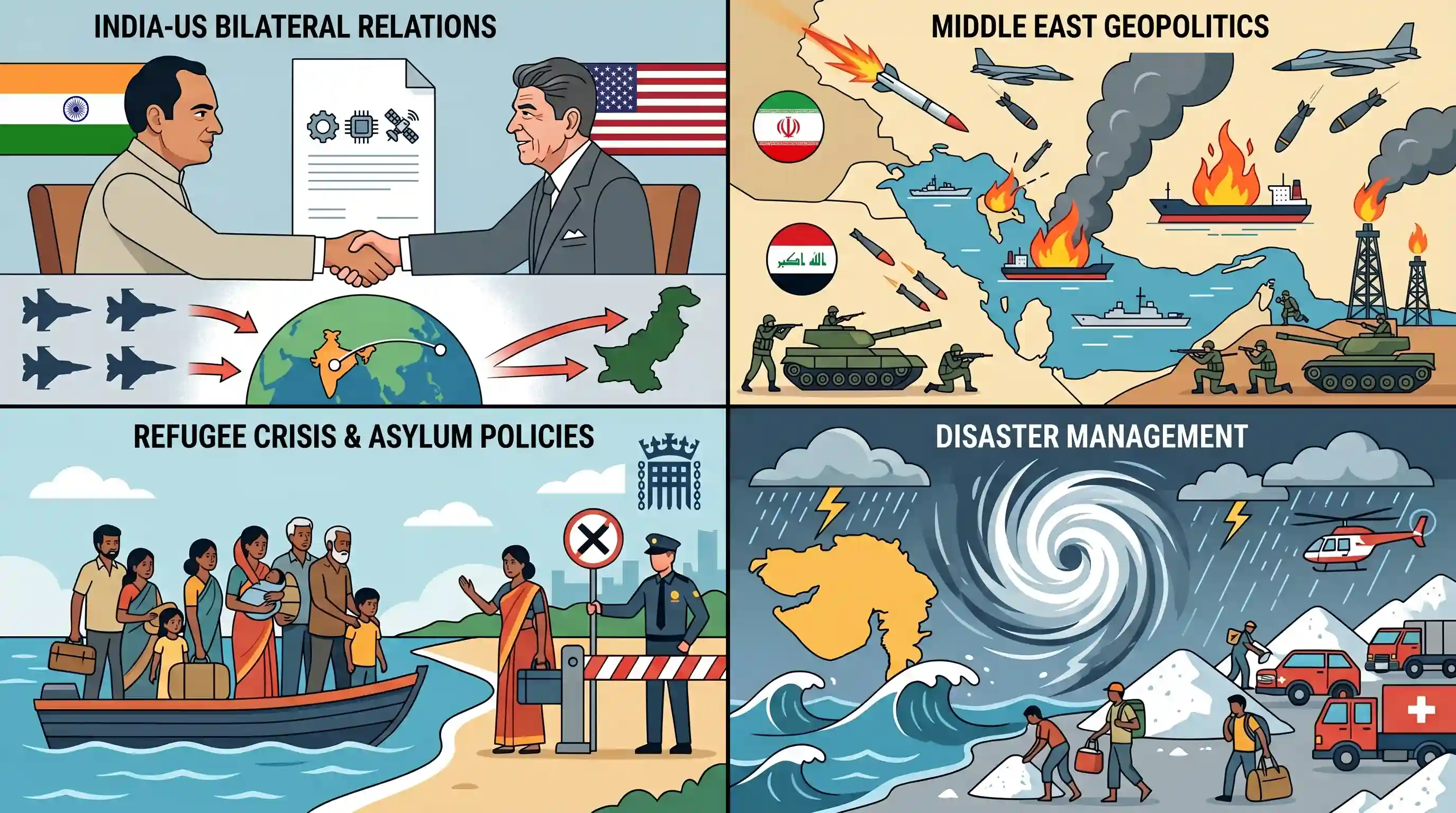
This historical overview from May 1985 captures significant diplomatic, geopolitical, and environmental events. Central to India's foreign policy was PM Rajiv Gandhi's visit to the US to address concerns over American arms supplies to Pakistan and to finalize a landmark India-US Memorandum of Understanding on technology transfer. Internationally, the Iran-Iraq War intensified with Iraqi strikes near Iran's Kharg Island, and the UK introduced restrictive measures for Sri Lankan Tamil asylum seekers. Domestically, early disaster management protocols were tested as a severe cyclonic storm neared the Gujarat coast, prompting the evacuation of saltpan workers.
Key Points
- PM Rajiv Gandhi's 1985 visit to the US focused on curbing US arms supplies to Pakistan and advancing bilateral economic ties via a technology transfer MoU.
- Escalating Middle East tensions during the Iran-Iraq War saw Iraqi airstrikes near Iran's Kharg Island, threatening regional stability and maritime oil routes.
- Sri Lankan Tamil refugees seeking asylum in Britain faced restrictive policies, with the UK limiting MPs to a 24-hour window for making representations on their behalf.
- Early disaster preparedness measures were activated in Gujarat as a severe cyclone approached, involving the evacuation of vulnerable saltpan workers in Kutch and Jamnagar.
Important Terms
US-India Memorandum of Understanding on Transfer of Technology (1984)

A landmark 1984-85 bilateral agreement facilitating the transfer of advanced dual-use and defense technologies from the U.S. to India, marking a historical pivot in Cold War-era relations.
UPSC context
GS Paper II (International Relations); tests understanding of the historical evolution of India-US strategic and technological partnerships.
Tanker War
A significant phase of the Iran-Iraq War (1984–1988) where both sides targeted merchant shipping and oil tankers in the Persian Gulf to cripple each other's economies.
UPSC context
GS Paper II (International Relations); relevant for Middle East geopolitics and its impact on global energy security.
Kharg Island
Iran's primary maritime oil export terminal in the Persian Gulf; a critical global energy chokepoint and frequent strategic target during regional military conflicts.
UPSC context
GS Paper II & III (Geopolitics/Energy Security); tests knowledge of strategic locations and vulnerabilities in global oil supply chains.
Agariyas
Traditional salt-pan workers in Gujarat (primarily the Little Rann of Kutch) who belong to vulnerable nomadic communities and face high displacement risks during cyclones.
UPSC context
GS Paper I (Social Issues) and Paper III (Disaster Management); highlights socio-economic vulnerabilities and livelihood-centric disaster risk reduction.
1985 UK Visa Requirement for Commonwealth Citizens
The 1985 policy shift where Britain imposed visa requirements on Sri Lankans—the first for a Commonwealth nation—to curb the influx of Tamil refugees during the civil war.
UPSC context
GS Paper II (International Relations/Diaspora); tests knowledge of Commonwealth history, refugee laws, and international humanitarian responses.
Prelims Trap
India-US high-technology cooperation and dual-use tech transfer began only after the 2005 Civil Nuclear Deal.
The foundation for dual-use technology transfer was actually laid during the Cold War era with the 1984/85 India-US MoU under PM Rajiv Gandhi.
Static Concepts Connected
What is India's legal framework for managing refugees?
- Foreigners Act 1946: India lacks a dedicated national refugee law, managing asylum seekers primarily under the Foreigners Act, 1946, and the Passport Act.
- Not a Signatory: India is not a party to the 1951 UN Refugee Convention or its 1967 Protocol, citing security and border porosity concerns.
- Non-refoulement principle: Despite non-signatory status, Indian courts often uphold the customary international law of non-refoulement under Article 21, preventing forced return to danger.
What is the geographic and economic significance of Kharg Island?
- Persian Gulf location: It is a continental island located off the coast of Iran in the Persian Gulf, north of the strategic Strait of Hormuz.
- Primary oil terminal: It serves as Iran's principal maritime oil export terminal, historically handling around 90% of the nation's crude oil exports.
- Geopolitical flashpoint: Due to its role in Iranian exports, it was a major target during the Iran-Iraq War ("Tanker War" phase) to cripple Iran's economy.
Cross-Topic Patterns
1985 MoU to modern iCET
Rajiv Gandhi's 1985 MoU on dual-use technology laid the geopolitical groundwork for modern defense tech agreements like iCET and INDUS-X, bypassing traditional Cold War alignments.
Saltpan workers & coastal hazards
Evacuating Gujarat's saltpan workers links cyclone disaster management directly with the livelihood vulnerability of the marginalized 'Agariya' community, combining GS-1 geography with GS-3 disaster management.

A chronological arrangement of India-US strategic partnerships (1985 MoU, NSSP 2004, LEMOA, iCET) is highly probable in 2026 Prelims.
Linked PYQs · 4
Linked PYQs · 4
- 2014MainsGS2
The aim of Information Technology Agreements (ITAs) is to lower all taxes and tariffs on information technology products by signatories to zero. What impact would such agreements have on India's interests?
- 2025MainsGS2
"Energy security constitutes the dominant kingpin of India's foreign policy, and is linked with India's overarching influence in Middle Eastern countries.” How would you integrate energy security with India's foreign policy trajectories in the coming years?
- 2022MainsGS2
India is an age-old friend of Sri Lanka.’ Discuss India's role in the recent crisis in Sri Lanka in the light of the preceding statement.
- 2019MainsGS3
Disaster preparedness is the first step in any disaster management process. Explain how hazard zonation mapping will help disaster mitigation in the case of landslides.
